

Here’s a question most people avoid: if your company laid you off tomorrow morning, how many months could you go before it became a can’t-make-rent problem?
I remember experiencing layoffs at my first job and seeing grown adults walk around miserable. I never wanted to be that vulnerable; the idea of a company having so much control over your wellbeing is insane!
From that day forward, I prioritized building a second income stream with dividends.
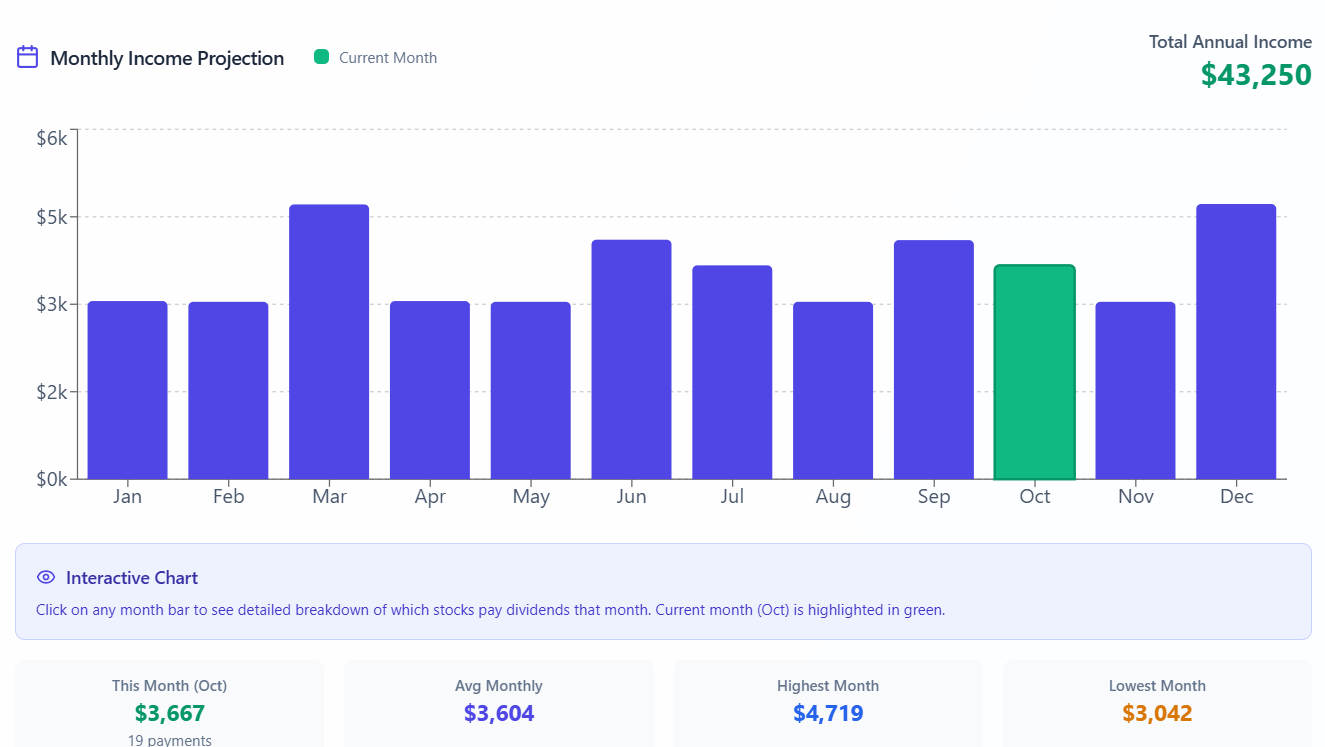
👉 Fast forward nearly a decade and I’ve been able to build that income stream up to $43,250 annually. I share a monthly dividend income report for subs.
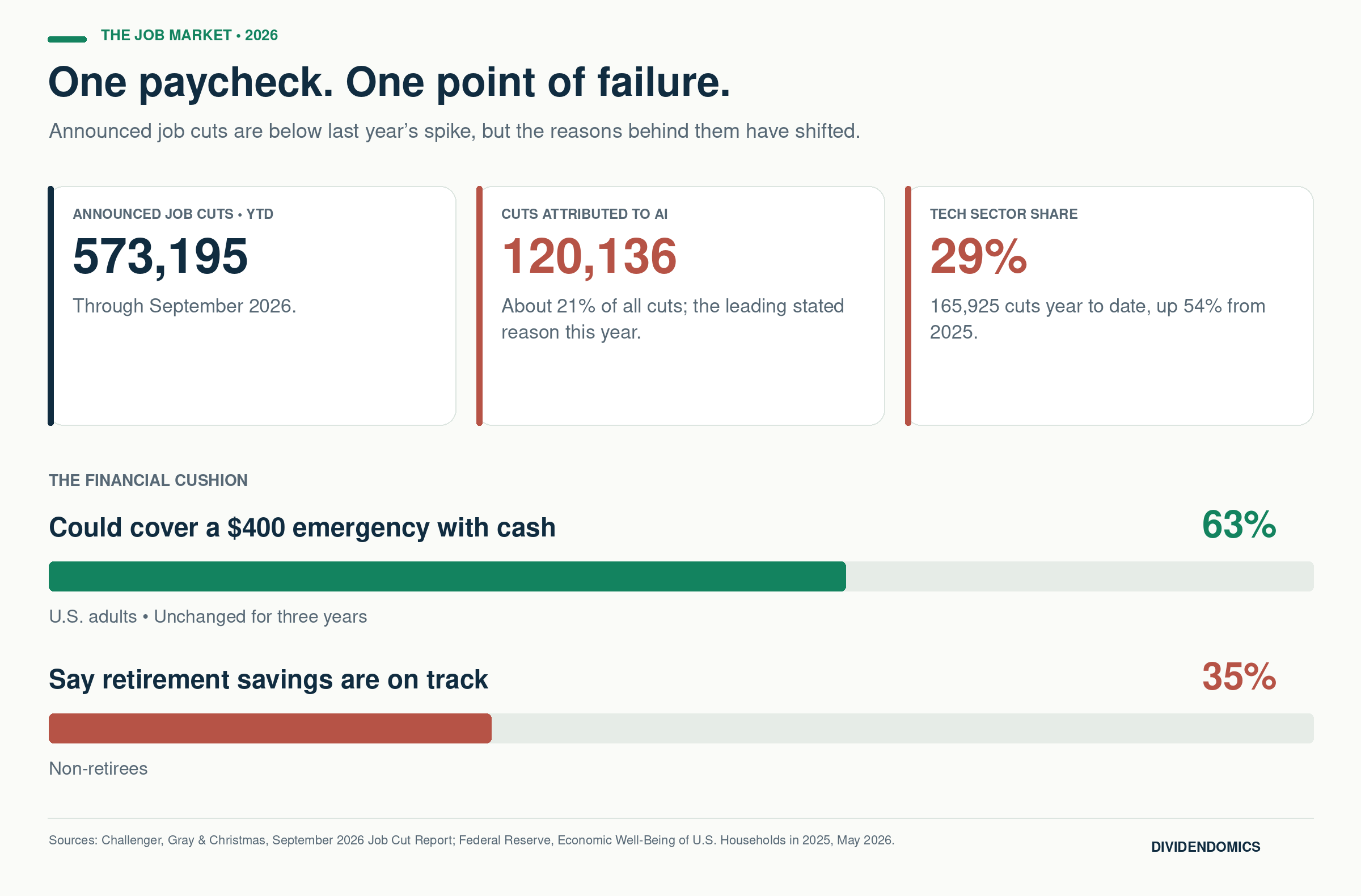
The Fed’s own survey says only 63% of adults could cover a $400 surprise with cash, and that number hasn’t moved in three years, per the 2025 well-being report. Meanwhile companies have announced 573,195 job cuts this year through September, and for the first time ever the number one reason given is AI, per Challenger, Gray & Christmas. Tech alone is 29% of those cuts.
If you work at a desk, that’s your industry.
I spent years as a senior analyst at large companies, and the thing nobody tells you about a good salary is that it’s ONE income source controlled by ONE person who isn’t you. You can be great at your job and still get an email on a Tuesday. The only thing that ever made me feel safe at work was a second income that showed up whether I was employed or not, and by the time my portfolio was covering the bills, I didn’t need the job anymore. Last month it paid me $3,220 and I didn’t sell a share to get it.
That’s what this article is about. Not getting rich, I covered that on Tuesday. This is about building a second income stream with two dividend ETFs, one that pays monthly and grows, and one that pays every single week, so the next layoff headline is something you read about instead of something that happens to you. Everything below is free. What they pay, how I’d pair them, what a month looks like, and the risks nobody puts in the fund’s marketing.
👉 Upgrade Your Subscription for $0.82 a day and get every buy alert first, plus the Yieldly Dashboard and the High Yield ETF Database on day one.
A Second Income Stream Changes How You Work
A second income doesn’t have to replace your salary to change your life. It has to be big enough that losing the salary is a setback instead of an emergency, and that threshold is lower than people think.
$500 a month covers a car payment and the phone bill.
$1,500 a month covers rent in a lot of the country.
Once a few bills are paid by something that isn’t your employer, you negotiate differently, you say no to things, and you stop reading every reorg announcement like it’s about you.
The way I build that income is in layers, which I laid out in The Dividend Stack Strategy. One layer is a check that grows every year, so the income keeps up with your bills. One layer is a bigger check that shows up constantly, so the account never goes quiet. The two funds below are one of each, and I picked them because they fail in different ways, which matters more than people think when the market has a week like last week.
DIVO: The Monthly Dividend ETF That Grows
I personally hold this fund and reinvest all dividends so that my income can snowball larger over time. In fact, I just added to DIVO and shared it in the subscriber chat. I try to stay consistent adding to existing positions each week.
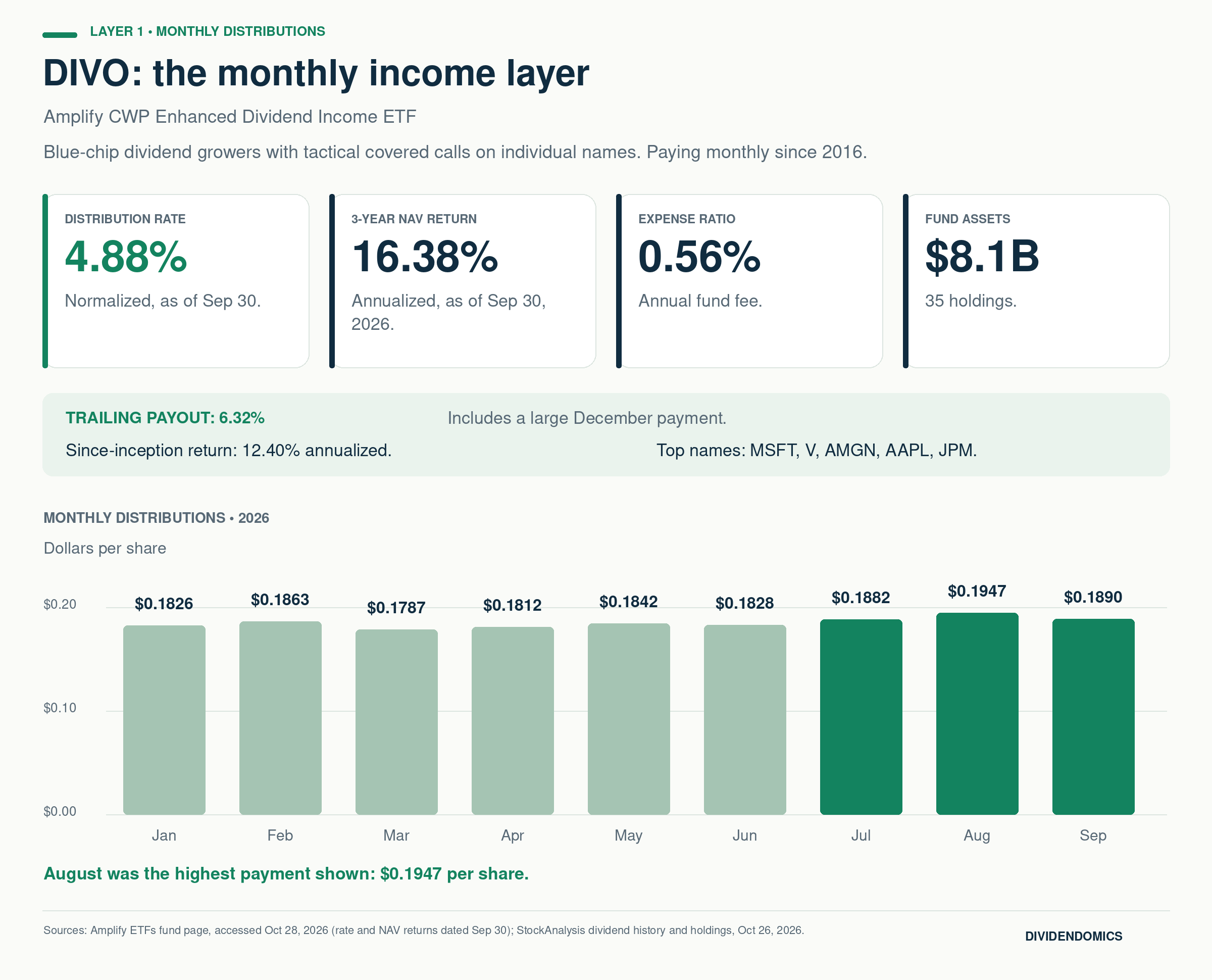
DIVO 0.00%↑ holds about 35 large U.S. companies with a record of growing their dividends and earnings, names like Microsoft, Visa, JPMorgan and Caterpillar, and then writes covered calls on individual stocks only when the manager thinks the premium is worth it, per Amplify. That “only when it’s worth it” part is the whole difference between this fund and most covered call ETFs. It isn’t selling away all its upside every month to hit a yield target, which is why it has returned 16.38% a year over the past three years at NAV and 12.40% a year since 2016.
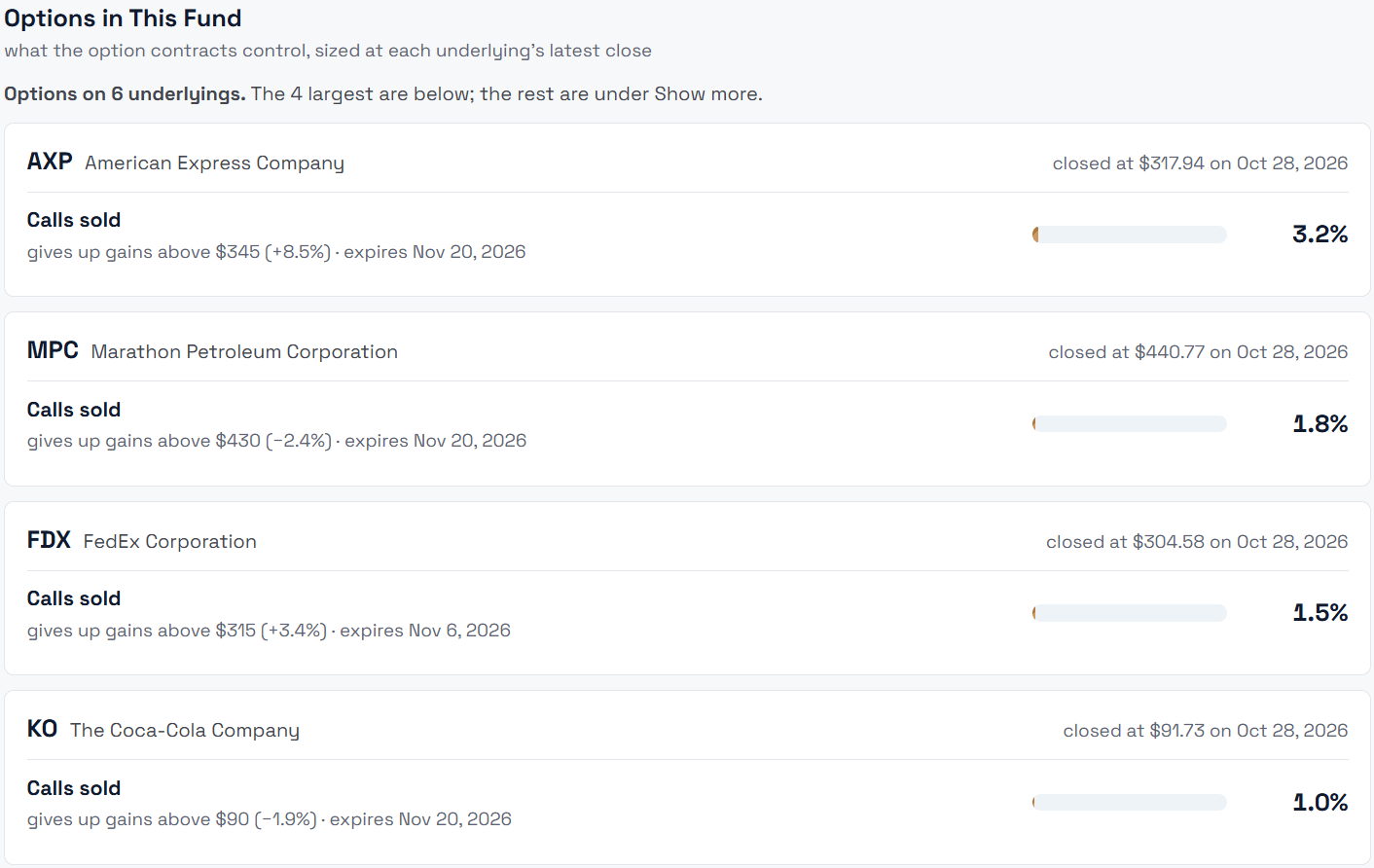
Jack Bowman and I built a tool within the ETF Portfolio Mechanics toolkit that allows us to actually see what options are being written within an ETF. I will release more updates here next week. For now, you can sign up for access here. I will be giving access to some Founding Members.
The payout is the boring part, and boring is the point. Nine monthly distributions so far in 2026, every one of them within two cents of each other, and the trend inside that range is up, per StockAnalysis.
The normalized distribution rate is 4.88%, which won’t impress anyone scanning a yield screen, and that’s exactly why it works as the growth layer: it pays you from dividends that companies raise every year and from premium on top, without eating the share price to do it. With $8 billion in assets and a 0.56% fee, it’s the cheapest and most established fund in this article by a mile.