

The ultimate goal of investing is often described as capital appreciation, but the reality for many is that cash flow is what actually builds freedom. In a market where stock prices can swing 20% on a single earnings headline, passive income acts as a stabilizer. It is the only part of your return that you can actually take to the bank while you wait for the market to recognize a company’s true value.
Investors should care about income right now because we are entering a transition period. The rapid, AI driven gains of the last two years are settling into a more volatile and less predictable phase. If you can generate a 10% or 12% yield while the broader S&P 500 stays flat, you are winning.
In my last portfolio update, I highlighted the structure I use to generate more than $41,000 a year in dividend income. This income is my safety buffer. If I ever fall on hard times and need money, the cash flow protects. When I don’t need this money, it gets reinvested into my highest conviction growth stocks.
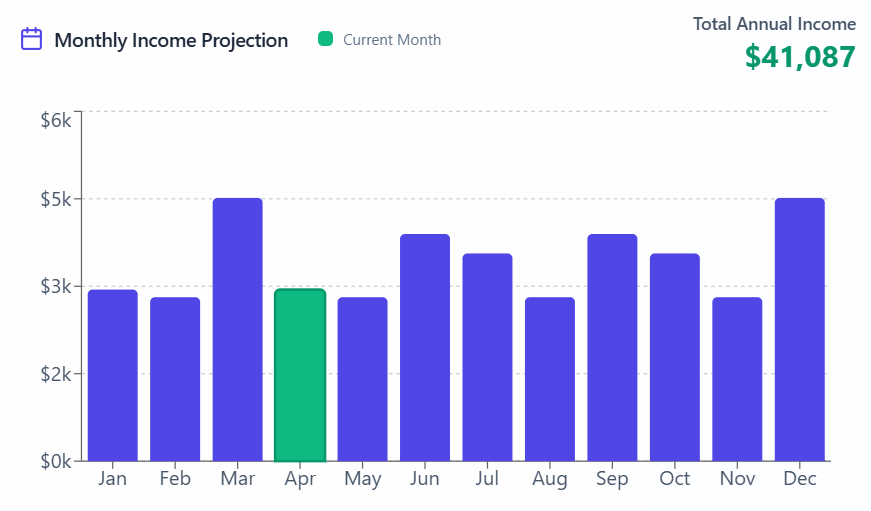
However, the trap many investors fall into is chasing the highest yield without looking at the risk. A 20% yield is useless if the underlying share price drops 30% in the same year. That is why I focus on risk adjusted income. I want ETFs that use sophisticated strategies like covered calls or dividend multipliers to generate high payouts without the “principal decay” found in lower quality yield traps.
Today, I am highlighting four specific ETFs that I believe provide the best balance of safety and high yield for the remainder of 2026.
1) iShares U.S. Large Cap Premium Income Active ETF
BALI 0.00%↑ is an active fund designed for investors who want broad large cap exposure but with significantly higher monthly cash flow. It combines a systematic stock selection process with an options overlay to generate income while aiming for lower volatility than the broader market.
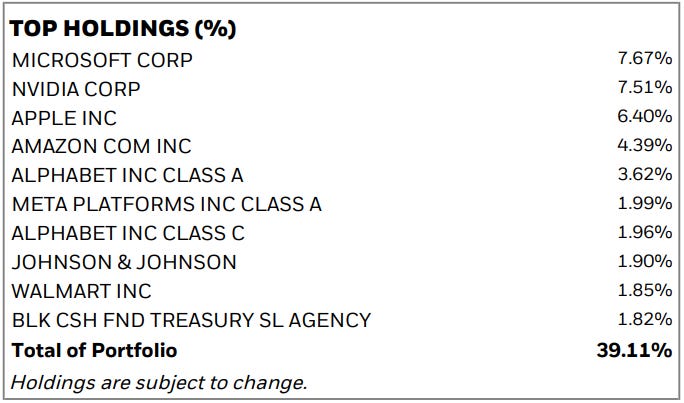
The strategy for 2026 continues to leverage BlackRock’s Advantage model. This systematic approach uses data to identify large cap stocks with strong momentum and quality characteristics. Current top holdings include technology leaders like Nvidia, Apple, and Microsoft. By holding these high growth names and selling call options against them, BALI captures both the structural growth of the tech sector and the elevated premiums currently available in the options market.
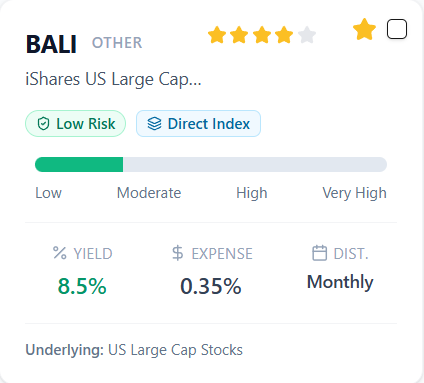
According to the High Yield Database, BALI offers a 8.5% dividend yield and pays out a dividend every month. It is also a low cost fund with an expense ratio of 0.35%.
The fund offers direct exposure to the strongest companies in the world.
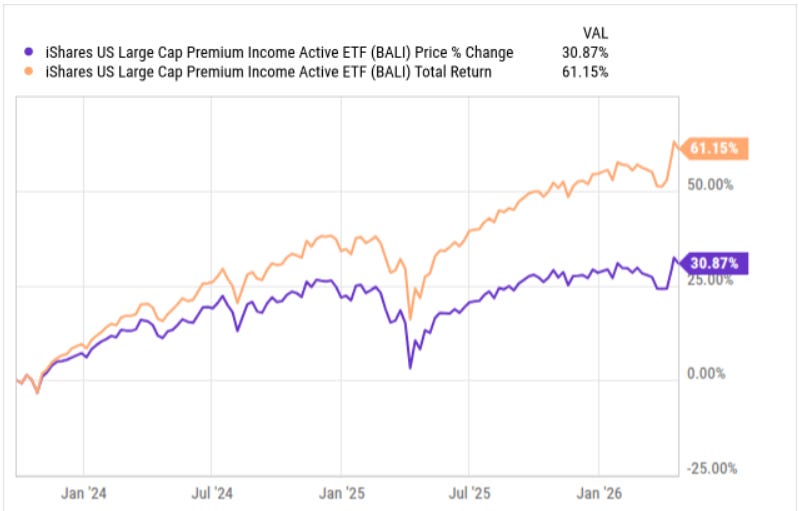
Even better, the fund has demonstrated that it can grow its NAV (price appreciation), while also providing large total returns because of the dividends being paid. Since inception, BALI has returned more than 61% since 2023. This averages out to 20% annually through 2026.
2) Pacer Metaurus US Large Cap Dividend Multiplier 400 ETF
QDPL 0.00%↑ is one of the more innovative funds for investors who want to stay invested in the S&P 500 but need a significantly higher yield than the index currently offers. Unlike covered call funds that can cap your upside potential, QDPL uses a futures-based strategy to separate price performance from dividend income.
The fund’s primary goal is to provide a cash distribution equal to 400% of the S&P 500 ordinary yield. It achieves this by holding a mix of S&P 500 stocks and long positions in annual dividend futures contracts. As of April 2026, QDPL is delivering a forward dividend yield of 5%.
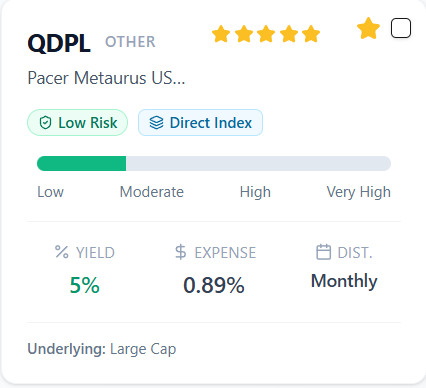
This is particularly impressive when you consider that the S&P 500 yield is currently hovering around 1.1%. By using QDPL, you are essentially quadrupling your organic dividend income without having to resort to selling shares or relying on high-risk options strategies. Management achieves this 4x multiplier with no leverage, which is a key component for those focusing on long term risk adjusted returns.
In exchange for this enhanced yield, you do take a modest reduction in market exposure. QDPL typically maintains about 90% exposure to the S&P 500 price performance. This means that in a massive bull market, you might slightly trail the broader index, but you are compensated with a much higher quarterly paycheck.
So far in 2026, the fund has shown strong resilience. It recently traded around $43.60, which is near its 52-week high of $43.72. For an investor who wants to keep their portfolio simple and stay within the safety of large cap U.S. equities, QDPL acts as a powerful yield booster that doesn’t force you to compromise your exposure to the best companies in the world.
👉 The High Yield Database Offers investors an easy way to filter through the uncertainty of high yield funds. Paid subscribers get immediate access. I’ve included a coupon code for readers that made it to the half way point of this article.
Founding Members get access to CainAI, the all-in-one AI chatbox that can review your portfolio.
3) NEOS S&P 500 High Income ETF
SPYI 0.00%↑ has quickly become a cornerstone for income focused portfolios because it solves the two biggest problems with high yield ETFs: tax drag and capped upside. While many covered call funds force you to choose between yield and capital appreciation, SPYI uses a sophisticated call spread strategy that allows for a much more balanced risk adjusted return.
The fund seeks to generate monthly income by investing in the stocks within the S&P 500 and overlaying that with an options strategy. Specifically, SPYI writes out of the money call options on the SPX Index. This is a critical distinction because index options fall under Section 1256 of the tax code. This means that 60% of the gains are taxed at the lower long term capital gains rate and 40% are taxed at the short term rate, regardless of how long you hold the fund.
Furthermore, a significant portion of SPYI’s distributions are often classified as Return of Capital. This can be a massive advantage in a taxable account, as it allows you to defer taxes until you sell your position. As of late April 2026, SPYI is delivering a distribution yield of approximately 12.1%. It has successfully maintained this double digit payout while still participating in market upside, with a total return of over 64.8%.
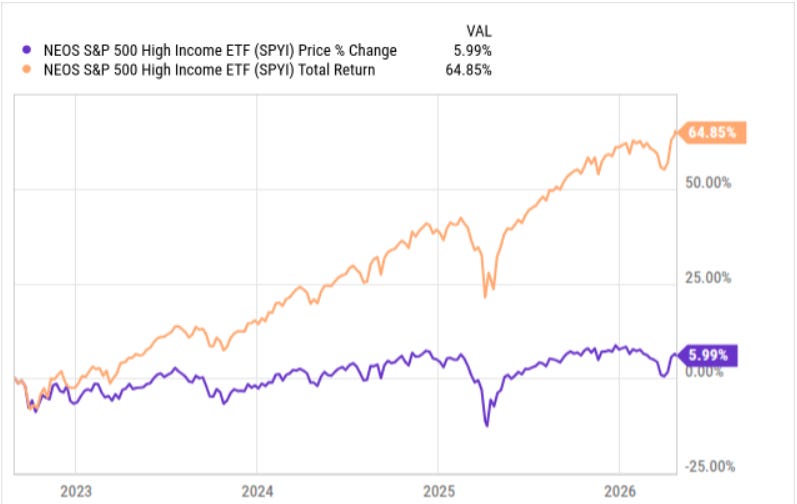
SPYI is built to thrive in choppy or sideways markets. By writing call spreads rather than single at the money calls, the fund can capture more of the market’s gains during sharp rallies. Over the past six months, SPYI actually outperformed the standard SPY ETF by 90 basis points during a period of high volatility.
With an expense ratio of 0.68%, SPYI is priced competitively for an actively managed derivative income fund. It offers a way to generate massive monthly cash flow without the traditional “yield trap” risk of losing your principal. For an investor looking to build a passive income machine, SPYI provides the rare combination of a 12% yield and the tax efficiency of a much more conservative instrument.
4) NEOS MLP & Energy Infrastructure High Income ETF
For investors looking to diversify their income streams outside of traditional technology or broad market equities, MLPI 0.00%↑ offers a powerful entry into the energy infrastructure sector. This fund targets Master Limited Partnerships and energy companies that act as the vital pipelines and storage hubs for the North American energy market.
I previously issued a buy alert on MLPI. Since then, MLPI has provided a total return of nearly 15% and outpaced the S&P 500.
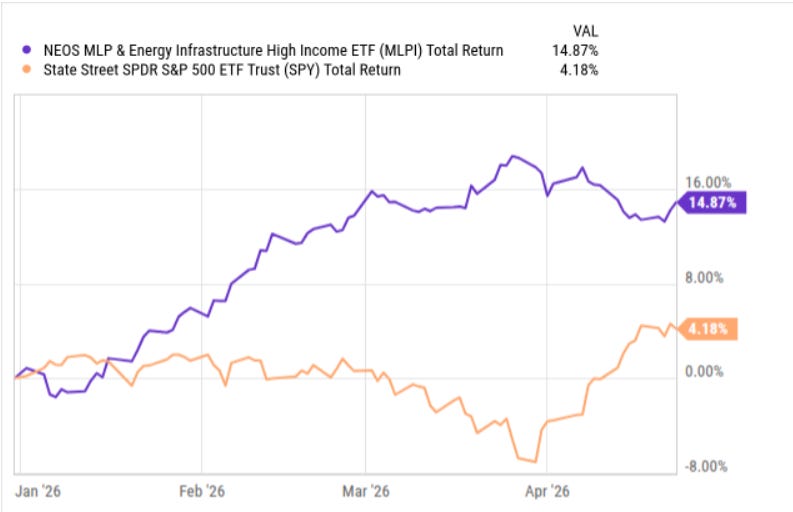
As of late April 2026, MLPI is delivering an impressive annualized distribution rate of 14.8%. The fund recently declared its April distribution of $0.6667 per share, demonstrating the consistent monthly cash flow that energy infrastructure can provide. Since its inception in late 2025, MLPI has focused on “toll booth” style businesses like Enterprise Products Partners and Enbridge, which generate reliable revenue regardless of the actual price of oil or natural gas.
Here are the fund’s top holdings.
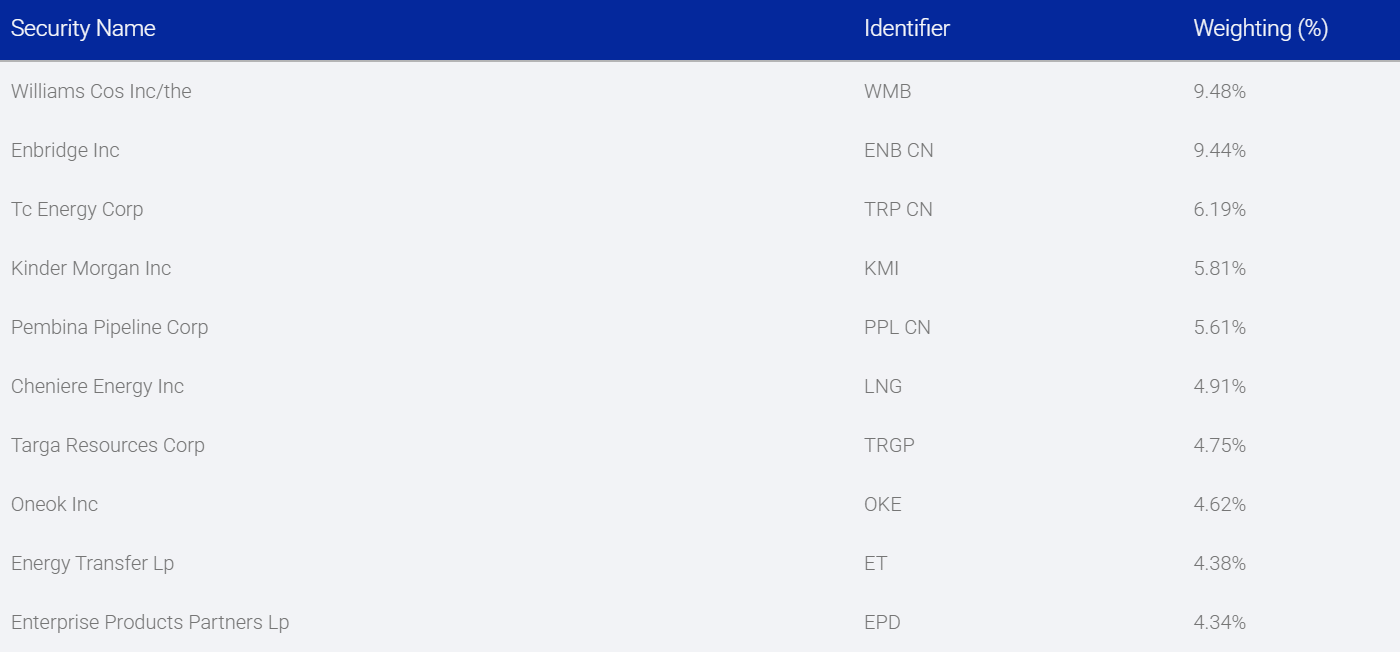
The strategy combines direct ownership of these high yielding energy assets with a data driven call writing overlay. This combination is designed to boost the organic yield of the MLPs while providing a layer of tax efficiency. One of the most significant benefits for individual investors is that MLPI issues a standard 1099 form rather than the complex K-1 tax forms usually associated with direct MLP investments. This makes it a much simpler addition to a retirement or taxable account.
With an expense ratio of 0.68%, MLPI is priced competitively within its category. When you consider that approximately 91% of its recent distributions have been classified as return of capital, the tax adjusted yield is even more compelling for those in higher tax brackets. For a risk adjusted income portfolio, MLPI serves as a strong diversifier that offers low correlation to the tech heavy S&P 500 while delivering one of the highest yields in the ETF space.
Final Thoughts on Building Sustainable Passive Income
Passive income is not just about finding the highest number on a screening tool. It is about building a cash flow machine that can withstand different market cycles without eroding your initial investment. The four ETFs we have discussed today—BALI, QDPL, SPYI, and MLPI—each offer a unique way to outpace the S&P 500 yield while maintaining a disciplined risk profile.
By diversifying across these strategies, you are not relying on a single market outcome. You are blending the active stock selection of BALI, the pure dividend multiplication of QDPL, the tax efficient index options of SPYI, and the infrastructure stability of MLPI. This multi-layered approach is the key to achieving high yields while keeping your principal as protected as possible.
The market in 2026 continues to reward investors who prioritize quality and cash flow over speculative growth. Whether you are looking for monthly distributions to cover your living expenses or simply want to reinvest and compound your wealth, these funds provide a professional framework for achieving those goals.
I want to hear from you. Are you already holding any of these income producers, or is there another high-yield ETF that has caught your eye recently? Let me know in the comments below.
really liking the NEOs funds. Currently have SPYI & QQQI as my core! Looking into adding MLPI
Thanks for the insightful article !
Was also eyeing on the NEOS S&P 500 High Income ETF.
I have shortlisted JPMorgan ETFs (Ireland) ICAV - Nasdaq Equity Premium Income Active UCITS ETF, it has a decent dividend yield with NAV preservation and tax optimization as it is domiciled in Ireland.