

Here’s what the market has been doing for a month: adding up what AI costs. Capex, data centers, power, chips, debt. Every earnings call got graded on the bill, and three of the four biggest spenders got sold for it. I covered that in Why Big Tech Is Selling Off and I said the market was being dramatic. I still think so, but this time I’m not going to argue about the bill.
Instead I went back through the earnings calls and pulled a different number: how much AI people are actually USING, as opposed to how much the companies are spending to build it, and that number is growing faster than the spending is. Amazon’s AI platform is doing 17 times the work it did a year ago. Google’s models are processing four times the tokens. Meta’s shopping agent has ten million accounts. That’s demand, and demand is what turns the capex bill into earnings.
Then there’s the part that matters for you specifically. All that AI usage is showing up in the economy as productivity, and productivity gains don’t get split evenly. The slice of business output going to workers just hit its lowest point since the BLS began keeping the series in 1947. The rest is going to the people who own the companies. So the AI payoff is real, it’s going to owners, and there’s a way to collect your share of it every quarter while the market keeps panicking about the cost.
Free readers get the usage data, where it’s showing up in the economy, and who’s collecting the gain. Paid subscribers get the three layers I use to get paid from AI usage, the four risks that could break it, and what I’m watching before Nvidia reports on November 17.
👉 Upgrade Your Subscription for $0.82 a day and get every buy alert first, plus the Yieldly Dashboard and the High Yield ETF Database on day one.
01. Nobody Is Measuring The Usage
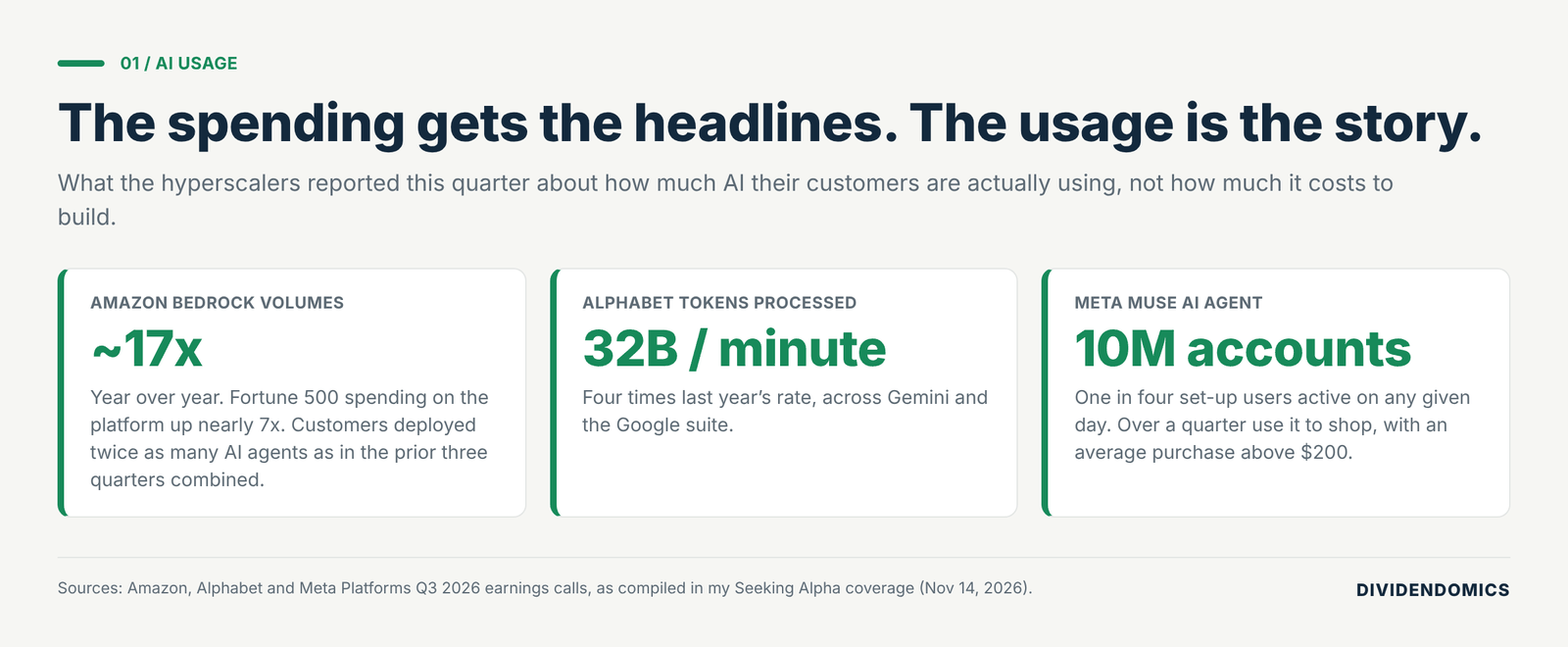
Amazon, Alphabet and Meta Q3 2026 earnings calls.
I was curious what consumers and businesses are actually doing with this stuff, so I went back through the latest earnings season looking for usage numbers instead of spending numbers. Amazon gave the clearest one. Bedrock is the platform companies use to build their own AI tools, and total volumes running through it were up almost 17x from a year ago. Fortune 500 companies increased their spending on it nearly 7x, and customers deployed twice as many AI agents in the quarter as they did in the prior three quarters combined.
Alphabet’s models are chewing through close to 32 billion tokens a minute, four times last year’s pace, and that’s with Gemini baked into Search, Gmail and the rest of the Google suite, and that usage compounds as more products get it. Meta’s number is the consumer one: its Muse agent passed ten million accounts, one in four of those accounts is active on a typical day, and more than a quarter of those active users are shopping with it at an average purchase above $200. People aren’t just trying AI anymore. They’re paying for things through it.
You can’t run 17x the workloads on last year’s data centers. The spending everyone is scared of is being built to serve usage that already exists, and I covered the contracted version of that, the $1.8 trillion of cloud backlog, in the hyperscaler piece. This is the uncontracted version, and it’s growing faster.
02. It’s Showing Up In The Economy
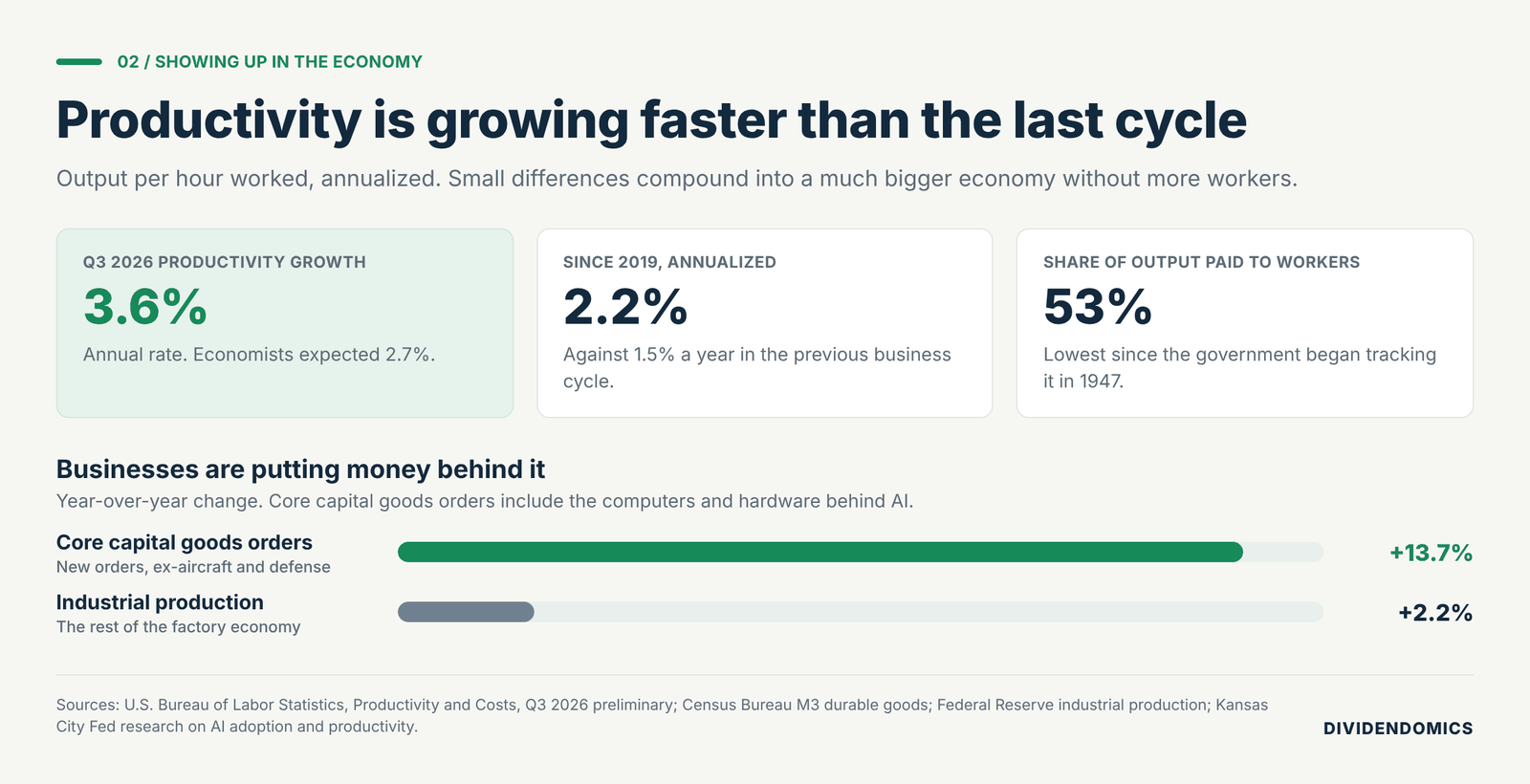
Bureau of Labor Statistics, Productivity and Costs, Q3 2026; Census Bureau; Federal Reserve; Kansas City Fed.
Productivity is how much the economy produces for every hour somebody works, and it’s the number that decides whether living standards and profits go up over time. In the third quarter it grew at a 3.6% annual rate against the 2.7% economists expected. Since 2019 it has grown 2.2% a year, against 1.5% a year in the previous cycle. Those look like small gaps. Compounded over a decade they’re the difference between an economy that needs more workers and one that doesn’t.
The Kansas City Fed looked at which industries are adopting AI, and the adopters are the industries where productivity is picking up fastest, which is the link I wanted to see. And businesses are putting real money behind it: core capital goods orders, meaning the machines and computers businesses buy to produce things, AI hardware included, are up 13.7% from a year ago while industrial production is up only 2.2%. Companies are spending on new equipment far faster than the rest of the factory economy is growing. That’s not what a bust looks like.
03. Who Collects The Gain
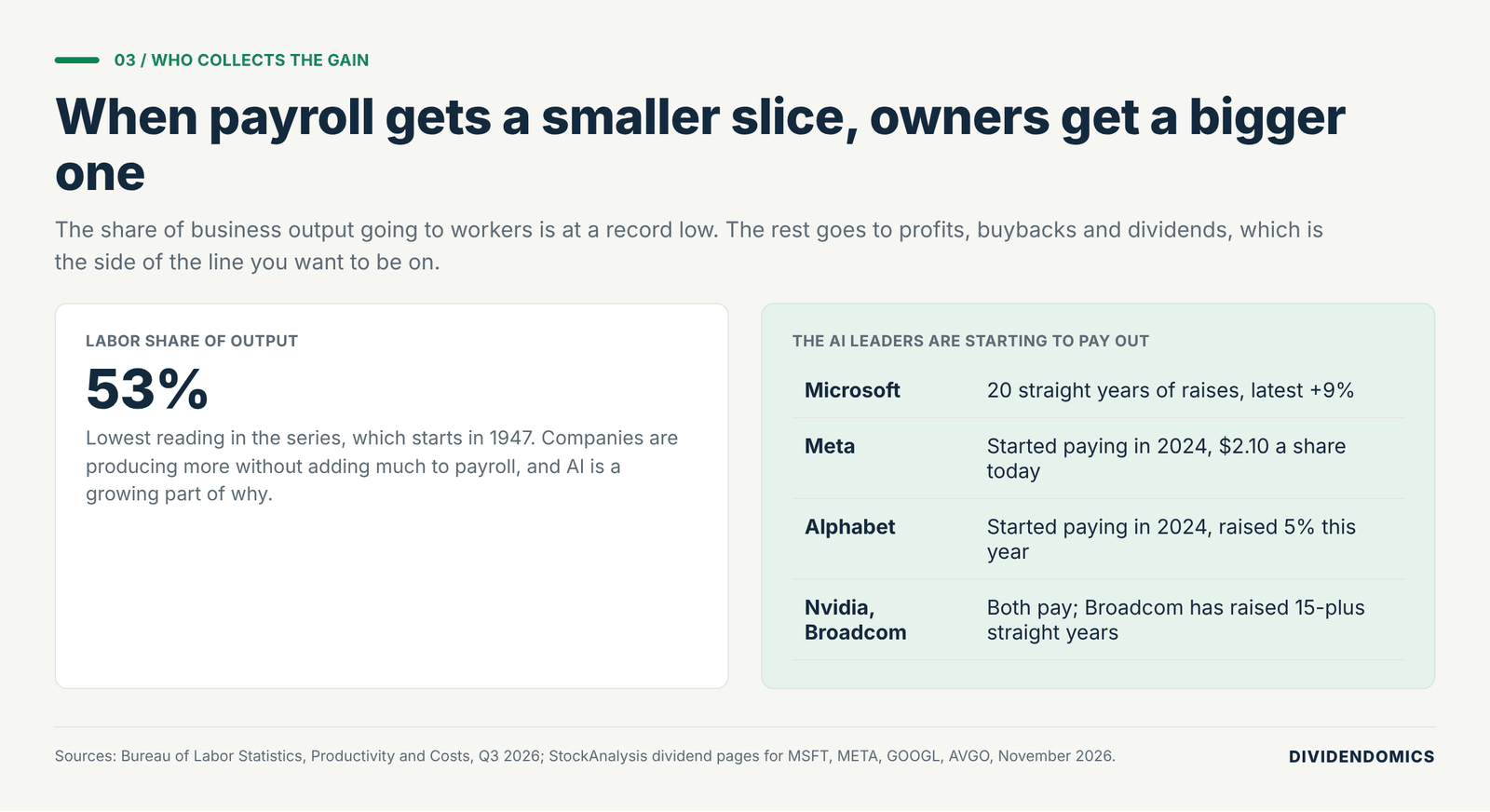
Bureau of Labor Statistics; StockAnalysis dividend pages, November 2026.
Now the part most AI articles skip. If companies are producing more per hour and not adding much to payroll, the extra output has to go somewhere, and the BLS just told you where: workers’ slice of what businesses produce dropped to 53%, a record low for a series that goes back to 1947. The other 47% is profit, and profit gets paid out as buybacks and dividends to the people who own the companies. Every productivity point AI adds that doesn’t go to a paycheck goes to a shareholder.
You can already see the AI leaders starting to act like it. Microsoft has raised its dividend 20 straight years and the latest raise was 9%. Meta and Alphabet both started paying dividends in 2024 for the first time in their lives, and Alphabet already raised its once. The yields are tiny today, under 1%, because the companies are still pouring cash into the buildout. But a company doesn’t start a dividend it plans to cut, and the direction is set. I wrote about which side of this line to be on last month, and AI is widening the gap.
04. What The Pullback Did To Valuations
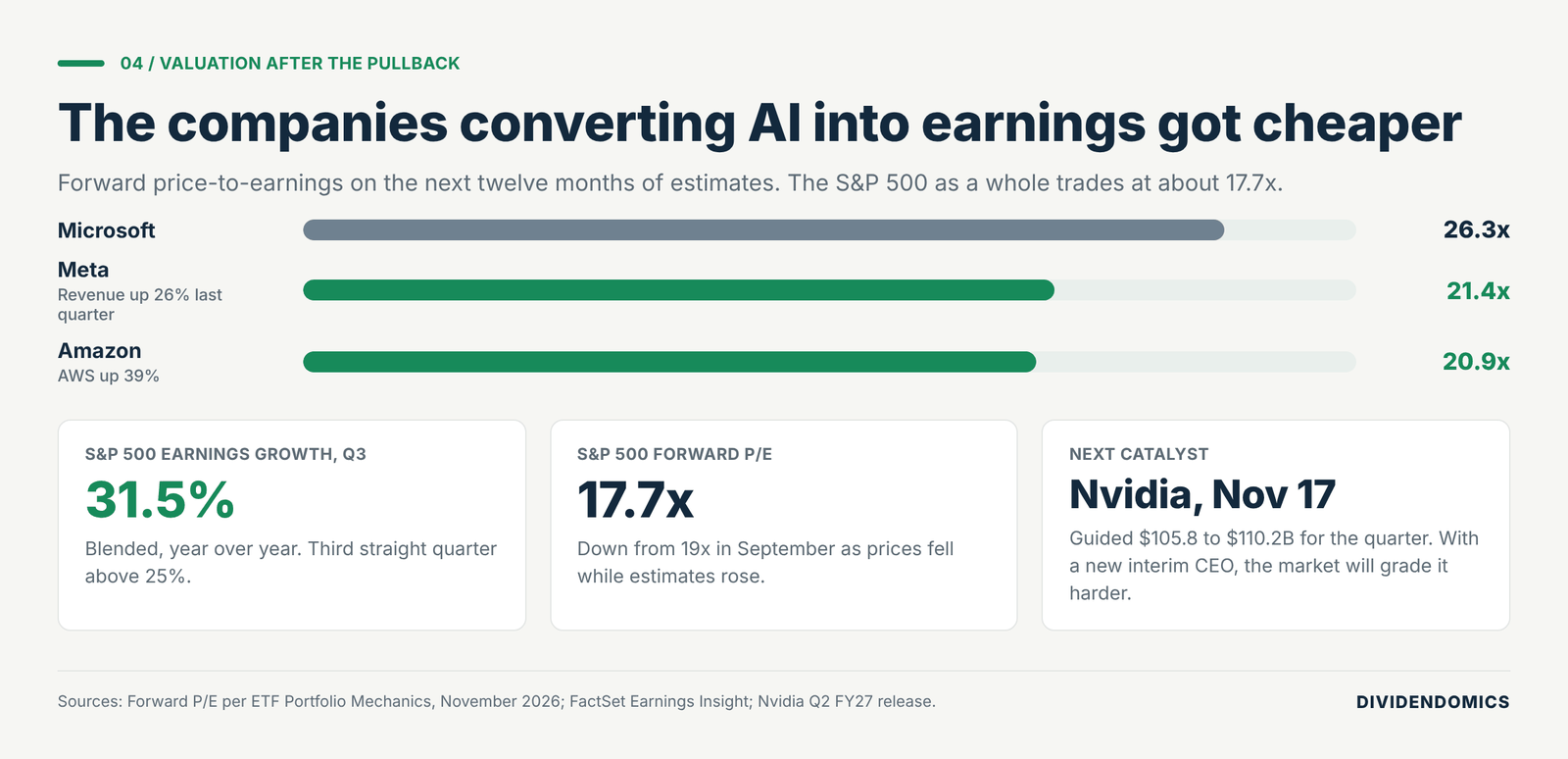
ETF Portfolio Mechanics; FactSet Earnings Insight; Nvidia Q2 FY27 release.
While the market obsesses over free cash flow, the companies converting all that usage into earnings got cheaper. Meta trades at 21.4 times next year’s earnings, Amazon at 20.9 times, Microsoft at 26.3 times. For the index as a whole, blended earnings growth for the quarter is 31.5%, the third straight quarter above 25%, and the forward multiple fell from 19x to 17.7x because prices dropped while estimates rose. You’re paying less for faster growth than you were in September.
I know the market can stay dramatic for a while. Nvidia has an interim CEO, a Democratic Congress is making people nervous about data center permits, and the Fed looks set to hike in December. All of that is real and none of it changes the usage numbers in section 01. So I’m treating this the same way I treated October: accumulate the companies collecting the gain, and get paid while I wait. How I do that is the paid half.
The two-number test, done for you on 118 funds
Every fund in my coverage goes through the screen I run in the High Yield ETF Database: payout against total return, a four-tier risk rating, and a flag for synthetic funds that hold options instead of stock. Updated weekly, included for every paid subscriber.
How to get paid for the AI payoff
Below the line for paid subscribers:
The three layers I use to turn AI usage into quarterly cash, and the fund with five AI leaders in its top six
The four risks that could break the thesis, and which stocks each one hits first
What I’m watching before Nvidia reports on November 17
