

Anthropic priced the biggest IPO in history last night at $83 a share, above the $70 to $78 range, raised $81.3 billion, and opened this morning at $111.50. At the first trade the company was worth about $2 trillion. Then it gave back a chunk of that pop within the hour, which is what happens when half the people watching are reading the headline “Anthropic lost $104 billion” and the other half are reading “Anthropic grew revenue 13x.”
So here’s the deal, I reviewed Anthropic’s filing and I will do my best to make the numbers easy to understand.
Both headlines are true, and that’s the problem if you’re trying to decide what to do with this stock. I read the filing so you don’t have to, and I’m going to show you four numbers that explain the loss in plain English, then one number the filing contains that is actually worth worrying about. I wrote about AI usage finally showing up in the economy last week. Anthropic’s prospectus is that article with an audit stamp on it.
Paid subscribers get the part I care about more than the stock itself: Anthropic has signed $901 billion of chip and data center contracts, every dollar of which lands on a company you can already own, and I’ll show you the fund that holds exactly those suppliers, what it trades at, and the weekly payer that turns the chip trade’s swings into checks.
👉 Upgrade Your Subscription for $0.82 a day and get every buy alert first, plus the Yieldly Dashboard and the High Yield ETF Database on day one.
Where The $104 Billion Went
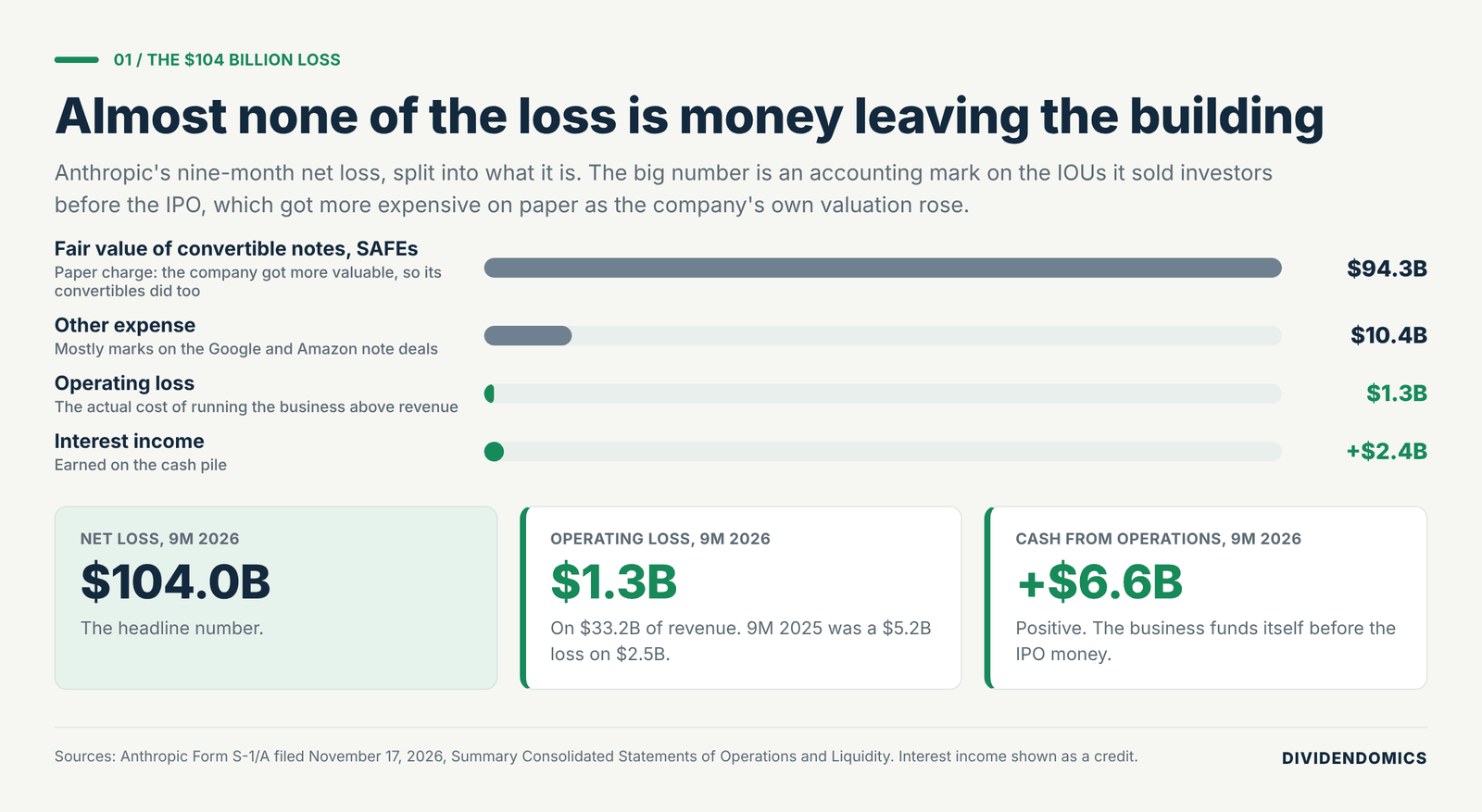
Here’s the whole trick.
Before the IPO, Anthropic raised money by selling convertible notes and SAFEs, which are IOUs that turn into shares later. Accounting rules say the company has to re-price those IOUs every quarter at whatever its shares are worth. Anthropic’s valuation went from the hundreds of billions to a trillion-plus over the year, so the IOUs got more expensive, and the rulebook records that increase as a loss. That one line was $94.3 billion of the $104 billion. No cash moved. The company got MORE valuable and booked a loss for it.
Strip that out and the business itself lost $1.3 billion on $33.2 billion of revenue in nine months, against a $5.2 billion loss on $2.5 billion of revenue a year earlier. And the cash statement says it’s already self-funding: operating cash flow was positive $6.6 billion for the nine months. A company burning money doesn’t produce $6.6 billion of operating cash. A company that just booked a $104 billion loss and didn’t need the IPO money to pay its bills is a company the headline is lying about.
The Growth Is Real And It’s Business Customers
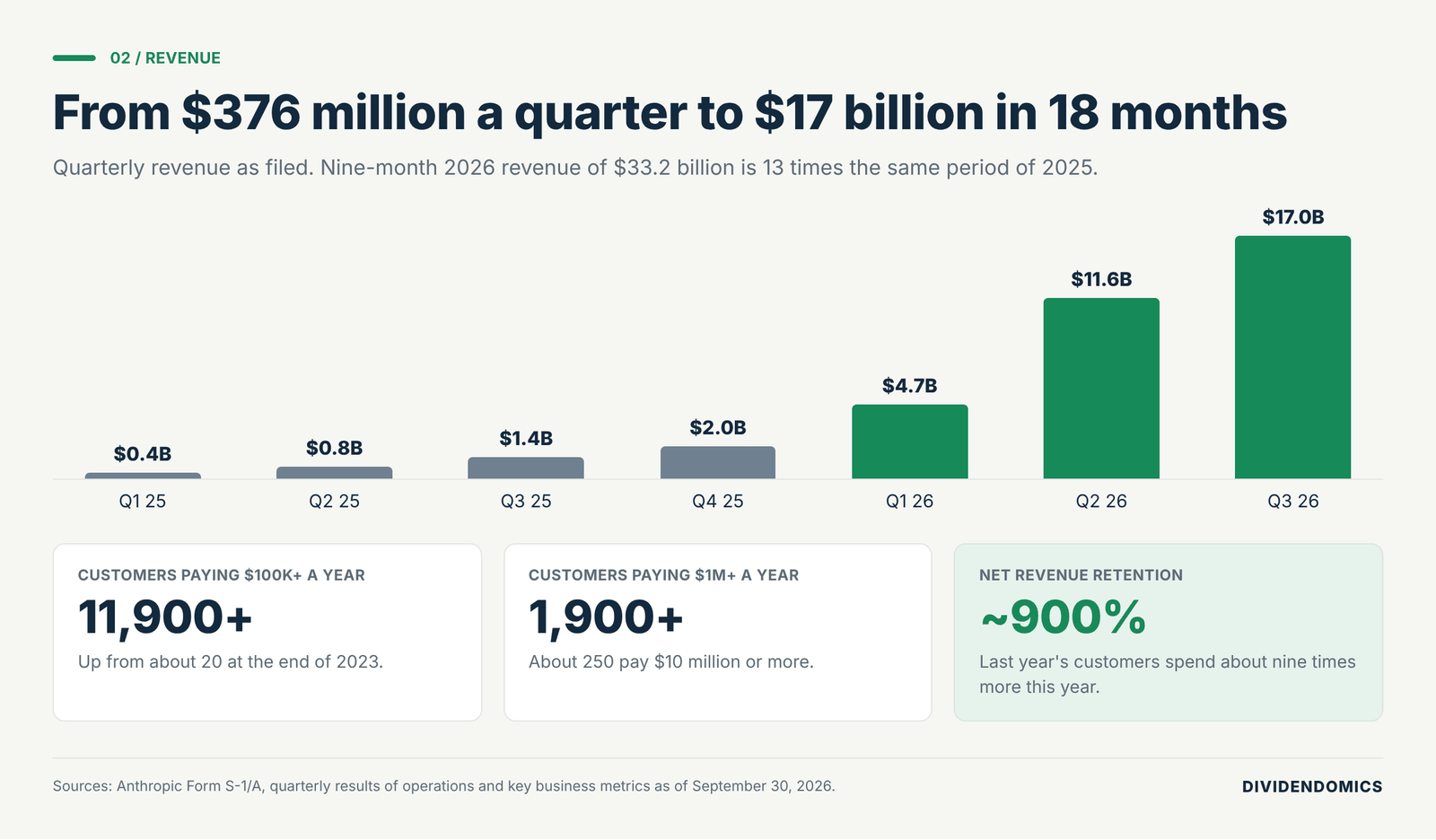
Quarterly revenue went from $376 million in the first quarter of 2025 to $17.0 billion in the third quarter of 2026. I’ve covered a lot of growth companies and I have never typed a sentence like that. The part that matters for durability is who’s paying: more than 11,900 customers spend $100,000 or more a year, 1,900 spend over $1 million, and about 250 spend over $10 million. At the end of 2023 the $100,000 club had about 20 members.
Net revenue retention is roughly 900%, which means the customers Anthropic had a year ago are spending about nine times as much today. Most software companies brag about 120%. This is the usage number I wrote about last week showing up in a company’s own audited filing: businesses aren’t testing AI anymore, they’re running on it and the bill grows every quarter.
The Chips Are Paying For Themselves
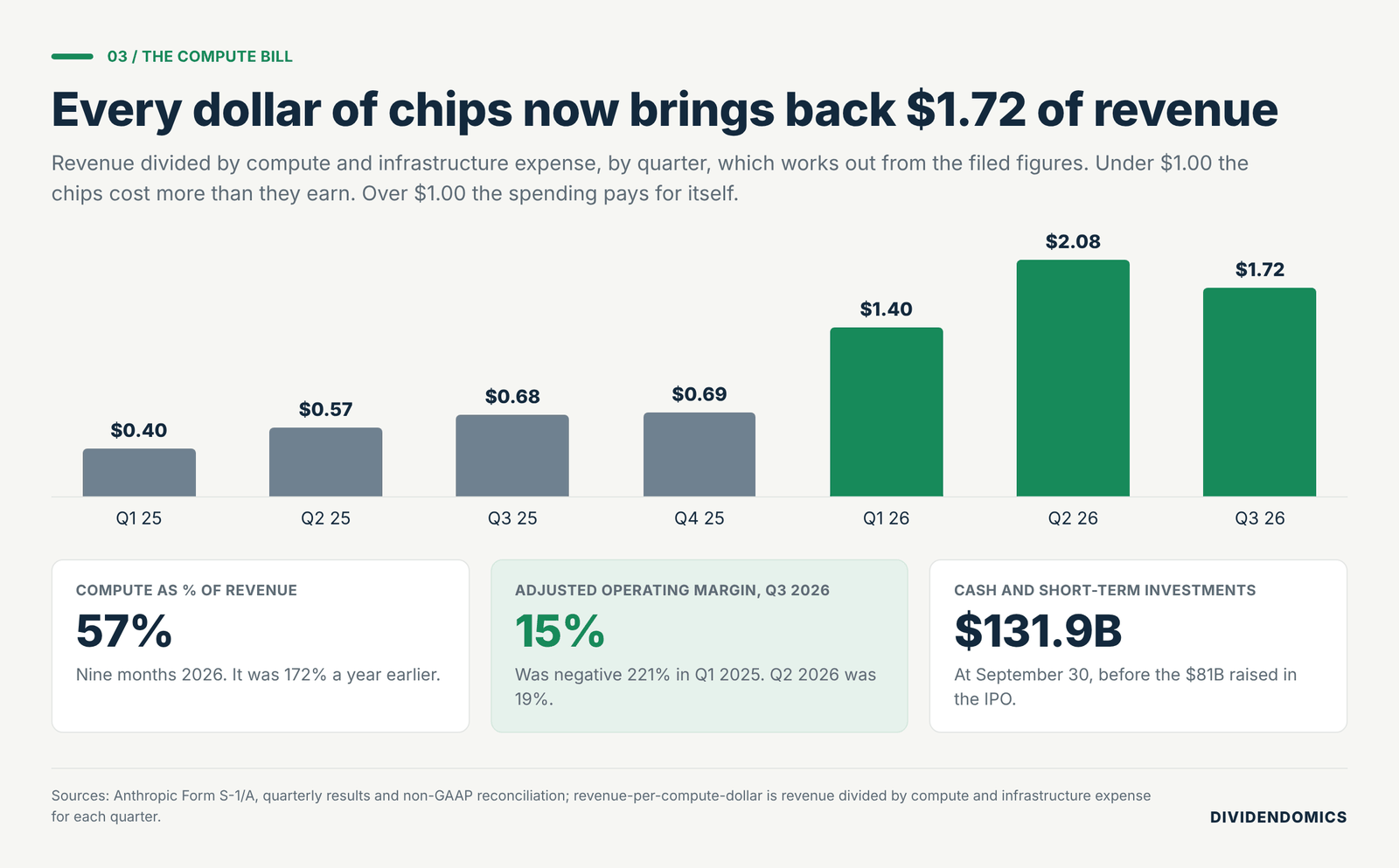
The bear case on every AI company is that the chips cost more than the product earns. For Anthropic that was true in early 2025, when every dollar of compute brought back $0.40 of revenue. By the third quarter of 2026 the same dollar brought back $1.72, which works out from the filed revenue and compute lines, and the quarter before that it was $2.08. Compute ate 172% of revenue in the first nine months of 2025 and 57% in the same stretch of 2026.
The margin tells the same story: adjusted operating margin went from negative 221% in the first quarter of 2025 to positive 15% in the latest quarter, and the June quarter posted the first GAAP operating profit in the company’s history, $974 million. Add $131.9 billion of cash and short-term investments before the IPO money arrived and you have a company that doesn’t need to raise again for a very long time. Which brings me to the number that should actually make you nervous.
The Number That IS Scary
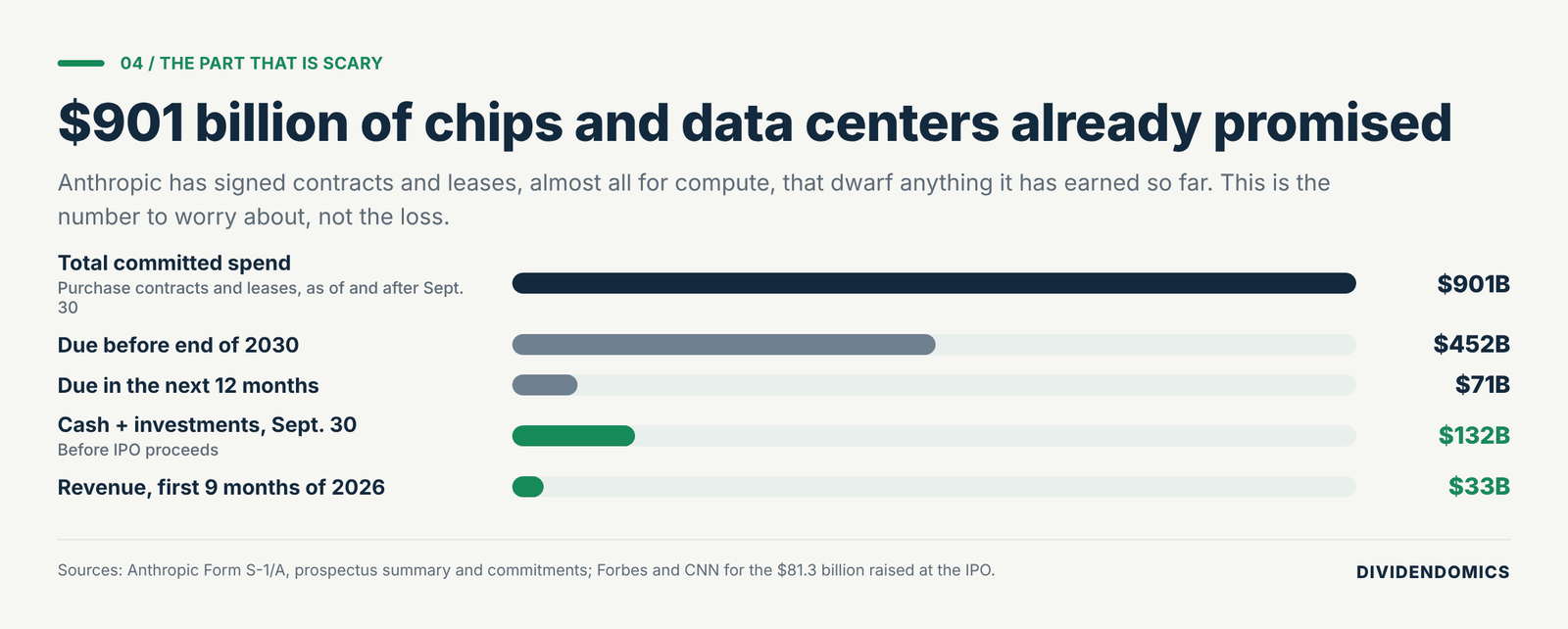
Anthropic Form S-1/A; Forbes and CNN for the IPO proceeds and opening valuation.
Anthropic has promised to spend about $901 billion on chips, data centers and cloud capacity under contracts and leases it has already signed. About $452 billion of that comes due before the end of 2030 and $71 billion in the next twelve months alone. Against that: $132 billion in the bank, $81 billion from the IPO, and $33 billion of revenue in nine months. The math only works if revenue keeps compounding at something close to the current pace for years. If growth slows, those contracts don’t.
So that’s my read on ANT at $2 trillion: the loss everyone is scared of is a paper charge, the growth and margins are better than almost anyone expected, and the risk is a mountain of spending commitments priced for perfection. I’m not buying the stock at the open on day one. But every dollar of those $901 billion of commitments is going to land in the pocket of a company that already trades at a normal multiple, and that’s the trade I’m actually making.
The two-number test, done for you on 118 funds
Every fund in my coverage goes through the screen I run in the High Yield ETF Database: payout against total return, a four-tier risk rating, and a flag for synthetic funds that hold options instead of stock. Updated weekly, included for every paid subscriber.
Free readers only · Black Friday · ends November 30
50% off a year of Dividendomics
Half price on everything paid subscribers get: every buy alert as I place it, the Yieldly Dashboard, the High Yield ETF Database with 118 funds rated, and the subscriber chat where Friday’s fills land first. The code works until November 30 and then it’s gone.
How to get paid on Anthropic’s $901 billion
Below the line for paid subscribers:
The fund that holds Anthropic’s suppliers, holding by holding, and what it trades at next to the chip index
The weekly payer that sells options on the chip chain, with what it actually earned and paid since day one
Four risks and who each one hits first, plus what I’m watching