

On Friday afternoon my ASTS position closed at $50.97, down 10.48% on the day after touching $47.57, a new 52-week low. Volume ran past 54 million shares against a three-month average of 12.9 million, according to The Motley Fool’s market wrap, and the stock finished the week down 12.8% after already giving up 5.4% the week before. From the May high of $133.86, that works out to a 62% drawdown.
A subscriber asked me this week what I make of the SpaceX headlines, so this is my full answer, and I’m still holding. The FCC approval and the spectrum purchase that caused the selling are real, and they come with a timeline the market skipped past: SpaceX’s own cell service doesn’t start until late 2027, and the constellation that just got approved isn’t due to be half built until 2032. ASTS has 13 satellites in orbit today, $1.3 billion of backlog and two governments publicly backing its next expansion.
The covered call premium this volatility generates has to go somewhere, so after the ASTS update I get to the three names on my buy list. Two are growth positions I’ve been building since August. The third is a 54-year dividend grower trading at a 4.70% yield and 14.9 times forward earnings, and I’m accumulating it with a rule about patience that I’ll explain.
👉 Upgrade Your Subscription for $0.82 a day and get every buy alert first, plus the funds paying my bills.
What SpaceX Actually Did This Week
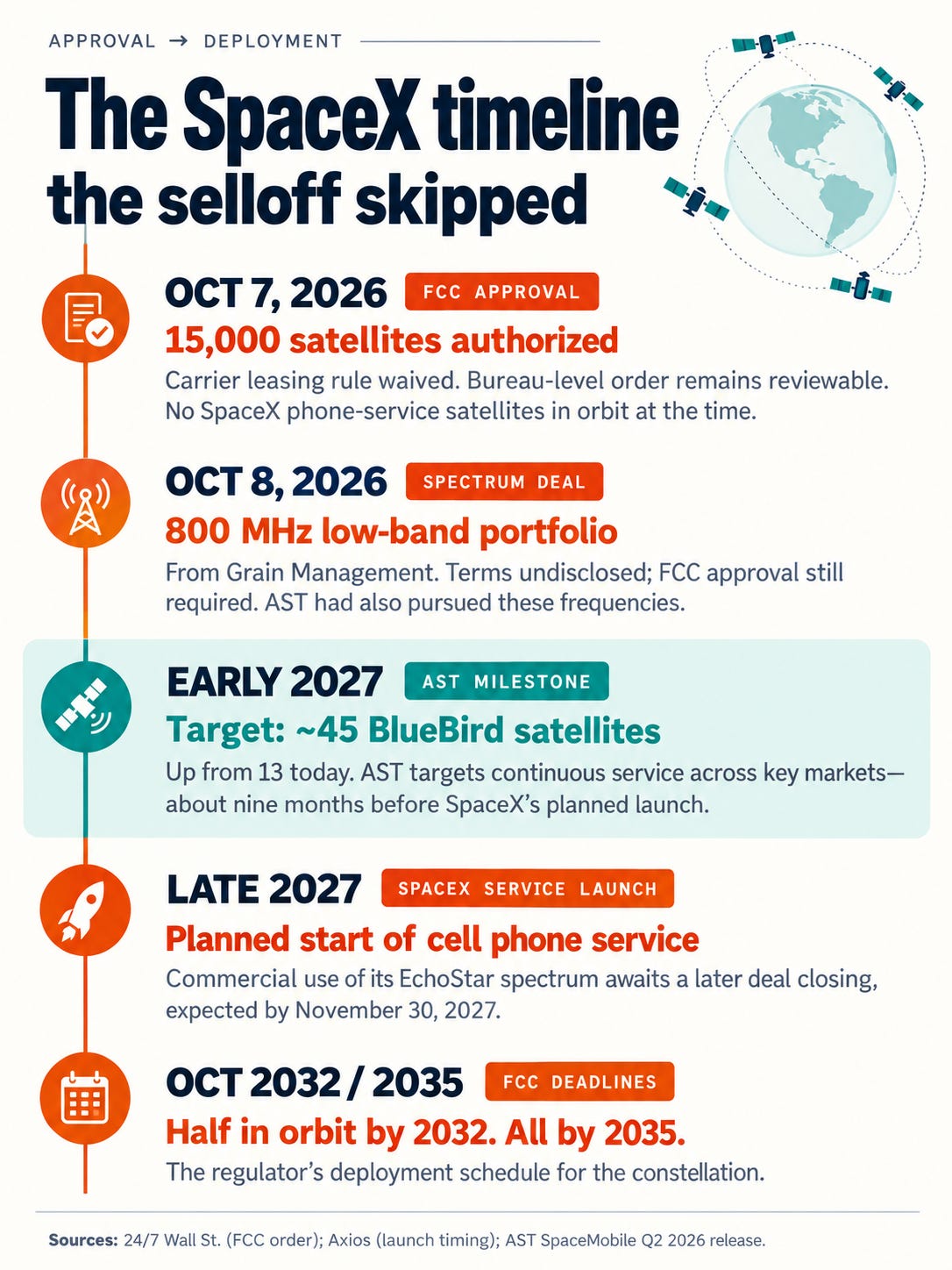
Three things landed inside 72 hours. On Tuesday the FCC’s Space Bureau authorized SpaceX to build a 15,000-satellite constellation at 326 to 335 kilometers that connects directly to ordinary phones, and it waived the rule that would have forced SpaceX to lease spectrum through a carrier, according to 24/7 Wall St. The FCC’s own words were that “requiring SpaceX to enter into a leasing arrangement with itself would be an unnecessary regulatory burden,” which means Starlink can sell phone service to you directly instead of only through AT&T or T-Mobile.
On Thursday night SpaceX announced it will buy Grain Management’s nationwide portfolio of 800 MHz low-band licenses, the frequencies that travel far and pass through walls. Terms weren’t disclosed and the deal still needs FCC approval, and the part that matters for ASTS is that AST had been pursuing those same frequencies, per 24/7 Wall St.
SpaceX has been a public company since June 12, when it raised $75 billion at $135 a share and closed its first day above a $2.1 trillion market cap, according to TIKR. A company that size with $93.52 billion of cash, per the same 24/7 Wall St. report, can outspend every satellite startup on earth, and the market priced ASTS this week as if that spending had already happened.
SpaceX has none of these phone-service satellites in orbit, its EchoStar spectrum can't be used commercially until the later stage of that deal closes by November 30, 2027, and the FCC gave it until October 2032 to get half the constellation up.
What Changed For ASTS & What Didn’t
The list of what changed is short. ASTS lost its shot at the Grain low-band licenses, and telecom analyst Roger Entner of Recon Analytics said “Ligado is next,” which puts AST’s mid-band agreements with Ligado Networks in the spotlight. If SpaceX ends up with that spectrum too, AST’s U.S. plan leans harder on its carrier partners’ airwaves.
The other change is sentiment, because a rival with its own licenses and a regulator willing to let it skip the carriers makes the “who needs AST” question louder, and that’s what Friday’s volume was.
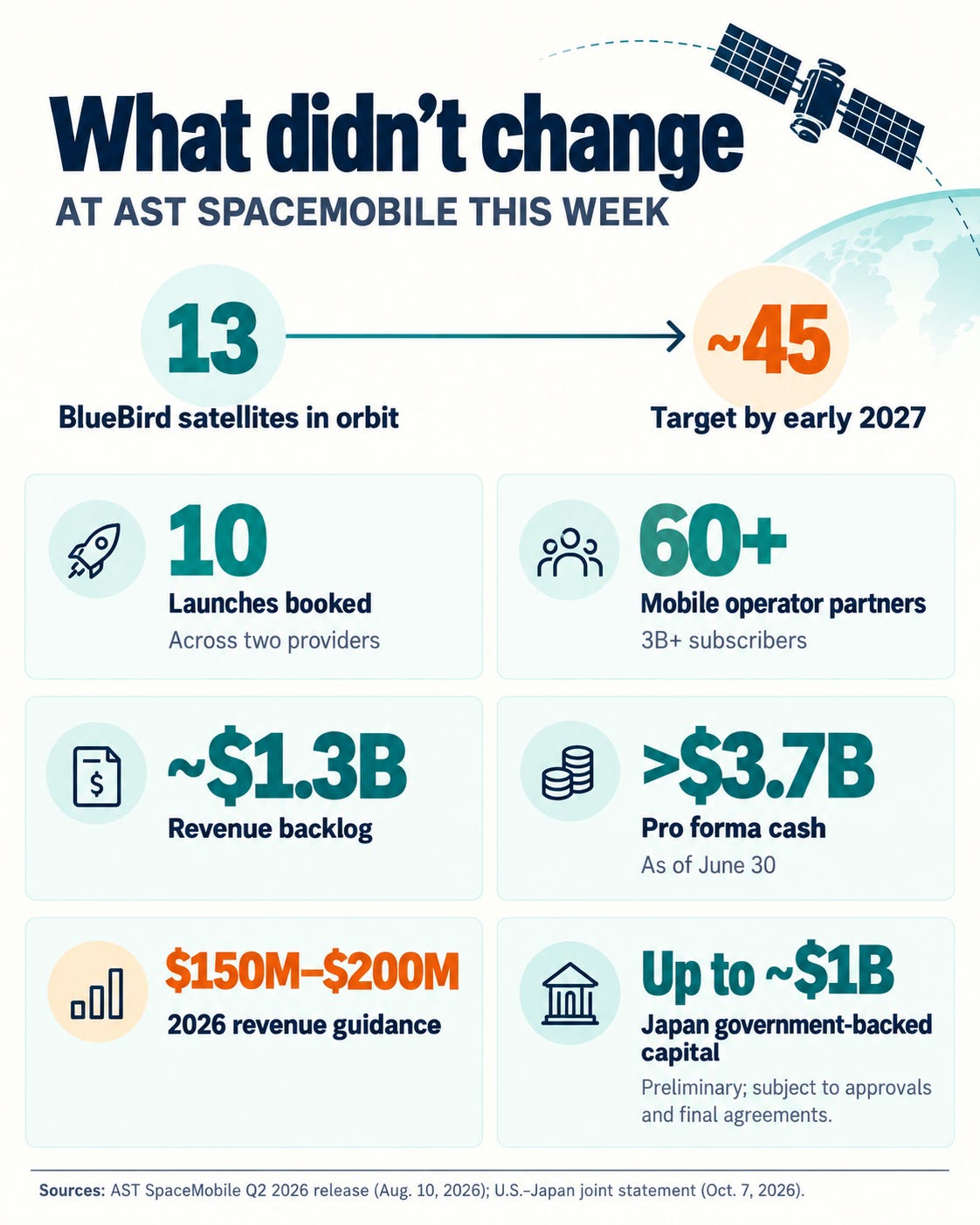
What didn’t change is most of the business. AST reported $31.5 million of revenue in the second quarter, reiterated 2026 revenue guidance of $150 to $200 million with the weight in Q4, and still plans about 45 BlueBird satellites in orbit by early 2027 from 13 today, with BlueBirds 14 through 16 in final testing and 17 through 46 in production, according to the Q2 release.
Ten launches are booked with two providers. More than 60 mobile operators covering over 3 billion subscribers are signed, backlog sits near $1.3 billion, and pro forma cash topped $3.7 billion at June 30 after the July convertible raise.
On October 7 the State Department confirmed that the U.S. and Japanese governments are jointly promoting AST’s constellation with Rakuten under the U.S.-Japan Technology Prosperity Deal, per SatNews. That sits on top of a preliminary selection under Japan’s J-LEO program worth up to about $1 billion of capital that is neither debt nor new shares, still subject to approvals, and Rakuten already owns about 5.3% of AST
Two governments putting their names on your satellites the same week a rival gets approved is not something a 10% down day prices.
The carriers haven’t moved either. AT&T, Verizon and T-Mobile formally set up a joint venture on October 2 to standardize satellite-to-phone service, per Via Satellite, and that venture still needs someone’s satellites. Those three companies just watched SpaceX get permission to poach their customers from orbit, and AST is the partner that extends their coverage without taking the customer relationship, so that argument got stronger this week.
The real bear case is cash. Consensus compiled by TIKR has AST burning about $1.96 billion of free cash flow this year, $1.49 billion next year and $723 million in 2028 before turning positive in 2029, roughly $3.2 billion in total against that $3.7 billion of cash, with second-quarter capex alone at about $610 million. The cushion is thin, a delayed launch or a slower ramp means another raise, and that was the risk before this week too.
How I’m Handling The Position
I’m not selling into a 62% drawdown on news that changes the competitive picture in 2028 rather than 2026. I’m also not adding until a launch actually lands, because the thing that moves this stock from here is satellites in orbit, and the next three have been “shipping shortly” since August. I said the same in my August report and the plan hasn’t changed.
What the drawdown does give me is premium. ASTS covered calls paid me $1,002.25 in September, my own total from the September report, and the volatility that produced Friday’s volume is the same volatility that fattens the calls I write. The strikes come down with the stock, so I’ll be writing closer to the money than the $65 to $95 strikes I used in July, and that premium funds the buys below, which is how the dividend stack works: the position I’m waiting on pays for the positions I’m not.
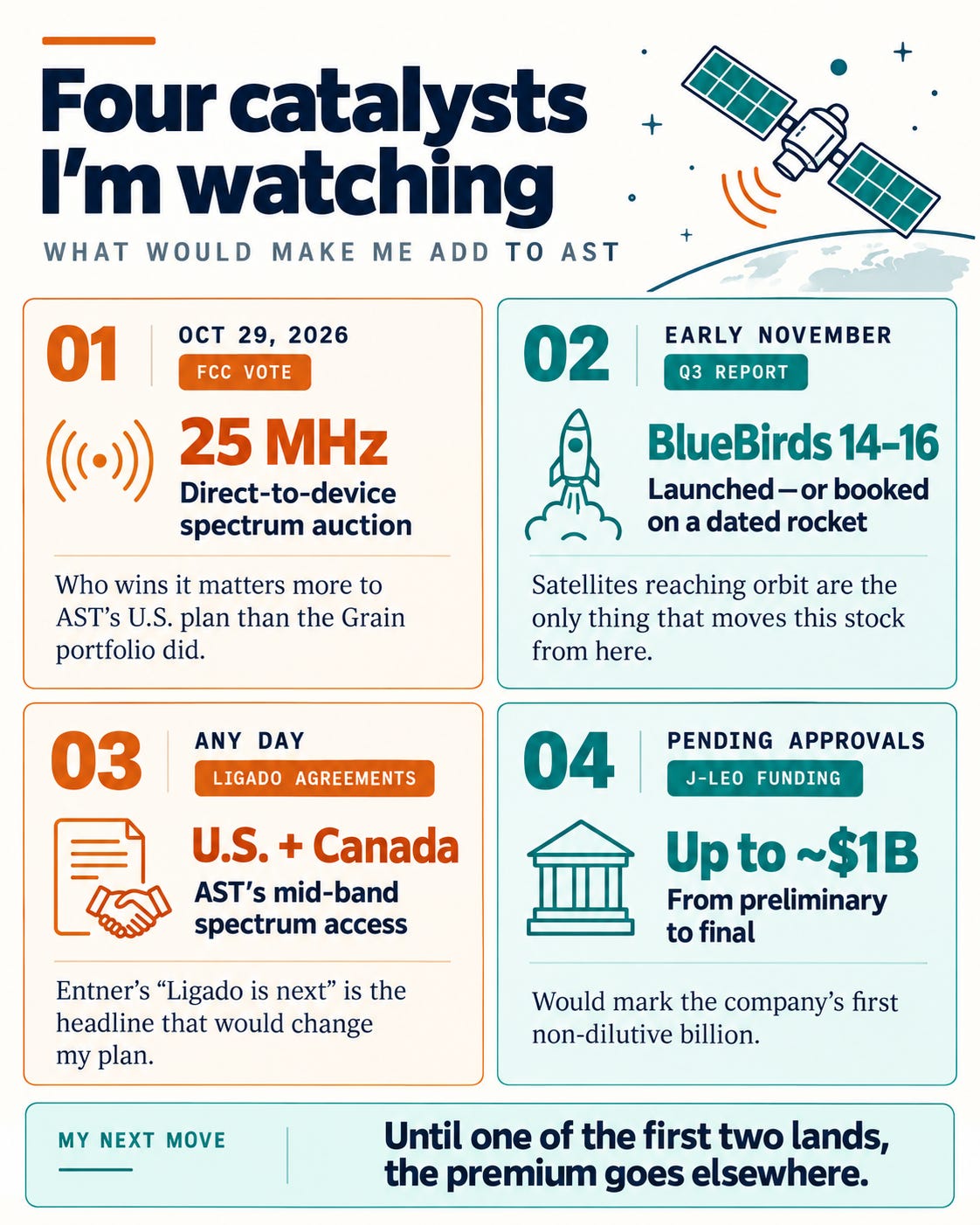
The FCC votes October 29 on auctioning 25 MHz of spectrum for direct-to-device service, and whether AST or SpaceX ends up with it matters more than the Grain deal did. The Q3 report in early November needs to show BlueBirds 14 through 16 either launched or on a rocket with a date, and until one of those two lands, the premium goes into the three names below.
Three Names I’m Watching Right Now
Every covered call premium I collect goes into one of these three. I firmly believe in the idea of accumulating positions while they are out of favor with the market.