

Bitcoin just pulled back sharply from its recent all time high. Volatility has increased and the cycle may be shifting. When digital assets fall twenty or thirty percent in a short period of time, people think something is wrong. When stocks fall the same amount, people call it a buying opportunity. This is why most investors miss the largest upside moves.
Bitcoin is a volatility driven asset. The best time to enter is almost never when it feels comfortable. It is when fear spikes and momentum cools down.
👉 Bitcoin fell nearly 30% from its all time highs.
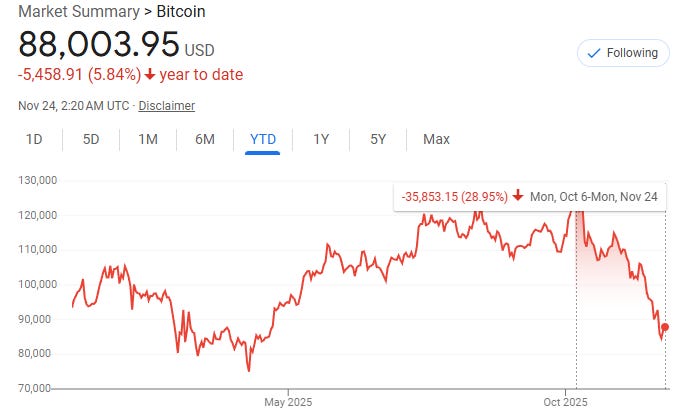
Instead of avoiding the volatility, I want to take advantage of it. I am preparing to increase my exposure during this weakness, but not by buying bitcoin directly. I plan to use ETFs that offer simple access, strong liquidity, and the ability to scale my position with margin without dealing with the complexity that comes with holding the asset itself.
👉 I may buy two different positions:
Weekly paying fund with a dividend yield of 49%.
Monthly paying fund with a dividend yield of 52%
Before I explain which strategies I am using and why, it is important to understand the historical behavior of bitcoin during pullbacks. Once you see the pattern, the current environment becomes much easier to navigate.
Get Free Bitcoin
Before we dig into the details, earn $30 of free Bitcoin! Yes, free!
I don’t cover my crypto holdings often but I do hold approximately $70K in Bitcoin and Ethereum. I am extremely bullish on these two holdings and I completely avoid the meme coin nonsense. Simply put, I don’t buy any of the smaller cryptos.
I buy $25 of bitcoin every single week on Coinbase. You can get your first $30 in Bitcoin for free, when you open a Coinbase account and deposit $20. No gimmicks here, just a reward for signing up.
Why Bitcoin Corrections Are Normal and Often Bullish
When bitcoin falls 20% to 30%, it feels dramatic. To new investors, it even feels dangerous. However, this type of movement is not only common, it has been a defining feature of every major bitcoin cycle.
I believe there are three reasons why we should take advantage of this pullback.
Leverage Reset: During rallies, traders layer on more leverage. Eventually the market needs to clear that excess. A sharp pullback forces leveraged positions to unwind, which resets the system and creates a healthier foundation for the next move.
Sentiment Shifts: When prices run quickly, optimism begins to outpace reality. A correction brings sentiment back to neutral levels, which has historically been the environment where the strongest recoveries begin.
Long Term Holders Create Stability: One of the most overlooked dynamics is that long term wallets almost never sell during these drops. The selling usually comes from short term traders. When long term holders stay steady, bitcoin supply effectively tightens, which supports eventual price recovery.
The third point is arguably the most important. As fewer people sell, this creates more price stability. So there will eventually be a point where Bitcoin no longer sees these dramatic pullbacks.
Additionally, Bitcoin sees a decline at the midpoint between every halving. We are currently at this point. Therefore, please remain cautious because there may be sustained downside over the next twelve months.
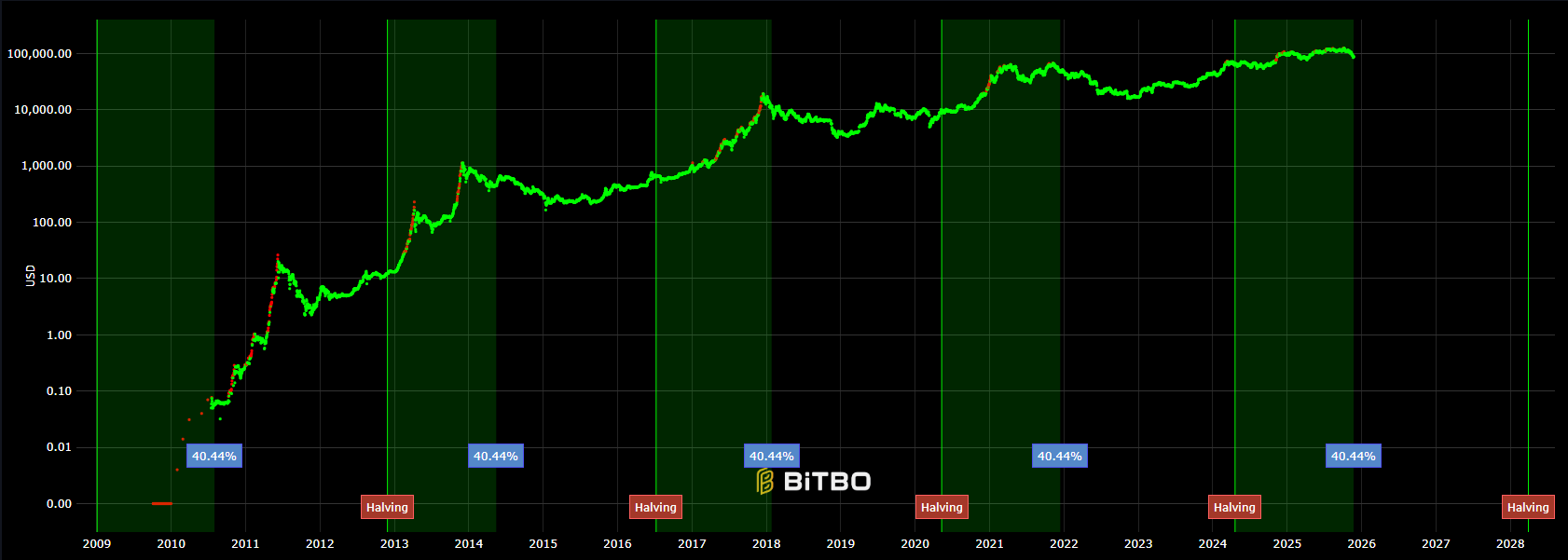
If you look back at previous cycles, the pattern is consistent. Sharp declines occur, the market stabilizes, and then a stronger advance follows. This does not guarantee a repeat, but it provides a clear framework. Bitcoin rarely moves smoothly. It moves in violent waves that reward patient accumulation during moments of weakness.
This is the environment that makes certain ETFs especially attractive. Before choosing how to position, you need to understand the different approaches these funds take and how they fit into this type of market.
How I Am Capitalizing on Bitcoin’s Volatility
During pullbacks like the one we are experiencing now, option premiums on bitcoin futures spike higher. Whenever that happens, income strategies become more attractive because they can harvest that premium and convert it into cash flow. Instead of avoiding the volatility, you can get paid because of it.
This is where two specific ETFs come into play. Both allow me to benefit from bitcoin’s recovery, but they approach the market in completely different ways.
Pick #1: Total return of 43%
Pick #2: Total return of 84%
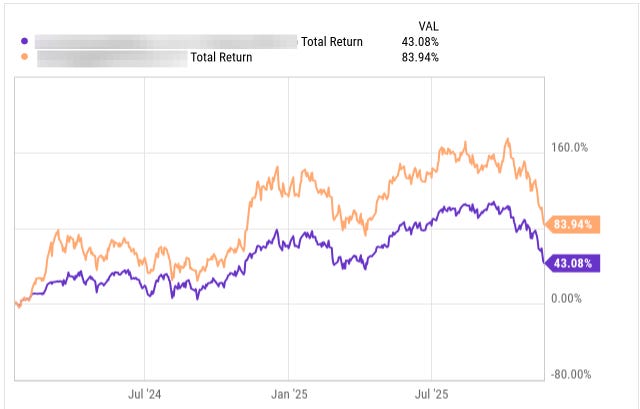
The first ETF uses a covered call style strategy to turn volatility into income. It thrives in sideways or choppy markets and can generate consistent cash flow even when bitcoin is not trending. The second ETF provides direct exposure to bitcoin futures, which allows you to participate fully if bitcoin makes a strong move higher after the pullback.
However, both of these also have larger downside risks due to their nature.
These two approaches give me flexibility. If I want income from uncertainty, I can use the first one. If I want uncapped upside during a potential recovery, I can use the second. In some cases, I may even hold both at the same time and let each do its job.
The Two ETFs I Am Considering
Now that you understand the purpose behind each type of strategy, here are the two specific ETFs I am evaluating for this pullback:
👉 Upgrade now! Black Friday Discount.
Roundhill Bitcoin Covered Call Strategy ETF YBTC 0.00%↑: dividend yield of 49%.
ProShares Bitcoin Strategy ETF BITO 0.00%↑: dividend yield of 52%.
Both give exposure to bitcoin, but they behave very differently. One focuses on income from volatility. The other focuses on pure bitcoin upside. Understanding how each one works will determine which is better for current market conditions.
YBTC uses a covered call style approach on bitcoin futures. Instead of relying on price appreciation alone, it sells options on a portion of its position and collects premium. This premium is then paid out to shareholders, which is why the fund can distribute high levels of income.
YBTC works best when bitcoin is:
Moving sideways
Choppy or range bound
Recovering slowly after a pullback
Experiencing elevated volatility
In these environments, the income potential is strong because option premiums are elevated. YBTC is not designed to capture the full upside during a strong rally, but it excels at turning uncertainty into cash flow.
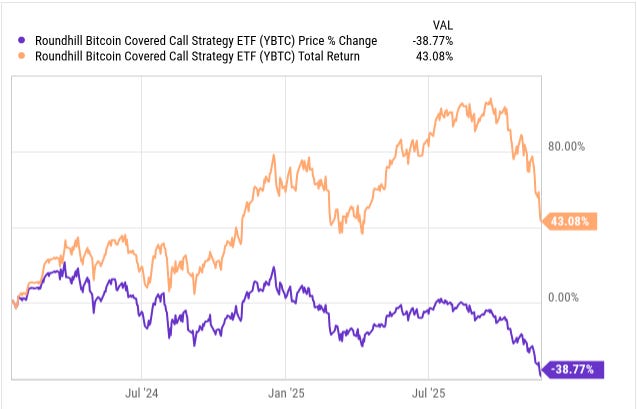
As we can see below, the recent decline has caused YBTC’s share price to suffer. However, the total return remains positive when including all distributions paid.
BITO is the first U.S. listed bitcoin futures ETF. It offers direct exposure to the price of bitcoin without selling options. This means it does not generate income, but it also does not cap the upside.
BITO performs best when bitcoin is:
Rallying strongly
Breaking out to new highs
Recovering after a capitulation
Moving in a clear upward trend
BITO is essentially a cleaner version of holding bitcoin itself, without dealing with wallet management or custody. It captures the full movement of bitcoin futures, which typically track spot prices closely over short and medium time frames.
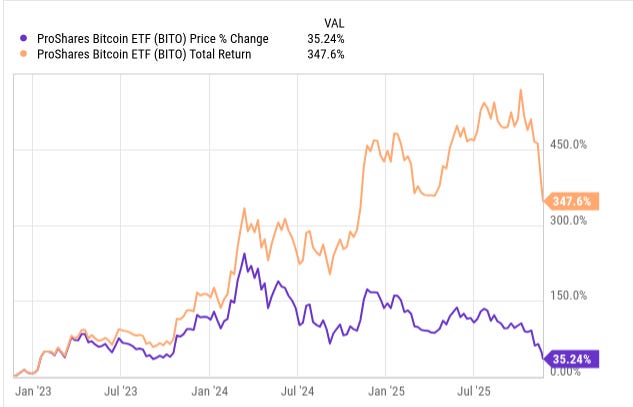
Over the last three years, BITO has crushed it when including all dividends paid. The goal is to catch this at a good entry point.
Why I Am Using Margin To Build This Position
Bitcoin corrections create opportunities that usually do not last very long. When the price drops quickly and volatility spikes, the window to accumulate exposure at a discount is often measured in weeks, not months. Using margin allows me to scale into this weakness without waiting for new cash deposits or selling existing positions that I want to hold long term.
Margin is not something I use casually. It is a tool that only makes sense when three conditions are true.
Condition One
My core holdings are generating enough income to support the position. The dividend and option income I collect throughout the month reduces my effective carrying cost. This is very different from using margin with no incoming cash flow to offset it.
Condition Two
The underlying asset has a long history of recovering after large drawdowns. Bitcoin has fallen more than thirty percent multiple times during prior bull cycles and has recovered to new highs every single time. The historical recovery pattern gives me confidence that a well timed entry has a favorable risk to reward profile.
Condition Three
The investment vehicle I am using has clear behavior patterns. YBTC produces income during volatility. BITO captures upside during a rebound. Both fit well with a margin-based approach because the catalysts that drive their returns are linked directly to bitcoin’s price movement and volatility.
Margin lets me take advantage of the temporary disconnect between short term fear and long term value. If bitcoin recovers as it has in every previous cycle, both YBTC and BITO will benefit. One through higher distributions if volatility remains elevated. The other through direct price appreciation if momentum returns.
The key is responsible sizing. Margin amplifies both gains and losses. I size these entries so that even if bitcoin falls another twenty percent, my portfolio remains stable and I do not face forced selling. The goal is to use margin strategically, not aggressively.
The Risks of Using Margin
Margin can be a powerful tool during volatile periods, but it also comes with real risks that investors need to understand. The most important risk is that margin amplifies every movement in your portfolio. If your position rises, the gains are magnified. If it falls, the losses increase at the same pace.
Another risk is the possibility of a margin call. If the value of your collateral drops too far, your broker can require you to deposit more cash or liquidate part of your position. This is why sizing is critical. A margin position should always be small enough that a pullback does not put you in a forced selling situation.
The final risk is psychological. Margin increases emotional pressure during drawdowns. If you size the position too aggressively, normal volatility can lead to rushed decisions that work against your long term plan.
These risks are manageable when you use margin conservatively, size your position correctly, and maintain enough liquidity to handle unexpected swings. The goal is to use margin as a strategic boost, not as a shortcut.
What type of income do you receive and how is it taxed?
Does account type matter IRA or taxable?
I already did something similar with cash not margin. I got BLOX & BTCI. What's your opinion on this combination?
Also, your article convinced me to add BITO.