

Overview
The environment for income investors has drastically shifted over the last decade. Only ten years ago, the meaning of "high-yield" was commonly defined as dividend yields that fell within the range of 5% to 15%. In order to receive yields this large, investors typically had to expose themselves to a variety of different debt-focused securities. This includes asset classes like Business Development Companies or Closed End Funds that focused on a portfolio of different below investment grade securities.
During the brief market lows of 2020, I was able to secure a lot of different positions that offered dividend yields above 10%. This included positions in several BDCs that helped significantly increase the level of annual dividend income that my portfolio generated. I believe I was lucky because only two years later, the Fed aggressively hiked interest rates, which helped boost the amount of supplemental distributions that I was able to receive. Some of these positions were:
Ares Capital ARCC 0.00%↑
Hercules Capital HTGC 0.00%↑
Capital Southwest CSWC 0.00%↑
Gladstone Investment GAIN 0.00%↑
Main Street Capital MAIN 0.00%↑
I've sold out of many of these positions now and I no longer feel the need to reinitiate a position in these BDCs. With the abundance of different covered call ETFs out there now, I feel like this growing asset class offers a lot of competitive advantages to BDCs. There's a good reason why there has been record inflows to these income focused derivative funds in 2025. Investors are more commonly searching for a higher yield from sources that have a lower risk profile.
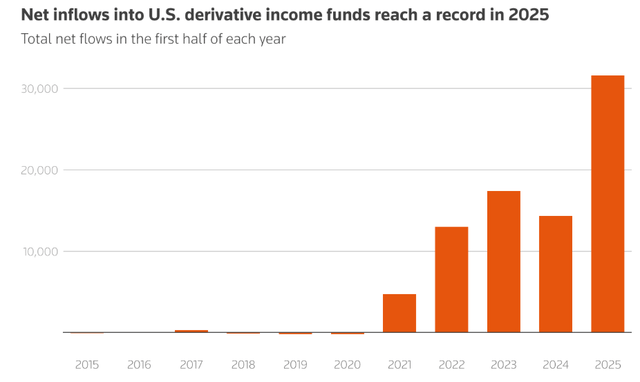
After tracking the performance of many different covered call ETFs over the last year, I fully understand why there has been such an increase in demand for this asset class. For instance, some of the highest quality covered call ETFs out there offer investors the following traits, which I find a lot more favorable compared to BDCs:
Capital Appreciation Potential
Linked To An Index, Such As The S&P 500
Stable Distributions
Resilient To Interest Rate Shifts
Tax-Efficient Income
So let's start by addressing some of the pros and cons of Business Development Companies. But first, I want to put emphasis on the fact that I am not suggesting that investors should sell out of their BDC positions and swap them for covered call ETFs. There are still plenty of benefits for investors to keep BDCs as a part of their portfolio.
Business Development Companies
Business Development Companies were created by Congress back in 1980, as a way to help small and mid-sized businesses obtain capital. This asset class is unique because it essentially allows investors to put themselves on the other side of the cash register; Instead of being the ones to always borrow the capital and pay the interest, investors can use BDCs as a way to now collect the interest payments from borrowers.
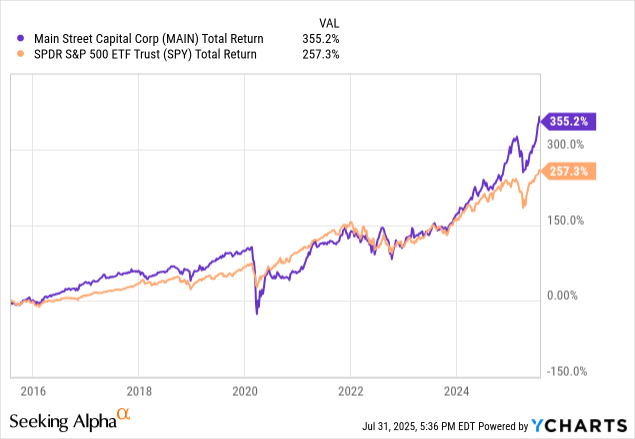
BDCs are legally required to distribute 90% of taxable income to shareholders to avoid paying corporate taxes, so these are popular income vehicles for many investors. Additionally, BDCs tend to favor senior secured loans because they are considered to be less risky and can reduce the impact of borrower defaults. The management structure for BDCs can vary between internal or external, but they usually have much higher fees than a traditional ETF. Most of all, many of the highest quality BDCs provide shareholders with the best of both worlds: capital appreciation and growing dividend income. Main Street Capital has been one of the highest quality BDCs for investors because it has been able to deliver excellent total returns compared to traditional market indexes.
Additionally, BDCs like MAIN structure a portion of their investment portfolio as floating rate debt. This helps these BDCs generate amplified levels of income during periods where interest rates are elevated. However, the opposite effect is also true; lower interest rates can translate to lower net investment income. What makes a BDC like MAIN so special is management's ability to structure their portfolio in a way that can provide investors with returns through different interest rate environments. For instance, MAIN has provided a higher total return than the S&P 500 (SPY) over the last decade, which reinforces its efficiency.
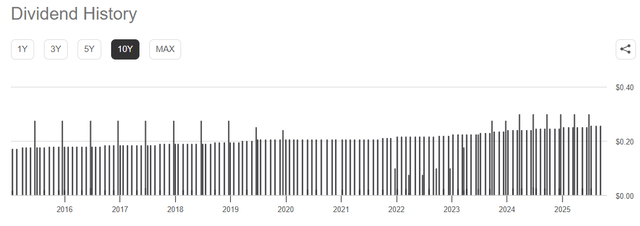
MAIN currently offers investors a starting dividend yield of 6.6% and monthly payouts. This makes it an attractive pick for investors seeking a source of reliable income generation. MAIN is also one of the standout BDCs that has been able to raise dividends for seventeen consecutive years without disruption. MAIN has also been able to increase its dividends at a CAGR (compound annual growth rate) of 5.40% over the last three year period.
However, this sort of income growth is the exception and isn't that common within the BDC sector. For instance, an option like Barings BDC BBDC 0.00%↑ offers investors a higher starting dividend yield of approximately 11.2% but doesn't have as strong of a dividend growth history. Not all BDCs are constructed with the same industry focus or lending criteria so the results may vary. However, the higher yield offered by this asset class has made it an attractive choice for retired investors that may be living off the income their portfolio generates.
One of the major downsides to BDCs is the sensitivity to the interest rate environment. As the cost of debt remains elevated, many BDCs are starting to experience a rising rate of non-accruals and defaults with their portfolio. While higher rates can be great for income generation, it also increases the interest expense that borrowers need to pay and this can put stress on the health of these companies.
Additionally, distributions from BDCs are most commonly funded by the interest payments received from its portfolio of borrowers, which falls under net investment income. Therefore, the distributions received from BDCs are typically classified as ordinary dividends, which have the largest tax burden for investors. This means that BDCs may not be the most tax-efficient choice for income investors that hold these funds outside of tax-advantaged accounts.
Covered Call ETFs Are Great Alternatives
Unlike BDCs, covered call ETFs offer investors exposure to a portfolio of equities that is more familiar. There usually isn't any exposure to debt securities with these covered call ETFs that aim to track the movement of an underlying index. For instance, I recently published an article on Goldman Sachs S&P 500 Premium Income ETF GPIX 0.00%↑ which is made up of constituents of the S&P 500 SPY 0.00%↑ Therefore, the fund can provide exposure to all of the highest quality companies in the world, such as:
Nvidia NVDA 0.00%↑
Microsoft MSFT 0.00%↑
Apple AAPL 0.00%↑
Amazon AMZN 0.00%↑
Meta Platforms META 0.00%↑
Alphabet GOOG 0.00%↑
Tesla TSLA 0.00%↑
These funds essentially write options against its holdings or an index, as a way to harness the volatility and collect income. Therefore, these covered call ETFs can actually outperform the indexes during periods of uncertainty where markets are highly volatile but are trading sideways. Since these ETFs may be linked to an underlying index, the success of these funds doesn't rely on a specific interest rate environment to thrive. Instead, investors can participate in the upward momentum of the market, simply because they have exposure to traditional equities.
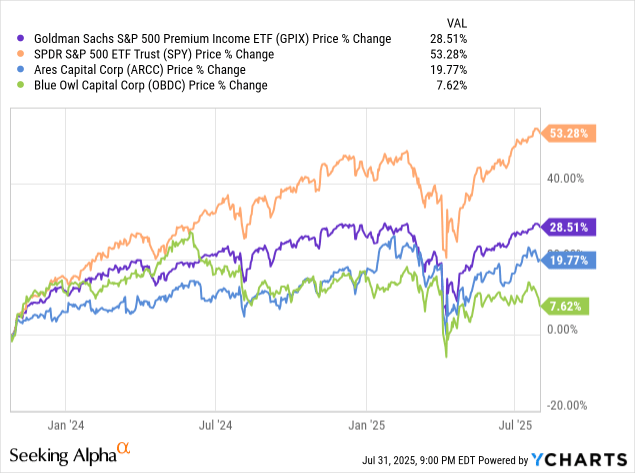
As we can see above, a covered call ETF like GPIX was able to participate in the overall direction of the market shifts. However, the main vulnerability of these option ETFs is that price growth is capped. While each option strategy may be different between funds, they generally share this same vulnerability.
In an effort to help visualize how this works, let's imagine that a covered call ETF holds an asset that is valued at $50 per share. The option ETF may write an option against the asset and select a strike price of $55 per share. If that underlying asset has a strong earnings report and the price appreciates up to $65 per share, the covered call ETF will only participate in the growth up to the selected strike price. All of the remaining upside above the strike price is essentially sacrificed in exchange for the premium income received.
However, GPIX is one of the more unique choices available to investors because the fund can dynamically adjust the rate at which it writes options, which may allow for a greater amount of capital appreciation. There are a few other covered call ETFs that offer a compelling value proposition for investors. I believe that the following covered call ETFs make for the best long term positions:
Goldman Sachs Nasdaq-100 Premium Income ETF GPIQ 0.00%↑ : offers a starting dividend yield of 9.8%.
JPMorgan Equity Premium Income ETF JEPI 0.00%↑ : offers a starting dividend yield of 8.3%.
JPMorgan Nasdaq Equity Premium Income ETF JEPQ 0.00%↑ : offers a starting dividend yield of 11.2%.
The differentiating factor of these funds is that they can pay out distributions in a tax-efficient method. For instance, GPIQ and GPIX both pay out the majority of their distributions using return of capital. Return of capital distributions aren't classified as income and therefore, aren't taxed as such. Instead, a return of capital distribution reduces an investor's cost basis and allows taxes to be deferred until the time of sale.

Therefore, some covered call ETFs offer very competitive yields with better tax-efficiency than BDCs. So we can argue that it can be more cost effective to maintain a position in a covered call ETF instead of a BDC, especially when talking about a large amount of capital invested. Just to demonstrate, $200,000 invested into each one of these groups would have vastly different results.
$200,000 Invested
GPIQ = produces ~$19,600 in annual dividend income. If only 4.2% of this amount was funded with ordinary income, only ~$823 of this amount would be taxable.
MAIN = produces $13,200 in annual dividend income. If 100% of this was funded with net investment income, the entire balance is classified as ordinary income and has a much larger tax consequence.
*These are estimates and could change based on your specific tax bracket.
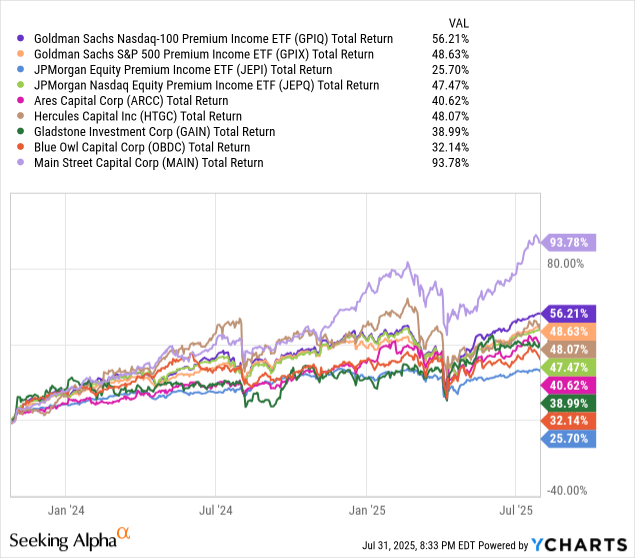
This makes covered call ETFs a compelling choice for investors that are specifically seeking income generation. Running a quick performance comparison, we can see that many of these covered call ETFs also offer very competitive performances to BDCs. Both GPIQ and GPIX outperform the included BDCs, with MAIN being the exception. However, this is a smaller time comparison and the outlook may look different if we allow more time to pass.
Takeaway
In conclusion, covered call ETFs can be an enticing alternative choice to Business Development Companies and offer many similar benefits for investors. Higher quality covered call ETFs can offer a similar dividend yield and similar monthly payouts. Additionally, covered call ETFs can track an underlying index, which presents a lower risk profile than a BDC that maintains a debt focused portfolio. A BDC may experience a greater vulnerability to changes in the interest rate environment, while index-tracking covered call ETFs can provide exposure to many of the high quality companies without much of a vulnerability to interest rates. Covered call ETFs can also utilize return of capital distributions to limit the tax burden for investors, making it more attractive for retired investors that live off dividend income.
Most people will never experience what it feels like to get paid without clocking in. But you can. And once you do, you will never go back.
Want to get a well-rounded idea of where to start your investing journey? I have you covered here as well!

📊 Tool: Track Your Progress
Want to keep track of what you're earning, how much your portfolio yields, and where to reinvest?
📥 Dividend Tracker Template – $5
Simple, powerful Google Sheet to track your holdings, income, yield-on-cost, reinvestment, and more.
📘 Full System: Go From $0 to $500/Month in Income
If you’re ready to build a scalable dividend income portfolio from scratch, with real structure, strategy, and support. You can start here:
🚀 The Dividend Income Blueprint – $25
My complete guide that shows how I built over $3,000/month in passive income using a three-layer dividend system, reinvestment strategy, and sustainable yield portfolio design.
It includes:
The strategy I use
Portfolio structure breakdown
Real examples + reinvestment tactics
Income planning + risk controls
Bonus: Checklist, glossary, & asset filters
Book A Call

Get a Professional Second Opinion on Your Dividend & Income Portfolio
🔒 Paid Subscriber Exclusive
How I Allocate Between BDCs and Covered Call ETFs
