

Energy was the best sector to own this year, and almost all of that gain came from a shipping problem. Conflict with Iran pushed crude above $90 in March, and constraints around the Strait of Hormuz kept it there. I wrote about that trade when it started, and it worked. All of it is still a supply problem, and supply problems eventually get fixed.
If you own energy for the dividend and your payout is large because the Strait of Hormuz is congested, one diplomatic breakthrough can shrink it. Therefore, I think we can position ourselves into the funds that thrive regardless of the price of oil.
A second demand story is building underneath the first one, and it runs on electricity instead of barrels. The market is still trading the headline about the strait, so this one is not priced in yet. The companies that collect from it get paid whether crude sits at $90 or $60, on contracts running ten and twenty years. The key here is that there are a bulk of companies that get paid on volume of contracted activity, which insulates them from the actual price of oil.
I’ll highlight 3-funds that offer a high yield:
Stock #1: 7.4% dividend yield.
Stock #2: 7.3% dividend yield.
Stock #3: 6.3% dividend yield.
For instance, the second fund in this list pays a 7.3% dividend yield, while getting exposure to the toll booth companies. This fund has crushed the S&P 500 SPY 0.00%↑ in total returns over the last three years. I believe this outperformance is likely to continue. Who says you can’t collect income AND outperform?
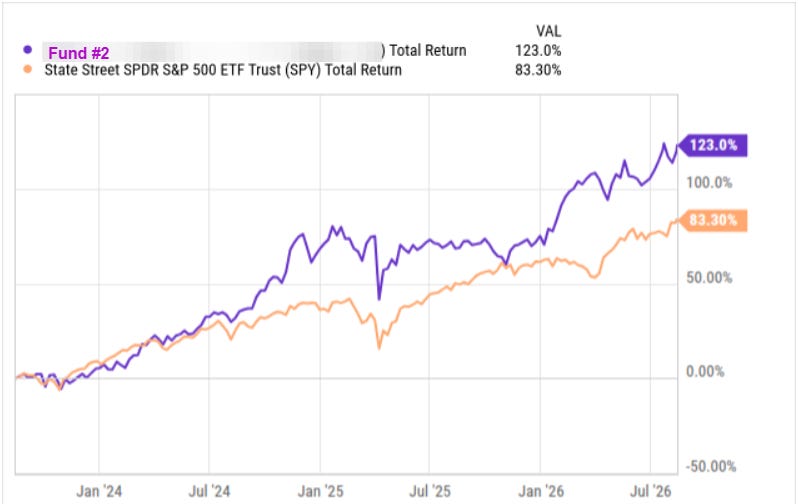
👉 You will finish this article knowing exactly how to position your portfolio and collect income along the way. I will list out three funds that offer a high yield and solid performance.
Below are the three ways an energy company gets paid, and one income fund for each of the two that do not care what a barrel costs.
The Breakdown Of Energy: 3-Levels
Every energy company gets paid in one of three ways. Which one decides whether your dividend survives a lower oil price. I think the below table is the easiest way to get an understanding of the dynamics here. I think it’s best to only maintain long exposure to businesses in the second and third categories.
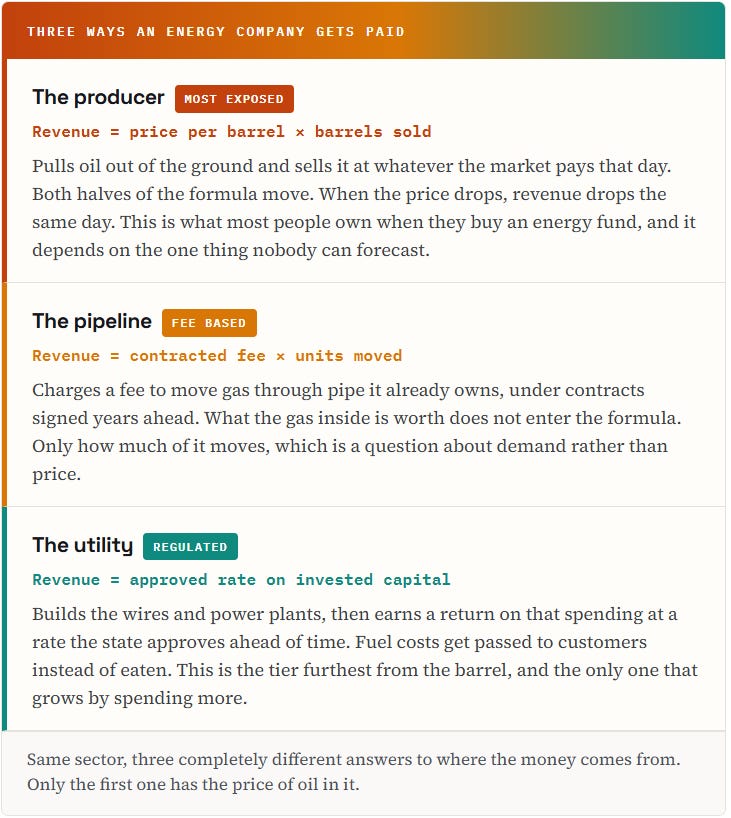
Say crude falls from $90 to $65 over the next eighteen months. The producer loses revenue that day, because the price is part of its formula.
However, the pipeline companies collect the same fee per unit as long as the gas keeps moving through, which makes these companies a bit more insulated against price fluctuations. Lastly, the utility never feels it, because its return is set on what it has built, not on what fuel costs.
Now run it the other way. Say electricity demand climbs hard for five years. The producer only wins if that demand lifts the price. The pipeline wins directly, because more electricity means more gas through the same steel. The utility wins most, because serving new demand means building, and building is what it earns its return on.
One tier needs you to be right about a price. The other two need you to be right about demand, and electricity demand is much easier to see coming than the price of a barrel a year from now.
The Demand Nobody Has To Guess About
Data centers used about 415 terawatt hours of electricity worldwide in 2024. The International Energy Agency expects that to reach roughly 945 by 2030, so it more than doubles. That figure comes from counting buildings that are already funded, already permitted, and in many cases already under construction.
The US picture is tighter. Morgan Stanley puts domestic data center demand near 74 gigawatts by 2028, against a shortfall of about 49 gigawatts in power that can actually be delivered. A shortfall means the power does not exist yet and someone has to build it. The fastest thing to build is a gas plant. Solar and wind need land and new transmission lines. Nuclear takes a decade. Gas turbines take about two years.
Every one of those plants needs gas delivered by pipeline, without pause, forever. Every one connects to a grid that a utility has to upgrade to handle it. Both of those jobs get paid a set fee for volume delivered, and neither one asks what a barrel of crude costs. It is the same reasoning behind the AI-resistant dividend stocks I have covered before, applied to the power side instead of the software side.
The length of those contracts is why this is an income story and not a trade. Pipeline and utility agreements run ten and twenty years. A distribution paid out of one of those has years of visibility behind it, which a distribution paid out of a price spike does not. The risk here is not that the demand fails to show up. It is that the building takes longer than planned, which delays the growth without cancelling it.
Stock #1: AMLP: 61 Quarters Without Missing
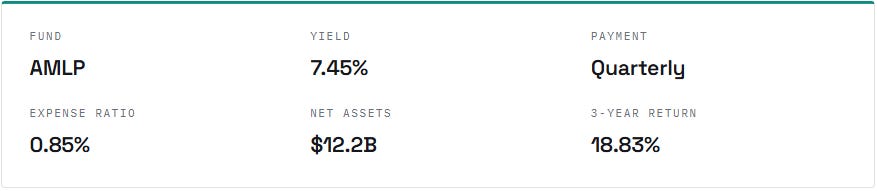
The Alerian MLP ETF owns the largest pipeline partnerships in the country and pays 7.45% at a recent price of $55.32. It has made 61 quarterly payments in a row since August 2010, a run that covers both the 2014 crude collapse and the 2020 shutdown. A fund paid on commodity prices does not get through those two events without missing.
Two things about how it is built matter more than the yield. It borrows nothing, so the payout comes from cash the partnerships actually earn rather than from debt stretching a smaller amount further. And it is set up as a corporation, so you get a 1099 in February instead of the K-1 that scares most people away from pipelines entirely. Only about 3.29% of the last year of payments was return of capital, so nearly all of it is real income.
Returns held up without crude cooperating. Through June the fund fact sheet shows 14.90% over one year and 18.83% a year over three. Look at the ten-year number too, 6.39%, which is far lower because it includes the 2015 and 2020 wipeouts. Pipelines spent years being written off, and the ones that made it through kept collecting fees the whole time.
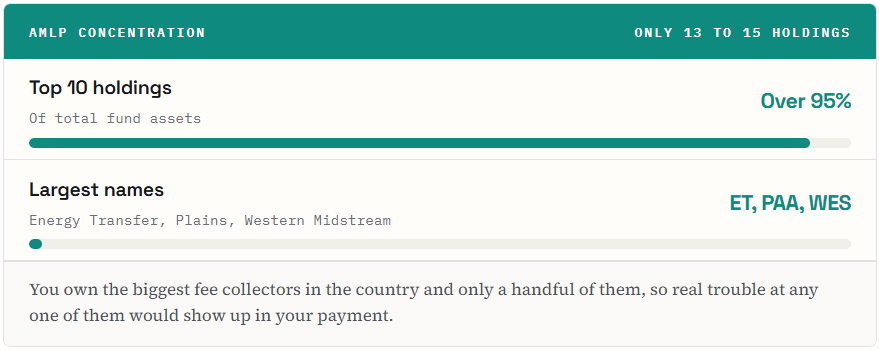
Thirteen to fifteen holdings, with the top ten above 95% of the fund, is a bet on a handful of large pipeline operators, and that is what you are paying for the yield with. It works as long as their contracts hold, and it means this belongs in your portfolio as a sector position rather than as something you build around.
Two more stocks now….
