

Many income investors are discovering weekly paying ETFs for the first time. These funds look attractive because of their unusually high yields and frequent payouts, but most people still misunderstand how they work and when they should be used. The YieldMax GOOGL Option Income Strategy ETF GOOY 0.00%↑ is one of the best examples of this.
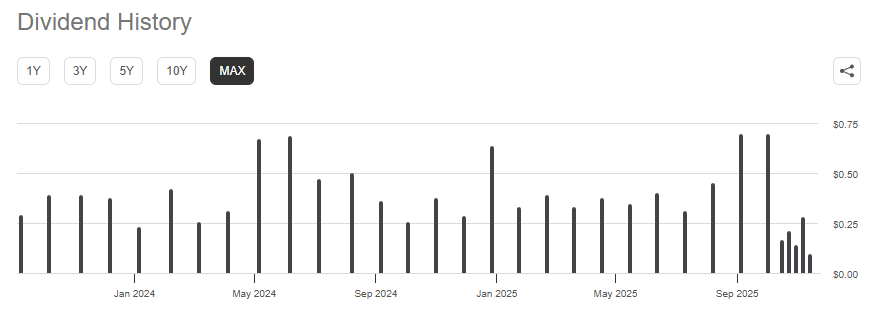
👉 GOOY now has an annual dividend yield of more than 36%.

Most investors assume that a fund connected to Alphabet should behave like Alphabet. They also assume that a high yield automatically means strong performance. Neither assumption is correct, and understanding the difference is the only way to use GOOY effectively.
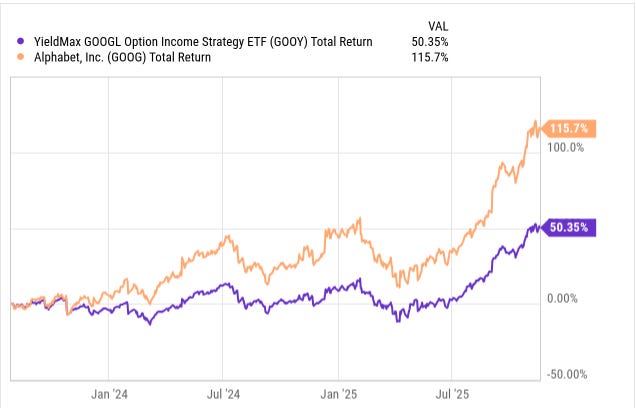
👉 As we can see below, GOOY severely underperforms GOOG since its inception, despite having a higher yield.
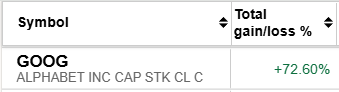
GOOG 0.00%↑ is now one of my largest positions, so I thought it would be fitting to discuss how I am extracting income from my unrealized gains. I previously alerted subscribers that Google was still undervalued back in September. If you added shares back then, you would now be up on your position.
My goal in this article is to explain, in simple terms, how GOOY works, when it performs well, when it struggles, and how I personally use it inside my income system. This will help you avoid common mistakes and use these ETFs with intention instead of guessing.
👉 Want to fast track your experience with option ETFs? Check out the option ETF guide. A purchase comes with 3 months of paid subscriber access here on Substack.
How GOOY Actually Generates Income
GOOY does not own shares of Alphabet. It generates income using a synthetic options structure that combines:
Flex options
Short dated options exposure
US Treasuries that serve as collateral
This structure creates a profile that moves in the same general direction as Alphabet but with a much higher level of income and a much higher level of price decay over time.
There are two major consequences of this structure.
1. Income levels are high but variable
Weekly payouts depend on:
Volatility in Alphabet
Options premium levels
Market momentum
Because these inputs change every week, GOOY’s income will never be predictable or stable.
2. NAV decay is normal over long periods
Since GOOY does not hold shares of Alphabet, it cannot capture the full upside of a strong rally. Most of the upside is converted into weekly income. Over time, this creates pressure on the fund’s net asset value.
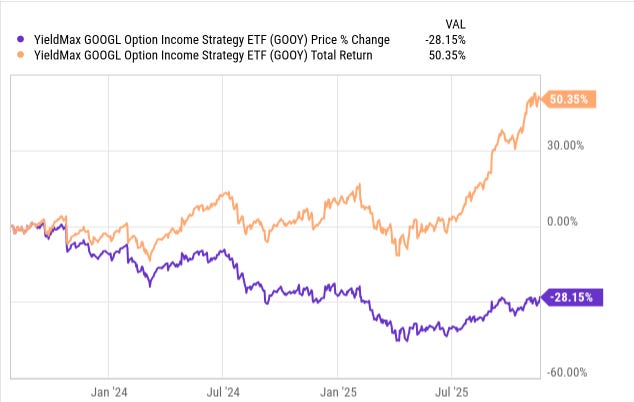
This is not a flaw. It is the natural outcome of converting upside potential into income. This is why GOOY’s share price has declined since its inception, despite GOOG’s share price appreciating over the same time frame.
As we can see below, GOOY’s share price has declined by more than 28% since inception. This is why I only hold my YieldMax positions with margin, rather than my own cash.
How I Use Margin Safely to Increase My Dividend Income

Margin is money you borrow from your brokerage firm to invest. You are borrowing money and using your stocks as collateral.
3 Scenarios & The Likely Outcomes
Once you understand the mechanics, the expected behavior becomes clear. In order to simplify how we can expect GOOY to perform, I put together three different scenarios that are very likely to play out over time.
👉 Black Friday Discount On Paid Membership. Limited Time
If GOOG’s share price rises = GOOY’s share price will appreciate but underperform GOOG. The option premiums will likely remain consistent.
GOOG’s share price remains flat or choppy = GOOY’s share price may stay within a consistent trading range and when including distributions, GOOY has the potential to outperform.
GOOG’s share price falls = GOOY is likely to experience share price erosion over time. The distributions may help offset these losses, but this isn’t a certainty. Additionally, the share price is unlikely to recover from declines unless there’s a strong rise in GOOG.
So the best case scenario is for Google’s share price to trade sideways and slowly upward over time. With the company’s ability to participate in the growth of the AI sector over the next decade, I believe that GOOG is ultimately still undervalued. Seems like Warren Buffet also agrees.
Peer Comparison: How GOOY Fits the Landscape
Several funds now provide income tied to Alphabet. They each approach the strategy differently, which affects performance and risk.
Here are three useful reference points:
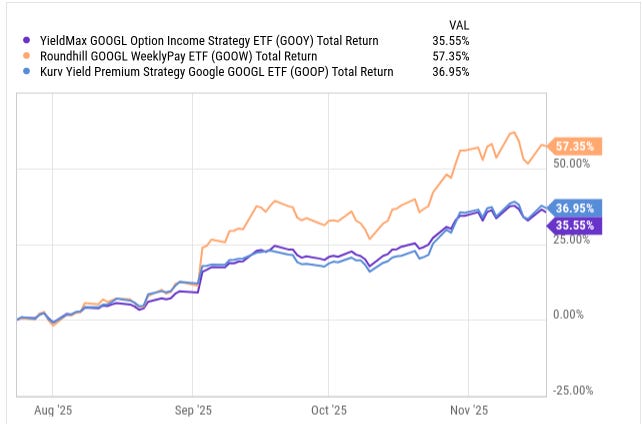
GOOY: Highest yield, most NAV decay, weekly payouts
GOOW 0.00%↑ (Roundhill): Holds Alphabet shares, offers leveraged upside exposure, highest potential return during strong rallies
GOOP 0.00%↑ (Kurv): Lower yield, lower volatility, synthetic options with a more conservative approach
This makes GOOY the most aggressive income choice. GOOW provides growth potential. GOOP provides stability. Looking at a quick performance comparison, we can see how GOOW has the strongest total return, when including all dividends paid.
Dividend Risk and Tax Considerations
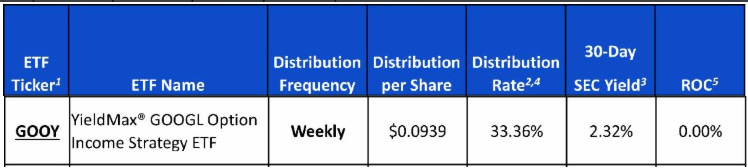
GOOY currently pays weekly, but the amount paid each week is not constant. It depends on market conditions and the options premiums the fund can generate.
Three important points to understand:
1. Weekly payouts fluctuate
Some weeks will be much higher than others. This is normal.
2. Payouts currently show zero percent return of capital
This means the distributions are treated as income rather than tax-deferred ROC.
As a result, GOOY can create a higher tax burden in a taxable account.
3. The best place to hold GOOY is in a tax advantaged account
A Roth IRA or traditional IRA is ideal because the high yield produces no tax drag.
How I Personally Use GOOY
Instead of dripping GOOY back into itself, I redirect the weekly income into long-term growth positions or other income funds. This turns GOOY into a reliable funding source for the rest of my portfolio.
Recent examples include:
Adding to Amazon AMZN 0.00%↑
Adding to Meta META 0.00%↑
Adding to growth ETFs, such as QQQ 0.00%↑
Adding to high-yield income funds
This approach allows me to benefit from GOOY’s income without being heavily exposed to its long-term NAV decay.