


Let’s be honest. Your bills do not show up once a quarter.
Groceries. Gas. Rent. Subscriptions. Life runs on a weekly schedule, not a quarterly one. So if your expenses are weekly, why should your income not match?
That was the question that changed everything for me.
Once I realized I could structure a portfolio to deliver weekly cash flow, not just passive income, but reliable and consistent income, I stopped thinking like a traditional investor and started operating like a builder. I added high yield ETFs, many of them tied to index based zero day to expiration strategies, and then used margin debt to scale.
Because when you borrow with intention to buy assets that pay you weekly, you unlock more than just dividends. You unlock time freedom. You unlock flexibility. You unlock control over how you live and when you want to work, spend, invest, or step back.
This is how I have bene able to scale my dividend income past $4K last month.
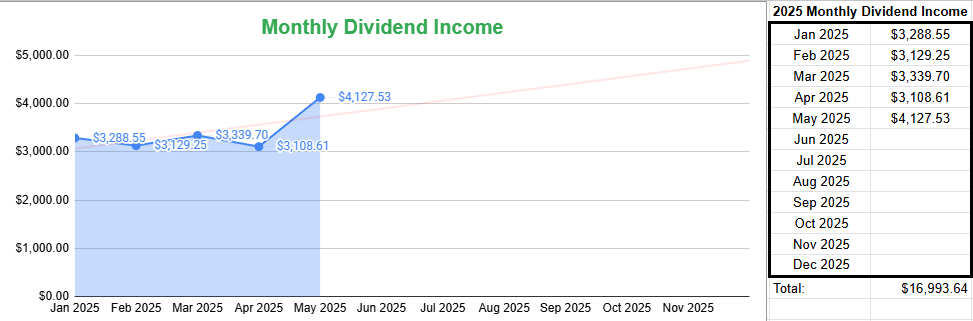
By the way, I share a breakdown of my dividend income every single month.
May 2025 Dividend Report

When I graduated college, my first job paid me about $3,000 a month. I worked full-time, sat in traffic, juggled deadlines, and waited two weeks for each paycheck to hit.
Margin is not dangerous when used with discipline. It can be the bridge between where you are now and the lifestyle you are working toward.
This is how I get paid every single week. And how you can too.

Why wait quarterly when you can build cash flow weekly?
Most dividend investors are trained to think in quarters.
But I prefer a different rhythm. Weekly paychecks from ETFs designed to distribute income every seven days. This approach not only smooths out cash flow, it allows me to reinvest faster, reduce margin costs more efficiently, and maintain flexibility across changing market conditions.
If you're building an income machine, weekly payers deserve a serious look. Now, these weekly payers come with a few tradeoffs that investors need to consider. There are several instances of weekly paying option ETFs deteriorating investor capital. For instance, I’ve spoken about the following funds several times in the past:
YieldMax Universe Fund of Option Income ETFs (YMA) - YMAX 0.00%↑
YieldMax Magnificent 7 Fund of Option Income ETFs (YMAG) - YMAG 0.00%↑
Looking at the price movement of these funds below, we can see that they have deteriorated since inception.
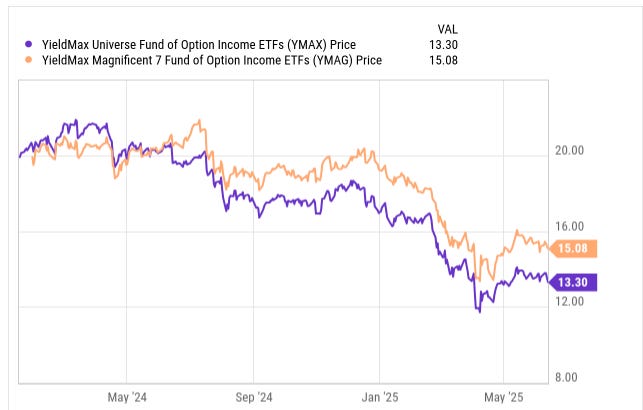
This is why I tend to focus on Index-linked structures.
Why I Focus on Index-Tied and Fund of Funds Structures
Some of the most reliable weekly payers I use are either tied to major indexes or operate as fund of funds. That gives them three key advantages:
Diversification
These funds are not betting on a single stock. Instead, they mirror entire sectors, themes, or indexes. That reduces the risk of one bad earnings report disrupting the entire payout.
Volatility Management
Many of these ETFs use options on broad indexes like the S and P 500, Nasdaq 100, or Russell 2000. That means their strategies are designed to monetize volatility rather than be damaged by it.
Income Resilience
When markets swing, individual stocks might cut or miss dividend payments. These funds generate income through systematic options selling or managed overlays, which can be more consistent and adaptable.
Let’s break down the core index-based weekly payers I use in my portfolio.
I Analyzed 10 Option Income ETFs So You Don’t Have To

The explosion of option income ETFs has created a gold rush for yield-hungry investors. With the promise of monthly payouts, sky high yields, and hands off management, these funds sound like the perfect solution for anyone trying to build passive income.
The Index-Based Weekly Dividend Stack
These ETFs pay weekly and are either:
• Tied directly to major stock indexes
• Diversified across multiple underlying ETFs or themes
• Built to deliver structured, options-generated income
These are the holdings that I utilize to collect weekly income:
