

Why the First $100K is a Nightmare
Charlie Munger famously said that accumulating your first $100,000 is the most difficult thing you will ever do in finance. He warned that you have to do whatever it takes to get there, even if it means walking everywhere and eating nothing but rice and beans.
He was absolutely right.
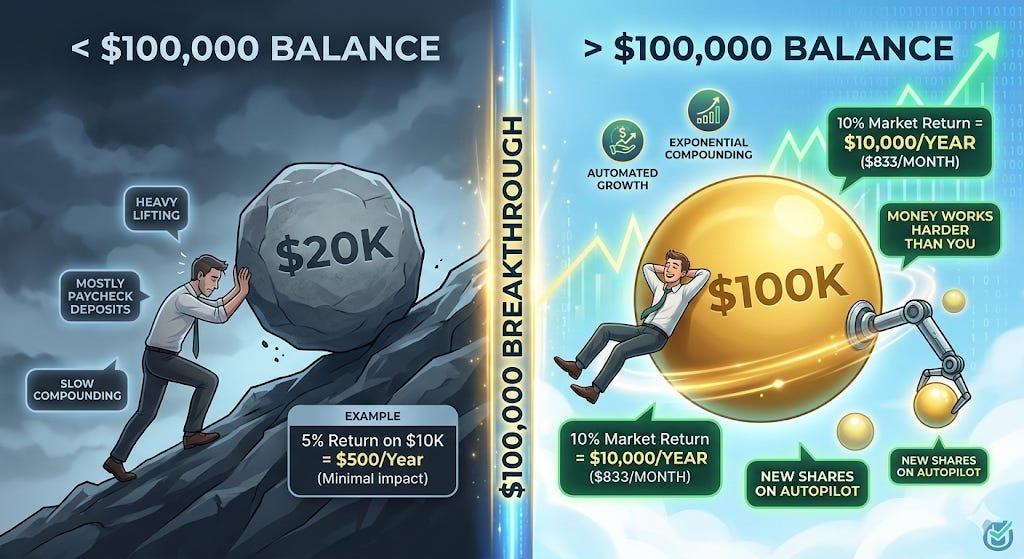
When you are starting from zero, the math feels punishing. You log into your brokerage account, make a $500 deposit, and a 10% annual return only gives you $50. It feels incredibly slow. In this phase, compound interest has not really kicked in yet. Your portfolio growth relies almost entirely on your sheer willpower to save money from your paycheck and inject it into the market.
But once you cross that magical $100,000 threshold, the physics of your wealth completely change.
Suddenly, a standard 10% market return generates $10,000 in a single year. That is almost $833 of organic growth every single month. Your money is finally working harder than you are. If you have that capital deployed in high-quality dividend assets, the cash flow becomes substantial enough to buy whole new shares of stock on autopilot.
Getting to that first $100,000 requires a completely different strategy than managing a $1 million portfolio. You cannot afford to lose your principal chasing yield traps, but you also need enough growth to accelerate the timeline.
Today, I am going to break down the exact three-bucket framework I would use if I had to start over from zero and build my first $100,000 portfolio.
Step 1: Your Savings Rate
Before we talk about ETFs, dividend yields, or covered calls, we have to address the reality of the math.
You cannot invest your way to your first $100,000 with pennies. There is less than a 1% chance that you invest $1,000 into the next Nvidia NVDA 0.00%↑ and it grows to $100K by itself. You will need to do all the heavy lifting.
If you are only investing $50 a month, it will take you decades to reach six figures regardless of what asset you buy. The absolute most important metric in the beginning is your savings rate.
Your primary job is to widen the gap between what you earn and what you spend, and funnel that difference directly into your brokerage account.
If you can manage to invest $1,000 a month and achieve an average historical market return of 8%, you will cross the $100,000 mark in roughly six and a half years. If you can push that investment to $2,000 a month, you cut that timeline down to just over three and a half years.
Step 2: The Balance Between Growth and Dividends
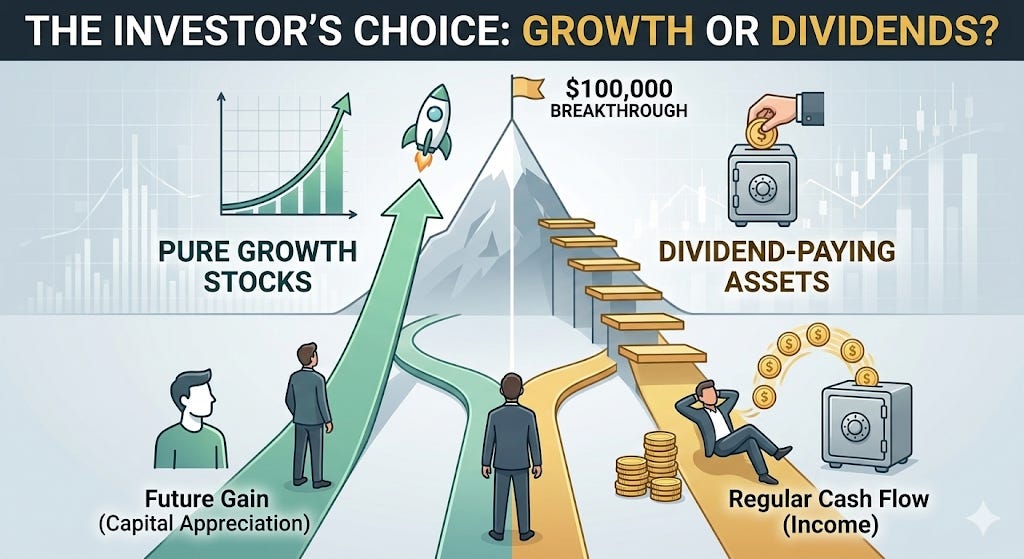
Once you have your savings rate dialed in and you are consistently pushing capital into your brokerage account, you face the biggest debate in investing. Do you buy pure growth stocks, or do you buy dividend-paying assets?
When you are fighting your way to your first $100,000, you are going to hear extreme opinions on both sides.
The growth maximalists will tell you that dividends are mathematically irrelevant. They argue that you should put every single dollar into a broad market index like the S&P 500 or the Nasdaq 100 and just let the share price appreciate over the next thirty years.
The high-yield chasers will tell you the exact opposite. They want you to buy risky 20% yield funds immediately so you can start seeing massive cash flow hit your account on day one.
Both extremes are flawed when your goal is your first $100,000.
If you go 100% into pure growth, the psychological game becomes incredibly difficult. During a brutal bear market when your portfolio drops by 20%, you have absolutely nothing to show for your hard work. There is no cash flow coming in to soften the blow, and it is incredibly easy to panic and sell at the exact wrong time.
But if you go 100% into ultra-high-yield funds right away, you risk destroying your core capital. As we discussed with single-stock option funds, many of these vehicles suffer from severe Net Asset Value (NAV) erosion. You might get a massive dividend payment, but your underlying investment bleeds out.
The Hybrid Approach: Getting Paid to Wait
The fastest and safest way to your first $100,000 is a hybrid approach. You need the aggressive capital appreciation of the broader market, but you also need the psychological anchor and tangible cash flow of reliable dividends.
You want to build a portfolio that naturally appreciates in value while simultaneously paying you cash to hold it.
This hybrid strategy creates a snowball effect. The growth portion of your portfolio does the heavy lifting of pushing your net worth toward that six-figure mark. Meanwhile, the dividend portion generates real cash that you can immediately reinvest to buy even more shares of your growth assets.
It is a self-funding loop. Your portfolio starts buying itself.
Dividend Investing for Beginners: How to Get the Snowball Rolling

With a bunch of new subscribers joining recently, I figured it would be great to take it back to the basics. The US government is on shut down, market indexes are trading near all time highs, and interest rates are starting to get cut. So what can you do to start building your dividends and how should you invest?
Step 3: Building the Core Foundation (The Assets)
To execute this hybrid strategy safely, you do not need a portfolio of fifty random stocks. Overcomplicating your investments is one of the easiest ways to derail your progress and lose track of your goals.
You really only need two core pillars to build your first $100,000.
Pillar 1: The Growth Engine
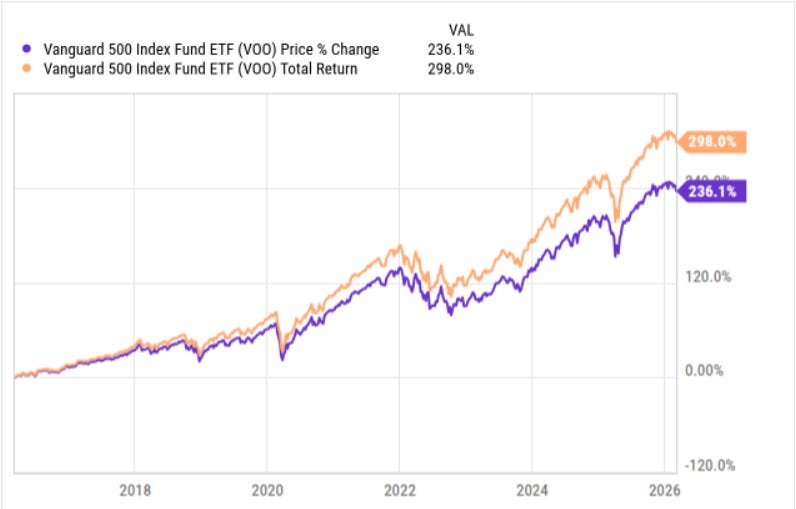
Your first bucket is pure market growth. For this, you want a low-cost S&P 500 index fund like the Vanguard S&P 500 ETF VOO 0.00%↑. This asset gives you immediate exposure to the 500 largest and most profitable companies in the United States.
This is the heavy lifter for your capital appreciation. When massive tech companies go on historic runs, VOO captures that upside. It pays a very small dividend, but its primary job is to aggressively push your total account balance higher over time.
Putting money into VOO for the last decade would’ve tripled your money while providing exposure to 500 of the largest U.S. companies in the world.
However, VOO is just one of the many growth engines that you can utilize. I created a separate beginners ETF guide that is available to free subscribers.
👉 Free Subscribers get access to a Beginners ETF dashboard
👉 Free Subscribers get access to a list of 50+ monthly paying dividend stocks.
👉 Free Subscribers get access to a list of companies that consistently raise dividends.
Get a shortcut on your investing journey with this starter guide. You can get the dividend starter bundle so that you can skip the mistakes that I made on my way to $40,000 a year in passive dividend income.
👉 Here is what’s included:
✅ The Dividend Blueprint (ebook)
A step-by-step guide showing how I structure my portfolio, grow monthly cash flow, and reinvest for long-term income.✅ Monthly Dividend Map
50+ hand-picked tickers that pay monthly so you can ladder your income all year long.✅ Dividend Tracker (Google Sheet)
The exact spreadsheet I use to track yield, forward income, reinvestment, and portfolio growth.✅ Dividend Growth Legends: 50+ Stocks
50 stocks that have an established history of dividend increases.✅ List of ETFs for Beginners To Start With
Pillar 2: The Dividend Growth Engine
Your second bucket is where the cash flow strategy begins.
👉 Upgrade To A Paid Membership For The Following Perks!
Instant access to the Yieldly Dashboard to optimize your monthly dividend income.
Priority alerts for buys and sells.
Covered Call Option ETF Database (dividend yields above 15%).
In-Depth Research & Reports on dividend funds and growth stocks.
Access to monthly dividend reports and portfolio reveals.
