


I’ll never forget the first time a friend told me about their life as a landlord. The late-night phone calls about broken toilets, the tenants who stopped paying rent, and the surprise repairs that erased months of profit made it sound more like a second job than a path to financial freedom. On paper, owning rentals looks like the perfect way to build wealth. In practice, it often comes with headaches that few people talk about.
Don’t get me wrong, rental properties have obviously worked for millions of people throughout history. I just want to shed light on the alternatives that we have available. We can become landlords without actually owning a property.
If you’re serious about building steady, predictable cash flow from dividends, this guide is the best place to start.
I’ve put together a curated, research-backed list of WEEKLY & MONTHLY paying option ETFs, designed to help you create reliable income every single month:
✅ ETFs that actually pay WEEKLY and monthly, not quarterly
✅ Estimated yields commonly above 30%. Dividend yields can be as high as 100%.
✅ My top picks for consistent income engines
✅ Includes newer, high-yield option income funds from the YieldMax suite, Roundhill, NEOS, Kurv, and Goldman Sachs

Real estate investment trusts, or REITs, give investors access to the same powerful income streams without the stress of being a landlord. These companies own and manage portfolios of apartments, office buildings, and other properties, then return the cash flow to shareholders in the form of dividends. Instead of fixing leaky roofs, you receive distributions. Instead of chasing down tenants, the income shows up directly in your brokerage account. And instead of needing six figures to get started, you can begin with only a few hundred dollars.
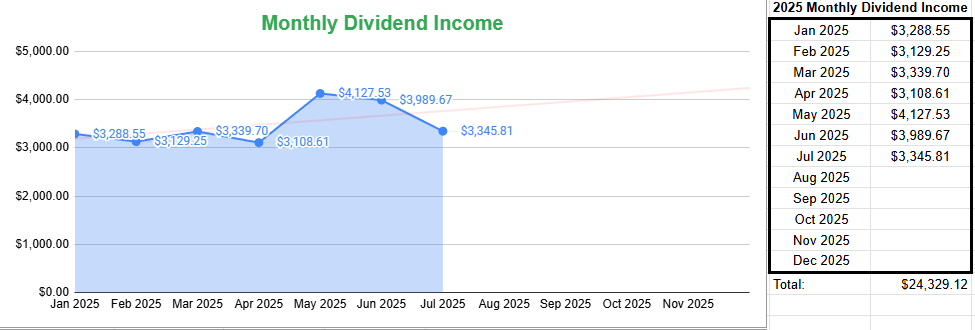
I collect an average monthly dividend income of $3,500. A portion of this income comes from REITs. Think about it… how many properties would you need to own to be able to collect $3,500 in passive income every month?
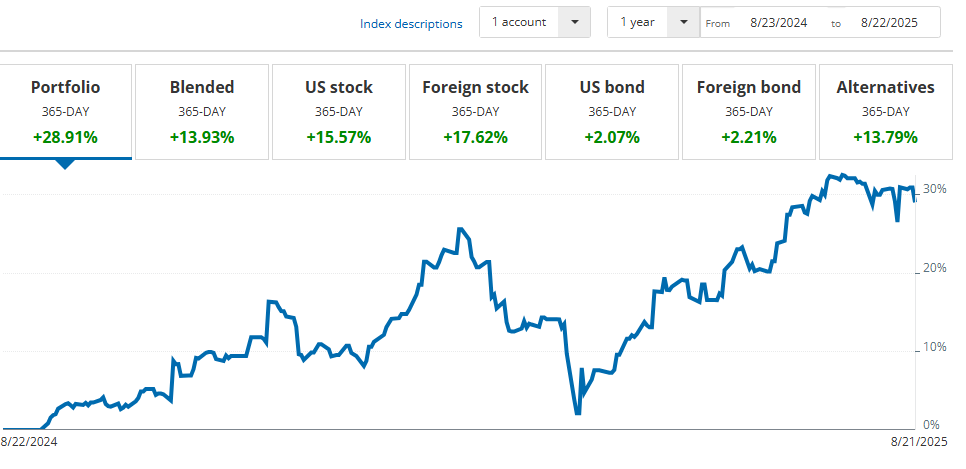
By focusing on income generation within my portfolio, I’ve been able to implement a dividend wheel strategy. This has led to outperformance against the US Stock market over the last twelve months.
My Portfolio: 28.90%
US Stock Market: 15.57%
Why REITs Often Outperform Direct Rental Investments
Most investors are drawn to real estate for its promise of steady income and appreciation. But the reality of being a landlord with maintenance, vacancies, legal hassles, and capital demands often dampens that appeal. This is where REITs shine because they offer an effortless way to collect rental income with far fewer headaches.
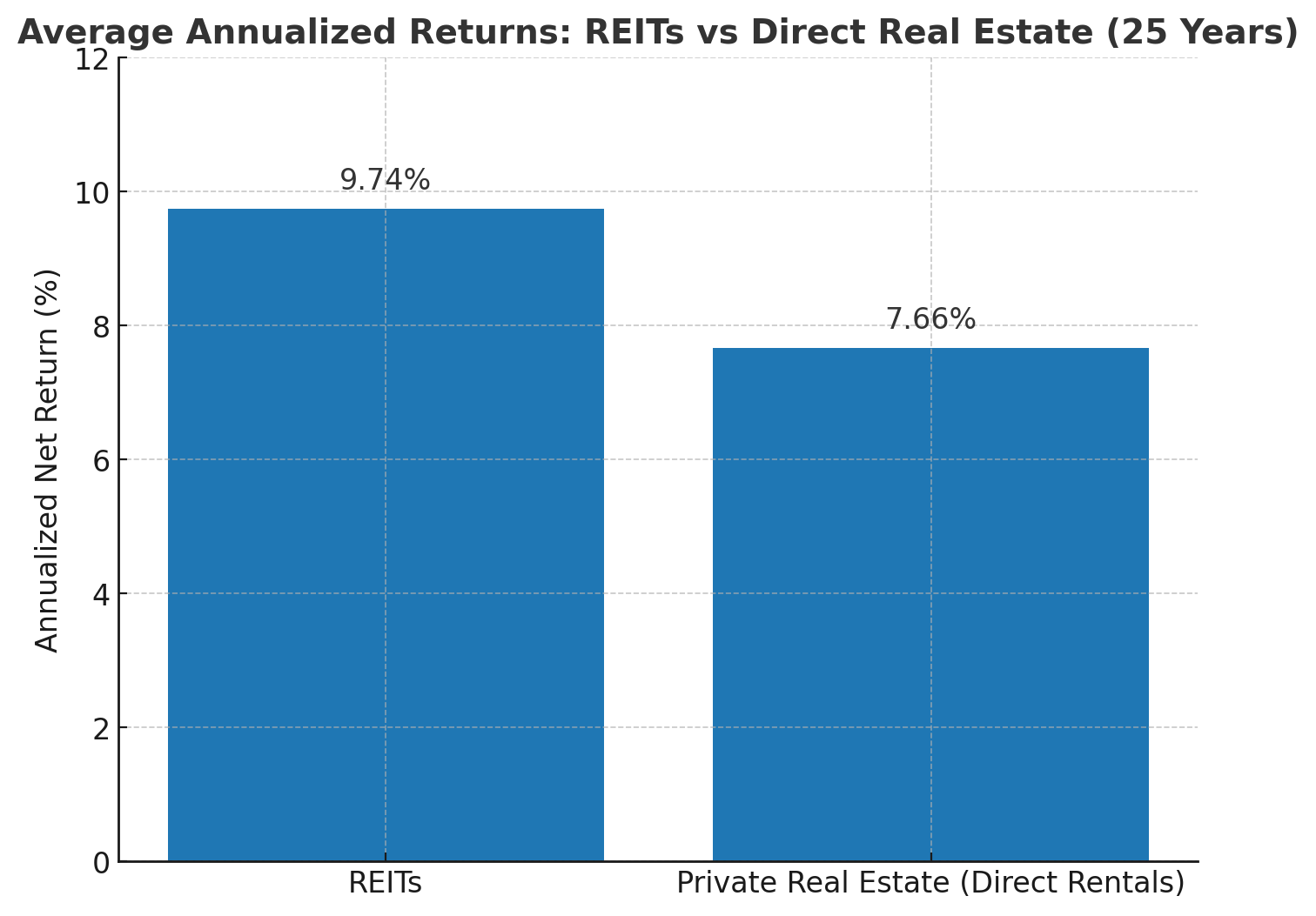
Even more compelling is the data. According to a comprehensive benchmarking study, listed equity REITs delivered an average annual net return of 9.74% over a 25 year period, outpacing private real estate’s 7.66% by more than 200 basis points (reit.com).
It is not just private real estate funds. REITs have consistently outperformed the broader market over long horizons. One data series shows that REITs surpassed U.S. stock market returns more than 56% of the time over rolling periods of increasing duration. Notably, when holding periods extend beyond 19 years, REITs outperformed stocks in every single month of those spans (reit.com).
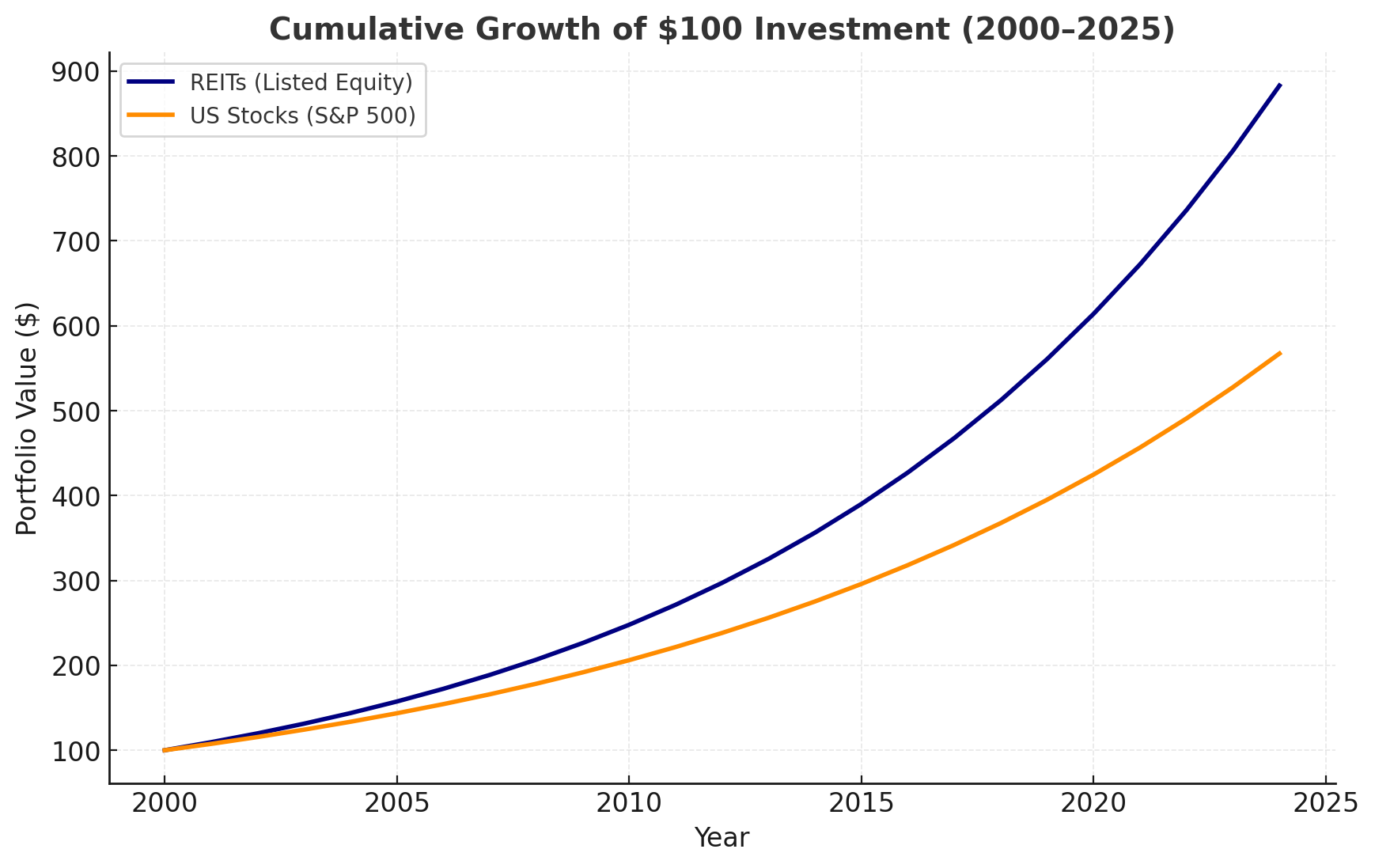
In short, REITs offer the combined benefits of rental income and capital appreciation with liquidity, diversification, and financial discipline that most private rentals simply cannot match.
Dividend Income Advantage
he headaches of being a landlord. A physical rental may look attractive on paper, but cash flow can easily be eaten away by repairs, vacancies, and rising property taxes. A REIT solves this by pooling together high quality real estate and passing most of the rental income directly to shareholders in the form of dividends.
Take Alpine Income Property Trust (PINE) as an example. This REIT owns a portfolio of single tenant retail and commercial properties across the U.S. and currently offers investors a 7.6% dividend yield. That means a $100,000 investment in PINE could generate about $7,600 in annual income, nearly triple what you would get from a typical S&P 500 index fund.
Another example is BXP, Inc. (BXP), which focuses on high end office properties in major cities like Boston, New York, and San Francisco. Despite the challenges in the office sector, BXP still pays a 5.9% dividend yield, translating into $5,900 of income on the same $100,000 investment.
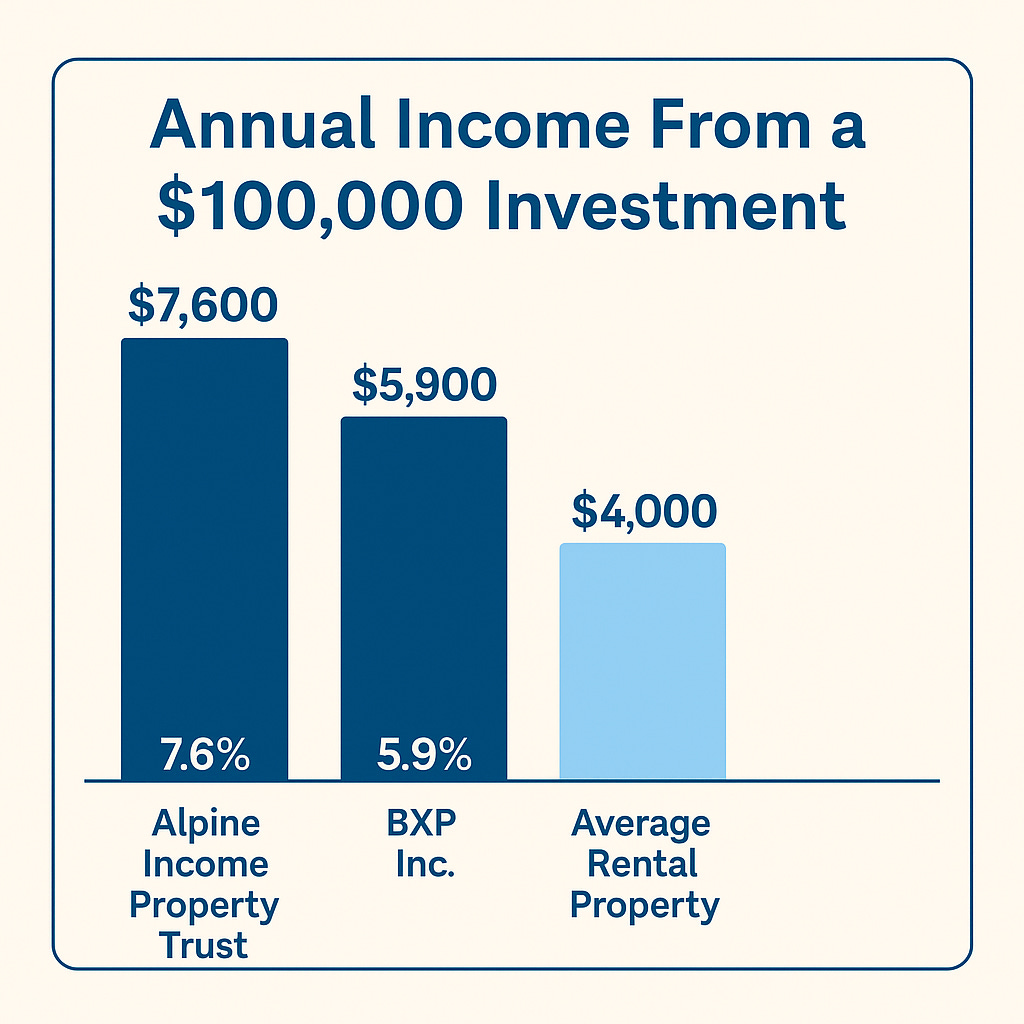
Here’s a visual comparison of the annual income from a $100,000 investment:
PINE (7.6%): $7,600
BXP (5.9%): $5,900
Average Rental Property (~4%): $4,000
This makes it easy to see how REITs can generate more income than owning a typical rental property and without the headaches of being a landlord.
When you stack these yields against direct property ownership, the comparison is striking. Instead of managing tenants and unexpected costs, investors in PINE or BXP simply sit back and collect dividends. And because both of these REITs trade on the stock market, you also have the flexibility to buy or sell at will, which is something you will never get with a physical rental property.
This is why I recently initiated a position in a brand new REIT. You can check out that article below.
America’s Housing Problem Could Be Your Dividend Advantage

I have always been fascinated by the idea of collecting real estate income through the stock market. Real Estate Investment Trusts, or REITs, allow investors to gain exposure to portfolios of properties without ever buying a building or managing a single tenant. Instead of dealing with the headaches of being a landlord, you can sit back and collect steady rent checks while waiting for market conditions to improve.
I also use the dividends received from these REITs to fuel growth positions. Some companies that I believe are undervalued right now, are the following:
Amazon - AMZN 0.00%↑
ASML Holdings - ASML 0.00%↑
Alphabet - GOOG 0.00%↑
Equifax - EFX 0.00%↑
Duolingo - DUOL 0.00%↑
SharkNinja - SN 0.00%↑
However, REITs come with some risks that investors should be aware of. These risks may not be the same for physical properties.
👉 Upgrade to a paid subscription to unlock the full article and get access to all of my high-yield income picks. There is an exclusive Seeking Alpha analysis at the bottom of this article.
If you are ready to take these principles and build a real plan for your finances, I have two ways to help.
My Book — The Dividend Income Blueprint
This is my step-by-step guide for building a portfolio that pays you consistent monthly income for the rest of your life. It walks you through exactly how to find, buy, and manage income-producing assets so you can create financial freedom without gambling or guessing. Want to get a well-rounded idea of where to start your investing journey? I have you covered here as well!
One-on-One Consulting
If you want personal guidance tailored to your situation, I offer private consulting sessions where we map out your income goals, investment strategy, and the exact steps you can take right now to start building wealth.

Risks and Considerations
While REITs can provide an easier path to income than managing a physical property, they are not without their challenges. One of the biggest risks is sensitivity to interest rates. Because REITs are highly dependent on borrowing to fund acquisitions and renovations, higher interest rates directly increase their costs. Elevated rates also put pressure on valuations, which can result in share price weakness even when the underlying properties continue to generate steady rental income.
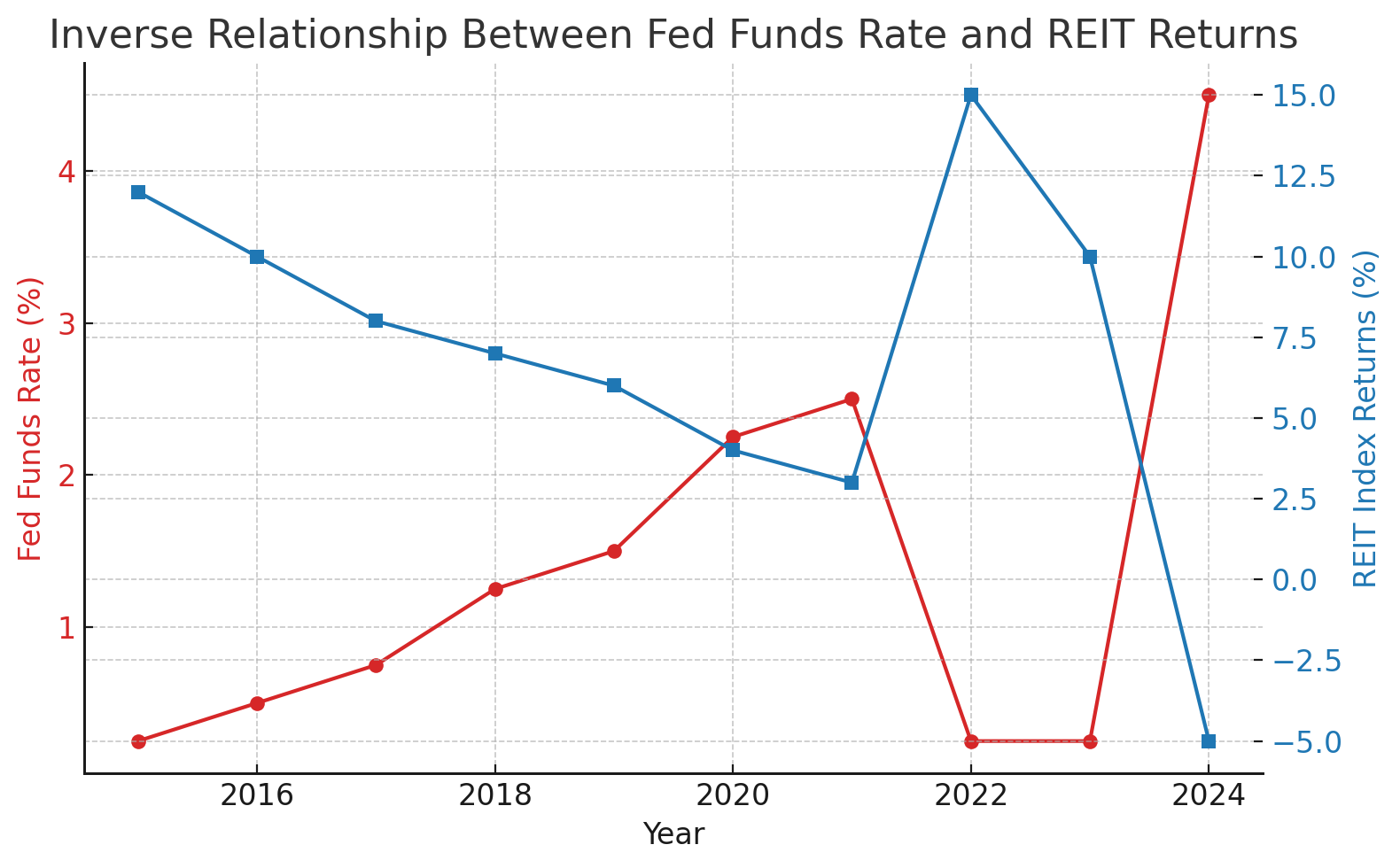
The good news is that future interest rate cuts serve as a catalyst for growth. Therefore, NOW is the appropriate time to continue accumulating.

The chart above illustrates the inverse relationship between interest rates and REIT returns. In years when the Fed kept rates near zero, REITs thrived, generating strong double-digit returns as capital was cheap and plentiful. Conversely, during periods of rising rates, performance often weakened as higher financing costs and investor preference for safer bonds pulled capital away from real estate.
This dynamic helps explain why REITs struggled in 2022 and 2023 while interest rates surged to multi-decade highs. Yet, just as quickly as higher rates can pressure REITs, a shift toward lower rates can ignite recovery. When capital becomes cheaper again, REITs regain their edge, offering not just stable dividends but the potential for meaningful capital appreciation.
Another factor to consider is market cycles. Unlike a personal rental property, which may remain relatively insulated from daily price swings, REITs trade on the open market. This means their value can move sharply during periods of market volatility, even if the fundamentals remain intact. Patient investors who focus on dividends rather than short term pricing will be better suited to handle these fluctuations.
Sector-specific exposure also plays a role. For instance, Alpine Income Property Trust (PINE) is concentrated in retail properties. While this can deliver strong income today, the long term risks tied to e-commerce adoption and changing consumer habits must be acknowledged. Similarly, BXP Inc. is heavily tied to office properties. The persistence of remote and hybrid work has made office demand less predictable, and while BXP owns high quality trophy assets, it is still exposed to industry headwinds that could weigh on growth.
Lastly, investors should always assess dividend sustainability. While PINE and BXP both provide attractive starting yields, the true measure of strength is whether earnings can comfortably cover those payouts. This is why analyzing funds from operations is more important than simply looking at the headline yield. A high dividend is only appealing if it can be maintained through different market environments.
As a reward for paid subscribers. Here is a Seeking Alpha analysis I recently published on Independence Realty Trust IRT 0.00%↑. Seeking Alpha typically requires a paid membership at > $200 per year, but you can access the article for much cheaper here. I will continue to provide access to these exclusive articles as much as possible.

Thank you for reading!
This is a great post! The reality is that REITs provide an opportunity to invest in a variety of properties. This would be hard to do if you were buying physical real estate. The cool thing about investing in REITs is that you can earn dividends within a week of investing.
If you’re thinking about rental income as a passive income, this is another way of looking at it. More profit, less stress!