

If you are looking for the best high-yield energy stocks to buy during the Iran crisis, you need to look at infrastructure. Brent crude prices exploded this morning. This follows U.S. and Israeli strikes on Iran over the weekend. Analysts now forecast $100 oil as the Strait of Hormuz faces a 10 million barrel per day supply cliff. This is the world’s most critical energy chokepoint.
On a YTD basis, Brent futures are up nearly 20%.
Brent crude futures are standardized financial contracts where buyers and sellers agree to trade a specific amount of oil at a set price on a future date. These contracts serve as the primary global benchmark for oil prices and allow investors to hedge against or profit from price swings without taking physical delivery of the barrels.
This is not just a price spike. It is a fundamental threat to the global energy chain. While the broader market fears inflation, savvy investors are pivoting to the “toll booths” of the energy sector. These infrastructure giants collect fees regardless of geopolitical chaos.
This video provides a deep dive into how a blockade of this critical waterway could immediately disrupt 20% of the world’s oil and gas shipments.
Global energy shifts of this scale are often telegraphed well in advance. For the prepared investor, these acts of conflict create specific, predictable windows of opportunity.
While the general public panics over rising gas prices, the capital flows into the infrastructure that manages the crisis. There’s always something to worry about. By identifying the exact chokepoints and the companies that control them, you can turn a global threat into a strategic portfolio move. It is about understanding that in a world of planned chaos, the “toll collectors” always win. Holding high quality companies like these allowed me to collect $2,435 in dividends in February.
👉 Stocks #3 & #4 have crushed the S&P 500 over the last five years and I believe outperformance may continue in the near-term.
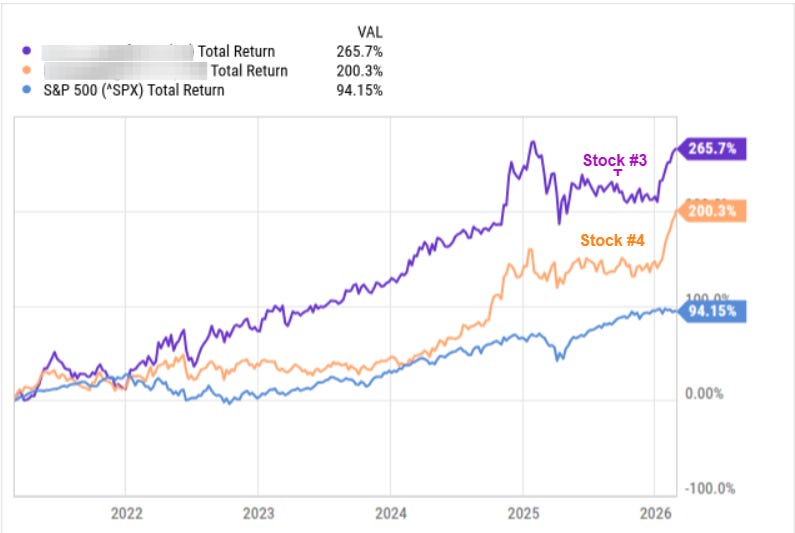
Here are 5 high-yield stocks that can make you money from the conflict.
1. Enterprise Products Partners (EPD): The High-Yield Export Leader
EPD 0.00%↑ is the backbone of the American energy export machine. If you want to profit from global supply disruptions, this is the company that controls the physical exit ramps for U.S. oil and gas.
Sector: Energy Midstream
Current Dividend Yield: 6.1%
Dividend Streak: 27 consecutive years of distribution growth
Credit Rating: A- (The highest in the midstream sector)
EPD does not bet on the price of oil. Instead, they operate a 50,000 mile network of pipelines, storage, and deepwater docks. They charge fees based on the volume of product moving through their system. This fee-based model means they generate massive cash flow even when commodity prices are volatile. As global conflict pushes the world to seek non-Middle Eastern supply, EPD’s Gulf Coast export terminals become the most valuable real estate in the energy world.
As an added bonus, EPD has a history of outperforming the S&P 500 over the last five years.
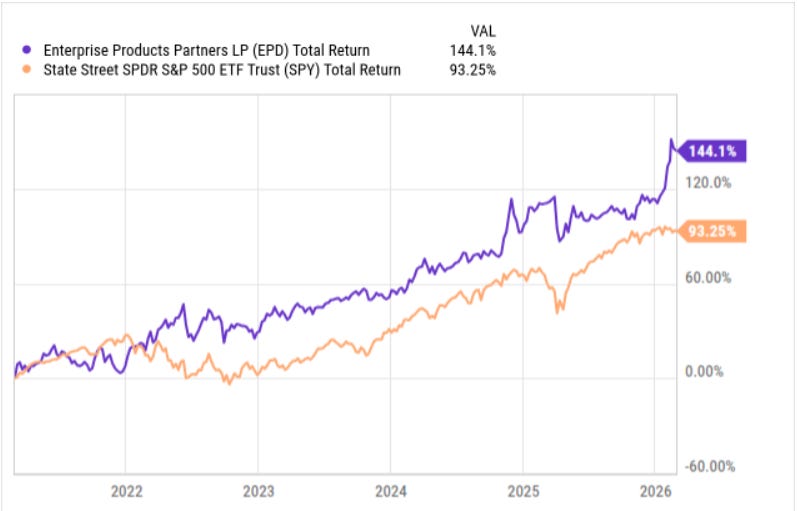
Why It Wins in the Iran Crisis: When the Strait of Hormuz is threatened, the world looks to the U.S. to fill the gap. EPD owns 20 deepwater docks and is one of the only companies capable of loading VLCCs (Very Large Crude Carriers) for global export. They are the primary beneficiary of a shift toward American energy dominance.
The Risks to Consider
Interest Rates: As a capital-intensive business, sustained high interest rates can increase the cost of debt for new projects.
Volume Dependency: While they don’t care about price, they do care about production. If U.S. drilling slows down significantly, it could impact their throughput.
I currently hold a small position in EPD because it pays out tax-efficient income. However, you should be warned that EPD produces a K-1 form, which can be a headache during tax time.
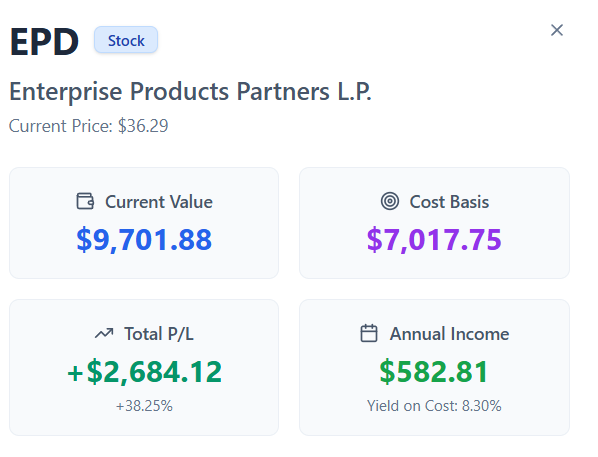
👉 Unlock Access To Yieldly By Upgrading Your Membership. Yieldly allows you to track your monthly dividend income.
2. Enbridge (ENB): A Safe-Haven Dividend Aristocrat
Enbridge ENB 0.00%↑ is the safe-haven giant of North American energy. While other companies chase the latest drill site, Enbridge owns the indispensable network that connects Canadian supply to U.S. demand.
Sector: Energy Infrastructure / Utilities
Current Dividend Yield: 5.3%
Dividend Streak: 31 consecutive years of increases
Enbridge operates a massive, diversified system. They move 30% of all crude oil produced in North America and 20% of the natural gas consumed in the United States. Their business is incredibly resilient because 98% of their EBITDA comes from low-risk, take-or-pay contracts. This means they get paid to have the capacity available, regardless of whether the oil price is at $40 or $100. It is effectively a utility business masquerading as an energy stock.
Earn Monthly Income from utilities that keep the world running.
Enbridge provides geographical security. As the Middle East becomes a “no-go” zone for tankers, the stability of the Western Canadian Sedimentary Basin (WCSB) becomes paramount. Enbridge’s Mainline system is the primary artery for this secure, land-locked oil. Furthermore, their recent $39 billion backlog of sanctioned projects includes massive natural gas storage expansions on the Gulf Coast. This makes them a key player as the world panics for non-Middle Eastern LNG.
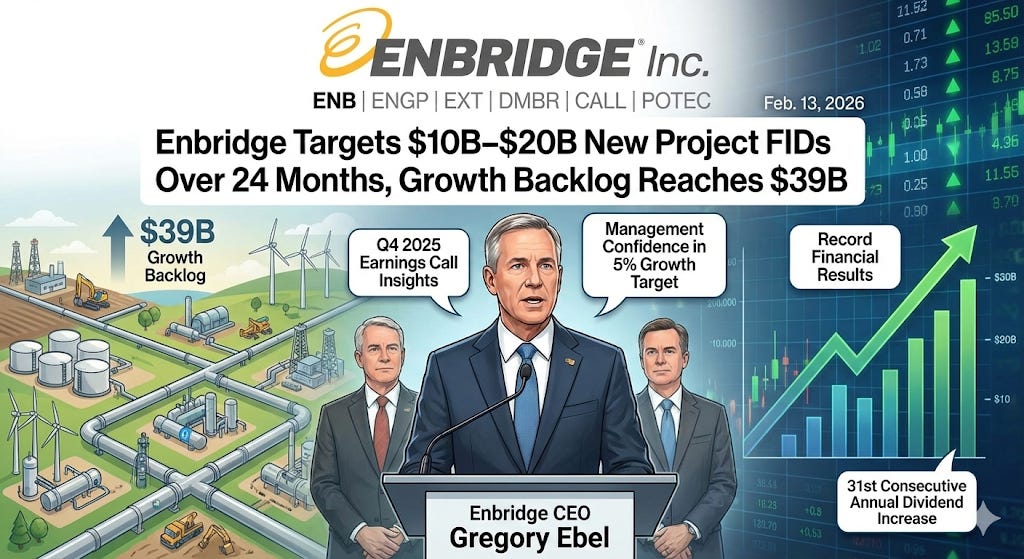
Management reaffirmed its confidence in the future, projecting 2026 EBITDA between $20.2 billion and $20.8 billion, supported by a massive $39 billion secured growth backlog that now extends through 2033. With plans to sanction an additional $10 billion to $20 billion in new projects over the next 24 months, including strategic expansions in gas transmission and renewables—Enbridge remains firmly positioned to achieve its target of 5% annual growth through the end of the decade.
The Risks to Consider
Debt Levels: Enbridge carries a significant amount of debt to fund its massive infrastructure. While well-managed, it makes them sensitive to credit market tightening.
Environmental/Legal Opposition: Their pipelines, particularly Line 5, often face intense legal challenges from environmental groups and state governments.
👉 Consider Upgrading To A Paid Membership For The Following Perks!
Instant access to the Yieldly Dashboard to optimize your monthly dividend income.
Priority alerts for buys and sells.
Covered Call Option ETF Database (dividend yields above 15%).
In-Depth Research & Reports on dividend funds and growth stocks.
Access to monthly dividend reports and portfolio reveals.
3. Energy Transfer (ET): Aggressive Growth in Natural Gas
If Enterprise Products is the “toll booth,” Energy Transfer ET 0.00%↑ is the “aggregator.” While EPD focuses on high-quality, steady exports, ET is built for sheer dominance and aggressive growth.
Sector: Energy Midstream
Current Yield: 7.15%
Distribution Growth Target: 3% to 5% annually
2026 EBITDA Guidance: $17.45 billion to $17.85 billion (Recently raised)
ET owns one of the largest and most diversified energy portfolios in the United States, spanning 140,000 miles of pipeline across 44 states. They handle approximately 25% of all U.S. natural gas. Unlike many peers, ET is vertically integrated from the wellhead to the export terminal. They don’t just move gas; they gather, process, fractionate, and store it. This scale allows them to capture margins at every single stage of the value chain.
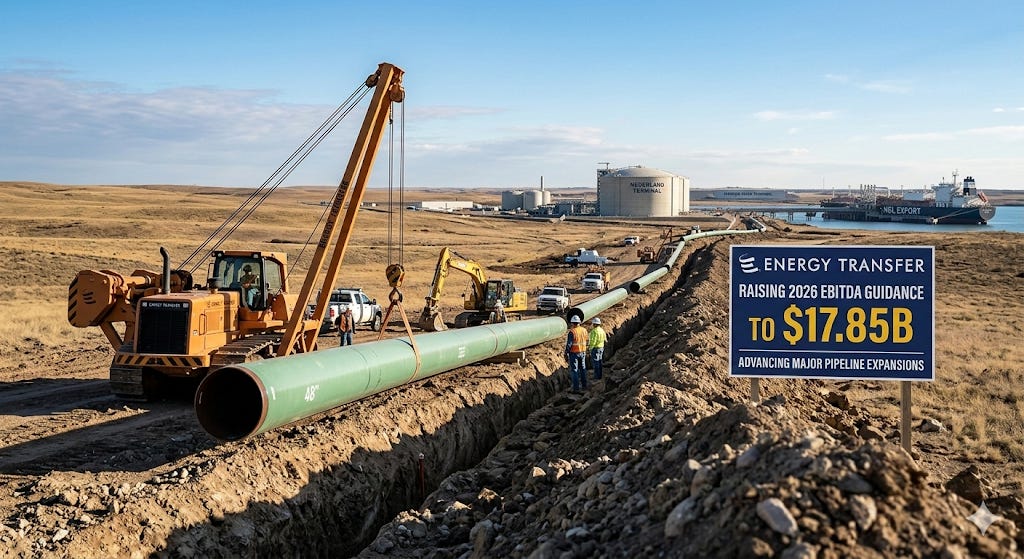
Energy Transfer has raised its 2026 adjusted EBITDA guidance to a range of $17.45 billion to $17.85 billion, following a record-breaking 2025 and the successful acquisition of J-W Power Company. The company is aggressively advancing major infrastructure projects, including the upsized 48-inch Desert Southwest Pipeline and the Hugh Brinson pipeline, to meet rising demand from data centers and power plants. With record export volumes at its Nederland and Marcus Hook terminals and a robust backlog of organic growth opportunities, management expressed high confidence in maintaining long-term distribution growth and operational momentum through 2026 and beyond.
In early 2026, ET significantly accelerated their NGL export expansions at the Nederland and Marcus Hook terminals. Furthermore, they are pivotally linked to the tech sector; they recently signed long-term agreements with Oracle to supply natural gas to massive data center facilities. ET is where the “old world” energy crisis meets the “new world” AI infrastructure demand.
The Risks to Consider
High Leverage: ET historically carries more debt than EPD. Their debt-to-equity ratio sits around 1.85, which can be a concern if credit markets tighten or if interest rates remain elevated.
Execution Risk: Management is currently leaning into a massive $5 billion to $5.5 billion growth capital program for 2026. Any delays or cost overruns on major projects like the Hugh Brinson Pipeline could squeeze their distribution coverage.
Complexity: ET operates through a complex web of subsidiaries and affiliated MLPs (like Sunoco and USA Compression). This can make their consolidated financial statements harder to parse than more “pure-play” competitors.
4. Kinder Morgan (KMI): The LNG Infrastructure King
Kinder Morgan KMI 0.00%↑ is the refined, natural gas specialist. They operate the largest natural gas network in North America, acting as the primary artery for the continent’s transition toward LNG and AI power.
Sector: Energy Infrastructure (C-Corp)
Expected 2026 Yield: ~3.6%
Dividend Status: 9th consecutive year of increases
Credit Rating: Upgraded to BBB+ by S&P and Fitch (Jan 2026)
Kinder Morgan operates approximately 79,000 miles of pipelines. They transport roughly 40% of all natural gas consumed in the United States. Unlike some peers, they are a pure-play C-Corporation, meaning you don’t have to deal with K-1 tax forms. Their revenue is remarkably stable because 95% of their earnings are supported by long-term, regulated contracts or take-or-pay agreements.
Why It Wins in the Iran Crisis: KMI is the “LNG King.” They currently move about 40% of all feed gas to U.S. LNG export terminals. As the Middle East conflict threatens global gas supplies, Europe and Asia are desperate for secure American LNG. KMI’s massive $10 billion project backlog is heavily weighted toward expanding this export capacity. They aren’t just a pipeline company; they are a structural play on the world’s desperate need for secure, non-Middle Eastern energy.
The Risks to Consider
Capital Intensity: KMI is planning to spend $3.3 billion on expansion projects in 2026 alone. This high level of spending requires flawless execution to ensure the expected 5.6x EBITDA multiples are realized.
Interest Rate Sensitivity: With over $30 billion in long-term debt, any sustained “higher for longer” interest rate environment will eat into their margins as they refinance older notes.
5. NextEra Energy (NEE): The Renewable Energy Hedge
NextEra Energy NEE 0.00%↑ is the world’s largest renewable energy company. While the other four picks capitalize on the movement of oil and gas, NextEra is the ultimate hedge against an era of expensive, volatile fossil fuels.
Sector: Utilities / Renewable Energy
Current Yield: 2.7%
Dividend Growth: 10% increase announced Feb 2026 ($0.6232 per share)
Business Model: The Clean Energy Monopoly NextEra operates two distinct businesses. First is Florida Power & Light (FPL), the largest rate-regulated electric utility in the U.S., providing a rock-solid foundation of cash flow. Second is NextEra Energy Resources, the global leader in wind, solar, and battery storage. They don’t just build projects; they sign long-term, 20-plus year contracts with corporate giants like Google and Microsoft to provide clean power. In Feb 2026, they reached a massive 30 GW backlog of projects.
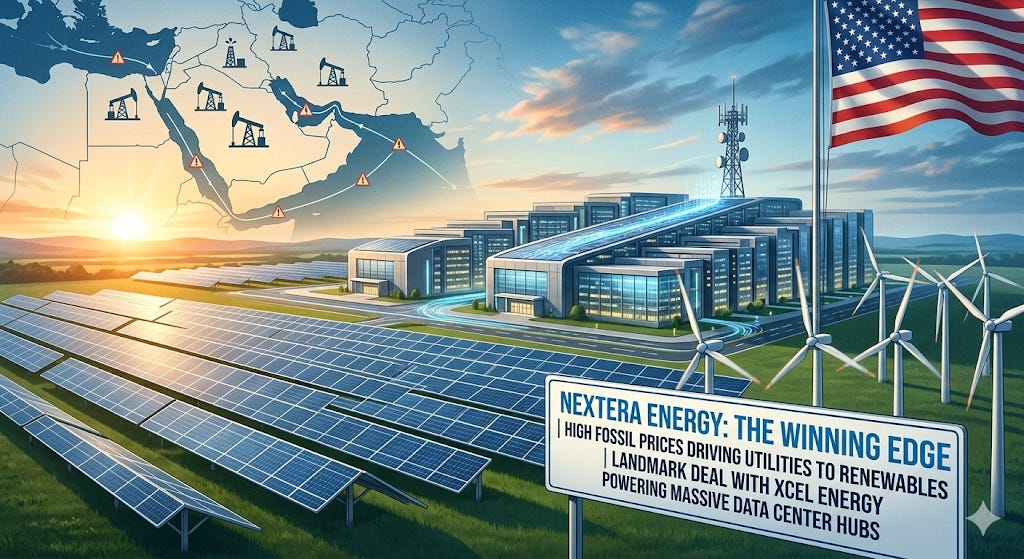
Why It Wins in the Iran Crisis: Every time oil spikes toward $100, the “energy security” argument shifts in favor of renewables. High fossil fuel prices make the economics of NextEra’s solar and wind farms even more attractive to utility customers and data centers. As Middle Eastern supply chains become risky, domestic, sun-and-wind-powered electricity becomes the safest bet for the American economy. NextEra is also pivoting to the AI boom, recently signing a landmark deal with Xcel Energy to power massive data center hubs.
The Risks to Consider
Interest Rate Pressure: NextEra uses significant debt to fund its massive $85 billion to $95 billion capital expenditure plan through 2027. If interest rates stay “higher for longer,” it can squeeze their margins.
Valuation: As a market leader, NEE often trades at a premium P/E ratio compared to traditional utilities. Any earnings miss, like the slight miss in Q4 2025, can cause short-term price volatility.
The Bottom Line: Pay the Toll or Collect It
The escalation in the Middle East is not a temporary headline. It is a fundamental rewiring of the global energy map. When 10 million barrels of daily supply are at risk, sitting in cash or broad index funds is a losing strategy. The smart money is already moving into the physical infrastructure assets that keep the world running regardless of geopolitical chaos. EPD, ENB, ET, KMI, and NEE offer the exact combination of high yield and impenetrable moats needed to survive a $100 oil environment. The crisis is already here and the capital is shifting. Your only choice as an investor is whether you are going to pay the toll or collect it.
Disclaimer: This analysis is for informational purposes only and does not constitute financial advice. Please do your own due diligence before making any investment decisions.