

Let’s do some quick math. If you take $10,000 and park it in a standard S&P 500 index SPY 0.00%↑ fund, you might collect about $130 a year in dividends. That barely covers a single utility bill.
Now, imagine taking that same $10,000 and generating roughly $3,900 a year in pure cash flow. That is over $325 hitting your brokerage account every single month. It completely changes the way you look at your portfolio because your investments are suddenly paying for your actual life.
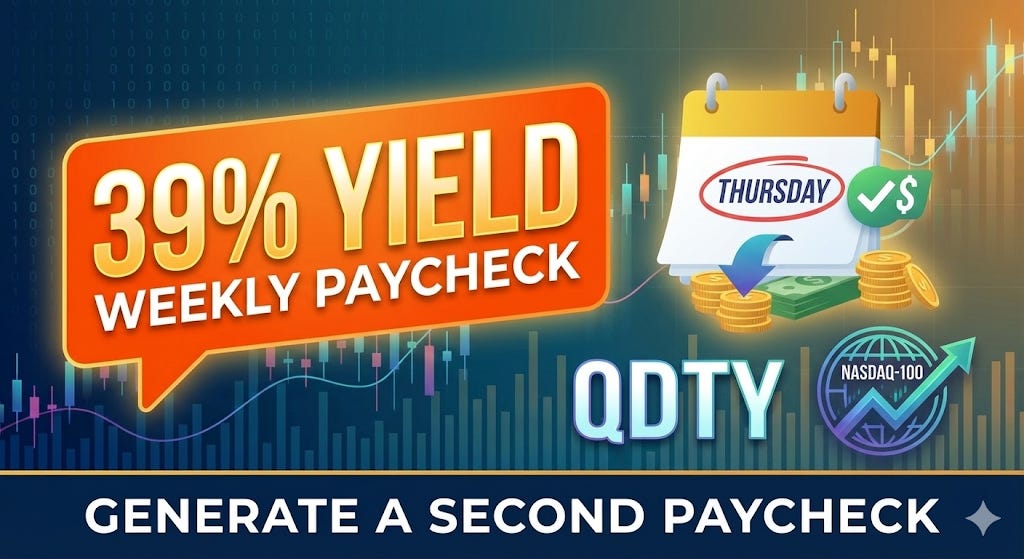
That is the mathematical reality of a 39% dividend yield. And right now, the YieldMax Nasdaq-100 Option Income Strategy ETF QDTY 0.00%↑ is sitting right at that exact mark. QDTY pays out a weekly dividend so that income is hitting your account every Thursday.

I know exactly what you are thinking. A yield that high is a massive red flag. You probably assume it is a gimmick and the fund is just going to bleed your initial investment to zero. If we were discussing a traditional single-stock covered call fund, I would agree with you completely. Those vehicles are notoriously flawed and famous for destroying your Net Asset Value (NAV).
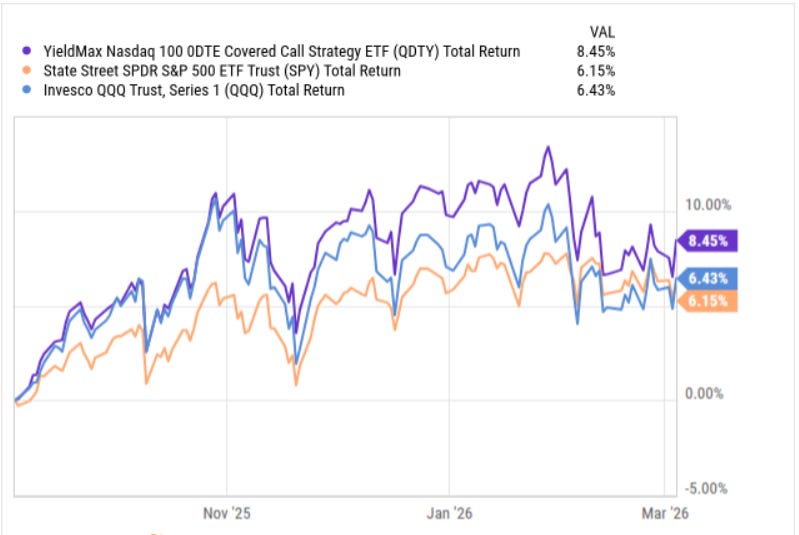
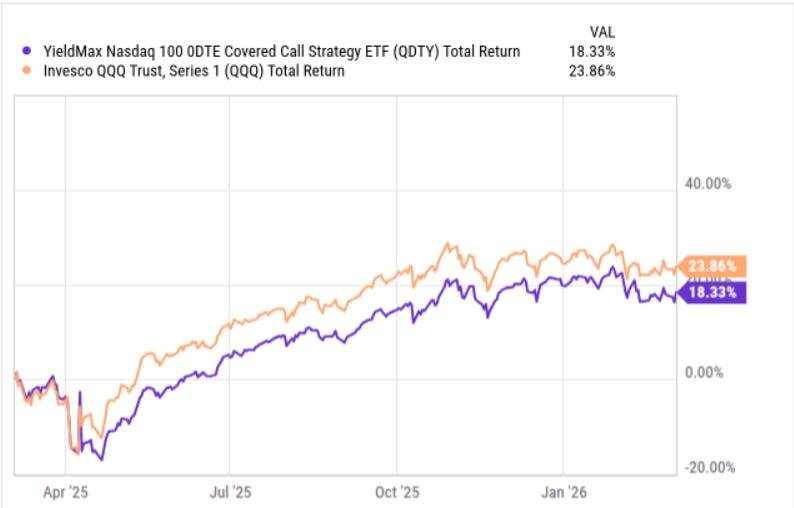
Funny enough, QDTY has outperformed the S&P 500 and the Nasdaq-100 over the last six months when including all dividends paid.
Today, I am going to show you exactly why I bought more of this, why it resists the structural decay that crushes most high-yield chasers, and how a Nasdaq-linked approach is the ultimate tool for funding a broader growth strategy.
I am now estimated to collect over $42K in dividends for 2026. I release dividend reports every month for subscribers.
This article will cover the following:
Problem that QDTY solves
Risks
Performance Insights & Outlook
Tax-Efficiency
Funding the Growth Pivot
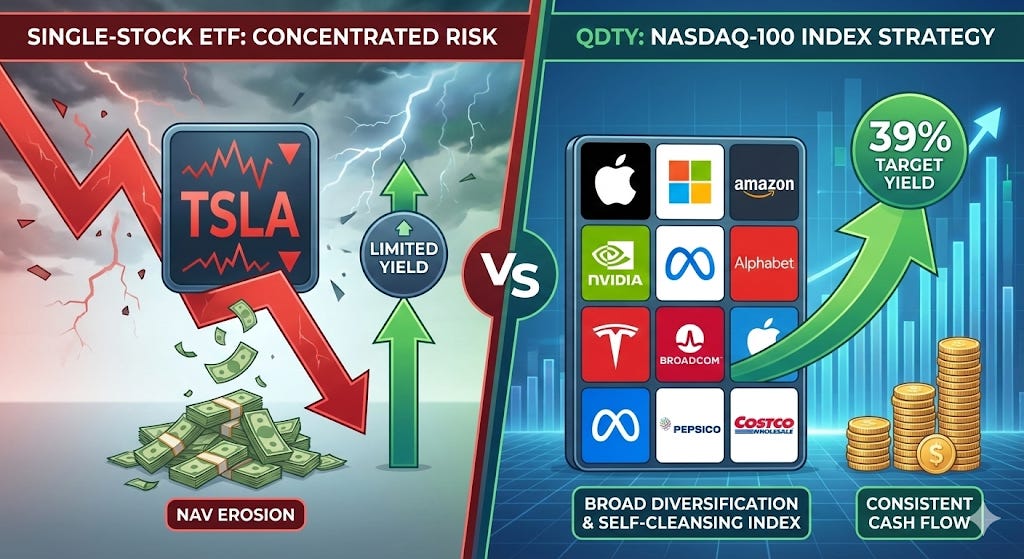
The Problem With Single-Stock ETFs (NAV Erosion)
To understand what makes QDTY a better holding, we must first understand the difference against single-stock ETFs. Over the last two years, retail investors have flocked to single-stock option funds chasing massive yields. But many of them learned a harsh lesson in NAV erosion.
When a fund writes covered calls on one highly volatile stock, it takes on concentrated risk. If that underlying stock takes a 30% hit after a bad earnings report, the ETF’s Net Asset Value (NAV) plummets right along with it. Because the upside is capped by the options contracts, the fund struggles to ever recover that lost NAV when the stock eventually bounces back. You get a massive dividend payment, but your principal bleeds out faster than the cash comes in.
Why QDTY Is a Smarter Income Play
Instead of tying your money to the erratic behavior of one CEO or one single product line, QDTY utilizes a synthetic covered call strategy directly on the Nasdaq-100 Index. Specifically, the fund harvests income daily by selling zero days to expiration (0DTE) call options on the index itself.
Here is why that framework gives income investors a massive advantage:
The Index is Self-Cleaning: The Nasdaq-100 naturally weeds out the losers. If a company fails or loses its market dominance, it drops out of the index and is replaced by a stronger, growing company. You are never tied to a single sinking ship.
Lower Volatility: While the Nasdaq is heavily weighted in tech and capable of swings, a basket of 100 mega-cap companies is mathematically less volatile than a single isolated stock.
Smoother NAV Retention: Because the underlying asset does not suffer from catastrophic, isolated corporate failures, QDTY experiences significantly less NAV decay over time.
This structure allows us to capture the high-frequency option premiums of the tech sector without absorbing the devastating single-stock downside risk. We get to collect a massive 39% yield, but we anchor it to the most robust tech index in the world.
Let’s Talk About the Real Risks (The Downside)
I am highly bullish on this strategy, but I never allocate capital without understanding exactly how a fund can hurt me. QDTY is not a magic money glitch. It comes with very specific structural risks that you need to be comfortable with before you ever hit the buy button.
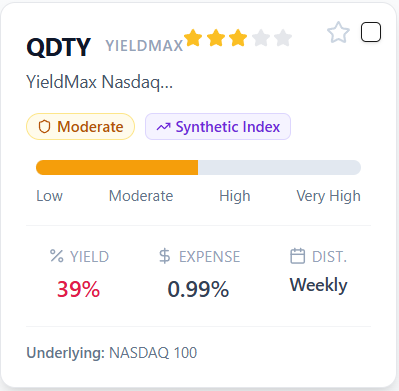
👉The High Yield Database indicates that QDTY is a 3-star fund.
👉 Unlock Access To The High Yield Database By Upgrading Your Membership.
You can instantly determine the highest quality income funds without second-guessing.
1. You Own the Full Downside (With Capped Upside)
Here is the mathematical reality of selling covered calls. When you sell a call option, you are agreeing to cap your upside in exchange for immediate cash. If the Nasdaq 100 goes on an absolute tear and rips up 3% in a single day, QDTY is not going to capture all of that gain. Its upside is structurally capped by the 0DTE options it sold that morning. However, you still own all of the downside risk. If the Nasdaq drops 3%, QDTY drops right along with it. In a fast, aggressive bear market, this fund will lose value. The massive dividend yield acts as a heavy shock absorber, but it does not make you immune to a market crash.
2. Yield Variability (The Volatility Dependency)
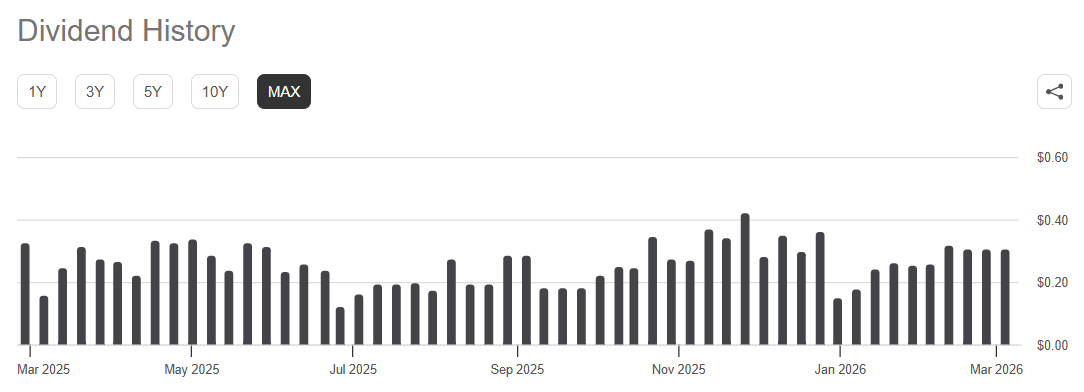
That 39% yield is a trailing figure, not a fixed bond coupon. The cash flow this fund generates is directly tied to the option premiums it collects. Those premiums are priced based on implied volatility.
When the market is choppy and volatile, option premiums are expensive, and QDTY prints cash. But if we enter a prolonged period of dead quiet, low volatility trading, those option premiums will dry up. If that happens, the weekly distributions will shrink. You have to be prepared for fluctuating income month to month.
The below chart shows the weekly dividend amounts. As we can see, payouts can fluctuate.
3. It Will Underperform in a Raging Bull Market
If your goal is to beat the total return of a standard Nasdaq index fund in a massive bull run, you are looking at the wrong asset. The underlying index will always outperform QDTY in a pure growth scenario because QDTY deliberately sacrifices capital appreciation to hand you that massive cash yield.
This is exactly why I do not use QDTY as a primary growth vehicle. I use it strictly as a cash flow mechanism to organically fund my actual growth positions without injecting new capital from my paycheck.
Therefore, QDTY will underperform something like QQQ 0.00%↑ during bull markets.
👉 Consider Upgrading To A Paid Membership For The Following Perks!
Instant access to the Yieldly Dashboard to optimize your monthly dividend income.
Priority alerts for buys and sells.
Covered Call Option ETF Database (dividend yields above 15%).
In-Depth Research & Reports on dividend funds and growth stocks.
Access to monthly dividend reports and portfolio reveals.
Not ready to upgrade? That’s fine! You can still get a shortcut on your investing journey with this starter guide. You can get the dividend starter bundle so that you can skip the mistakes that I made.
👉 Here is what’s included:
✅ The Dividend Blueprint (ebook)
A step-by-step guide showing how I structure my portfolio, grow monthly cash flow, and reinvest for long-term income.✅ Monthly Dividend Map
50+ hand-picked tickers that pay monthly so you can ladder your income all year long.✅ Dividend Tracker (Google Sheet)
The exact spreadsheet I use to track yield, forward income, reinvestment, and portfolio growth.✅ Dividend Growth Legends: 50+ Stocks
50 stocks that have an established history of dividend increases.✅ List of ETFs for Beginners To Start With
The Macro Outlook: Why the Underlying Index Dictates Everything
There is a golden rule when it comes to buying covered call ETFs.
