

Most investors overcomplicate investing. They chase the next hot stock, time the market, and end up with a portfolio that only works when prices go up. When shit hits the fan and the market declines, that’s when we see people crying about how the markets are rigged.
There is a simpler way to build wealth without all of the guesswork.
I often talk about building a strong foundation of investments in companies that are not speculative. These usually companies that you have in your home at this very moment. I believe that the Dogs of the Dow strategy can be efficiently used to build your unshakeable foundation.
The Dogs of the Dow is one of the oldest and most disciplined dividend strategies in existence. It has competed with the market for decades, and it requires almost zero maintenance.
You buy ten stocks.
You hold them for a year.
You collect the income.
You repeat.
That is it. I plan to create a separate portfolio that strictly follows this strategy over time so that I can actively measure the results for you guys. I will post a dedicated buy alert of that portfolio when I implement it.
In this article, I will break down exactly how the Dogs of the Dow strategy works, why it generates such reliable dividend income, how the 2026 lineup is positioned for growth potential going into 2027, and how to actually run it yourself.
What Is the Dogs of the Dow Strategy?
The concept was popularized by Michael O’Higgins in his 1991 book Beating the Dow. The rules are about as simple as investing gets.
The Dow Jones Industrial Average (DJIA), often referred to simply as “the Dow,” is a stock market index that tracks the performance of 30 large, publicly traded blue-chip companies that are leaders in their respective industries.
At the start of each year, you look at all 30 stocks in the Dow Jones Industrial Average. You sort them by dividend yield from highest to lowest. You buy the top ten highest-yielding stocks in equal amounts. Then you hold them for twelve months, and at the end of the year you rebalance back into the new top ten.
Why does this work?
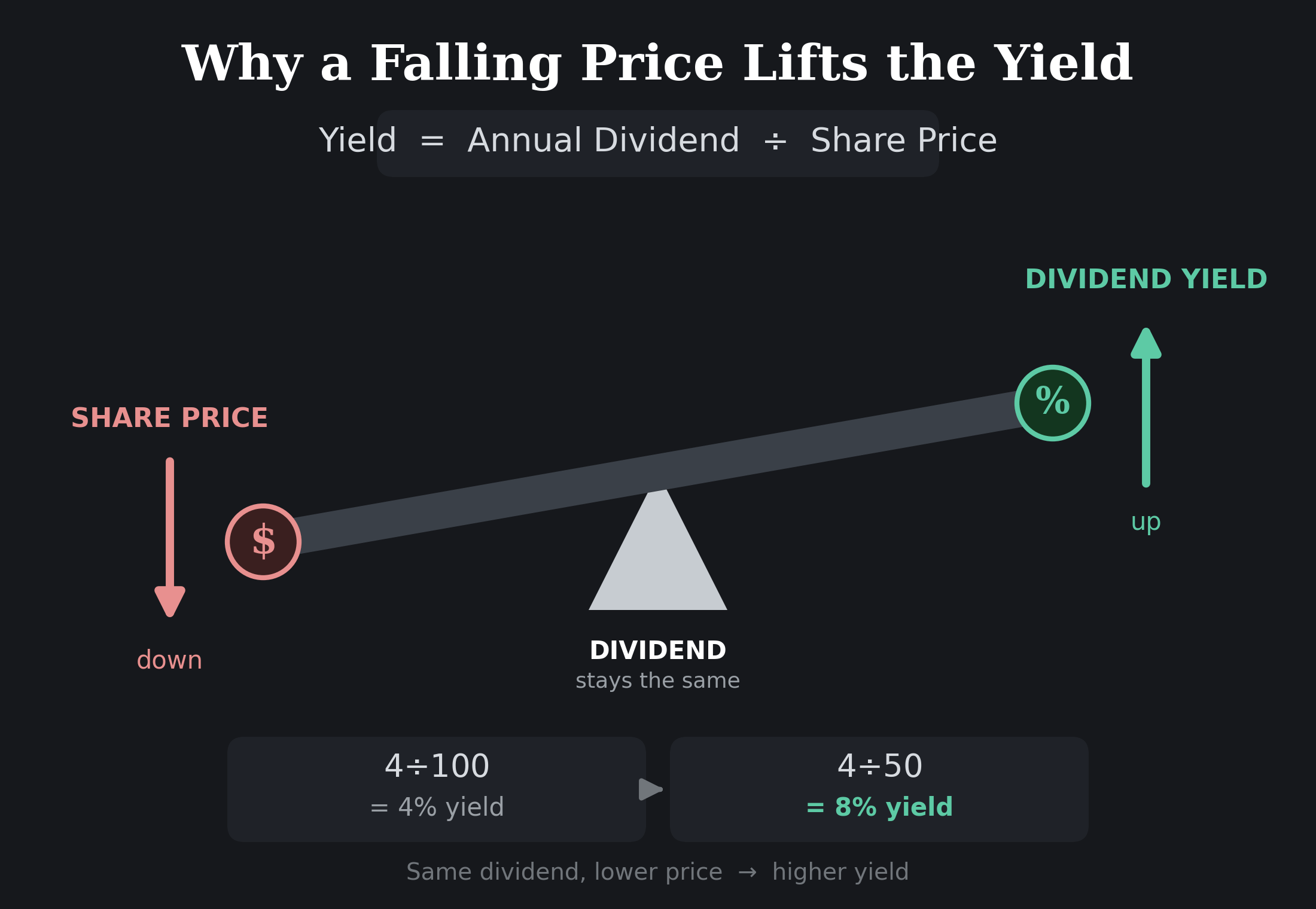
A high dividend yield often signals a stock that is temporarily out of favor. The dividend stays steady while the share price drops, which pushes the yield up. The strategy argues that these stocks can have significant gains in price plus relatively high dividend yields because the stocks are thought to be temporarily oversold.
You are buying quality blue-chip companies when the market has turned its back on them. You collect a fat dividend while you wait for the price to recover.
👉 Free subs get access to a list of 50 dividend paying stocks.

The 2026/2027 Dogs of the Dow List
Here is the official 2026 lineup, based on closing yields. This will update by January of 2027.
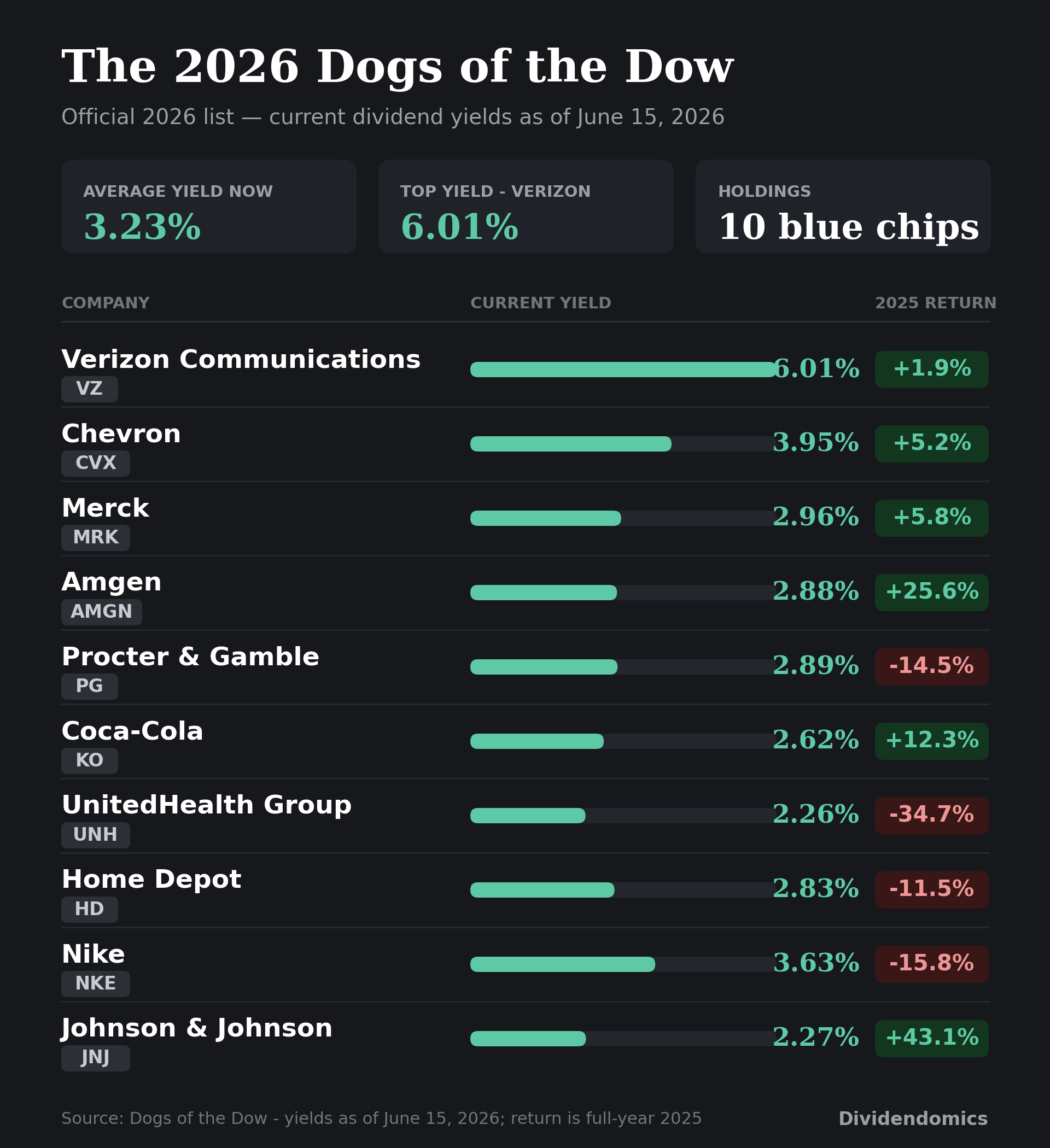
Look closely at that price change column. Stocks like UnitedHealth UNH 0.00%↑, Nike NKE 0.00%↑, and Home Depot got beaten down hard in 2025. That is exactly why their yields climbed and why they qualified as Dogs. You are buying them on sale.
👉 Does your savings account pay you 3.3% while also giving you exposure to ten of America’s strongest companies?
Probably not.
👉 Upgrade Your Subscription - $0.82 per day to become a better investor. Paid subs get buy alerts first.
The Dividend Income Angle
This is where the Dogs strategy shines for income investors.
Every one of these companies is a profitable, cash-generating blue-chip. These are not speculative names hoping to turn a profit someday. They mail you a check every quarter, and many of them raise that check every single year.
I hold several of these names in my own portfolio, and Verizon VZ 0.00%↑ is a great example of why. At a 6.8% yield, it sits right at the top of the 2026 list and starts working for me immediately. While the share price drifted sideways in 2025, the income kept landing in my account quarter after quarter. That is the entire point. I do not need Verizon’s price to skyrocket. I need it to keep paying me while I reinvest.
Coca-Cola KO 0.00%↑ and Johnson & Johnson JNJ 0.00%↑ are Dividend Kings that have raised their payouts for over 50 consecutive years. Procter & Gamble PG 0.00%↑ is right there with them.
These are the same defensive, recession-resistant names I build my own foundation around. People keep buying soda, soap, and medicine no matter what the economy does. That stability is what keeps the dividend income flowing.
If you want to understand why this kind of income holds up even when markets fall apart, I broke it down in detail here:
👉 How To Build A Recession-Proof Dividend Portfolio
Does the Strategy Actually Work? The Performance Data
Fair question, and the honest answer has two sides.
In the short term, 2025 was a banner year for the Dogs. The overall Dow Dogs portfolio delivered a total return of 18.91% in 2025, beating both the Dow Jones Industrial Average return of 14.92% and the S&P 500 Index return of 17.88%. Out of the ten Dogs in 2025, only one generated a negative return, and that was Procter & Gamble.
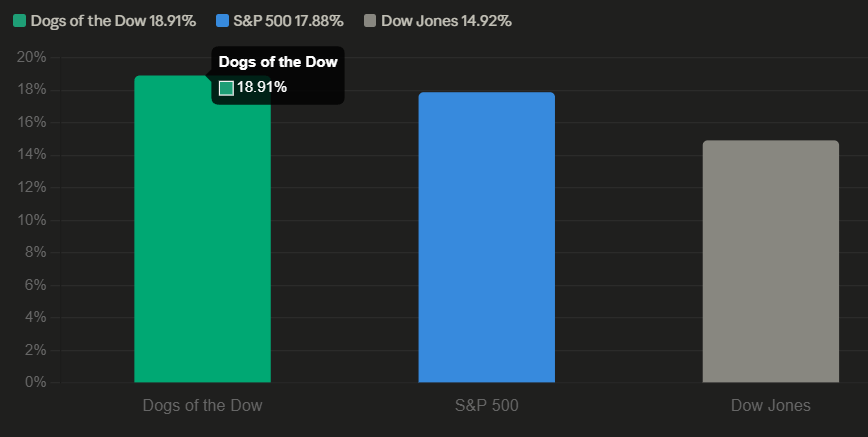
That was not a one-off. Through the end of November 2025, the year-to-date total return of the Dogs of the Dow hit 20.96%, outpacing the Dow at 13.86% and the broader S&P 500 at 17.74%.
The long-term picture is more balanced, and I want you to see it clearly. Going back 20 years, the Dogs of the Dow returned 10.8%, which is exactly the same as the Dow Jones Industrial Average over that same period. Some academic research has also found no abnormal returns after accounting for trading costs and taxes.
So what is the takeaway?
The Dogs strategy is a reliable, low-effort way to capture an above-market yield from quality companies, and it has periods of real outperformance. What it is not is a guaranteed market-beater every single year. You are buying discipline, income, and value exposure, not a magic formula.
👉 That balance of yield plus steady total return is exactly why I treat strategies like this as a foundation, then layer growth on top.
The Growth Potential Angle
Income is only half the story. The Dogs strategy has a built-in growth engine that most people overlook.
Because the list resets every year, you are systematically forced to buy low and sell high. When a beaten-down Dog recovers and its price climbs, its yield compresses and it eventually drops off the list. You sell it after the recovery. Meanwhile, the new laggards rotate in at a discount.
This is disciplined, mechanical value investing. No emotion. No guessing. I think the market has been spoiled by a decade of constant technology growth. Therefore, value investing like this has become a thing of the past.
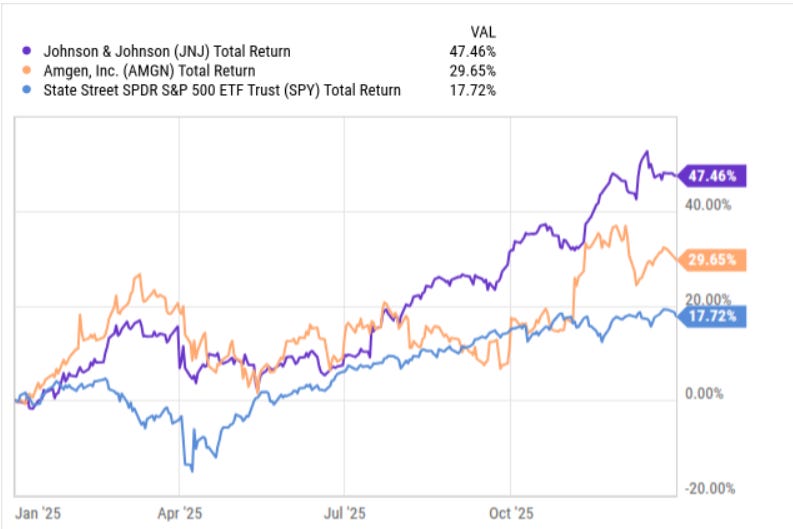
Look at Johnson & Johnson, which gained 43.1% in 2025 while still yielding enough to make the 2026 list. Or Amgen, up 25.6% on the year. These are not stagnant companies. They deliver real total return through both rising prices and rising dividends.
The turnaround candidates are where the explosive upside lives. UnitedHealth fell nearly 35% in 2025. If it stabilizes, you are holding a healthcare giant with serious recovery potential while it pays you to wait.
This blend of yield and growth is exactly what I aim for in my own strategy. I take the income my portfolio generates and roll it into growth positions to compound faster. I call it the dividend wheel.
👉 Here Is How I Use The Dividend Wheel Strategy
How To Actually Buy and Rebalance the Dogs
The beauty of this strategy is how little you have to do. Here is the full process, step by step.
Step 1: Pick your start date.
Most investors use the first trading day of the new year, based on closing yields from December 31. You can start any day you want, but pick a date and stick with it every year for consistency.
Step 2: Pull the ten highest-yielding Dow stocks.
Sort all 30 Dow components by dividend yield, highest to lowest. The top ten are your Dogs. For 2026, that is the list in the table above.
Step 3: Buy all ten in equal dollar amounts.
This is the key. If you are investing $10,000, that is roughly $1,000 into each name, not weighted by price or by how much you like a company. Equal weight keeps the strategy disciplined and removes your bias.
Step 4: Do nothing for twelve months.
Collect your dividends. Reinvest them if you want to compound faster. Ignore the daily noise. This is the hardest step for most people, because doing nothing feels wrong. It is the entire edge.
Step 5: Rebalance at the one-year mark.
Re-sort the Dow by yield. Sell any stock that fell off the top ten. Buy the new names that rotated in. Rebalance the survivors back to equal weight. Then repeat.
One practical note. Holding positions for at least a full year lets you reap the tax benefit of being taxed at the long-term capital gains rate instead of the short-term rate. Timing your rebalance just past the twelve-month mark on winners can save you real money at tax time.
That is the whole system. Five steps, once a year.
A Few Honest Caveats
No strategy is perfect, and I want you to go in with clear eyes.
The 2026 list is concentrated. By following this strategy, 40% of a portfolio would be in the Healthcare sector, 20% in Consumer Defensive, and another 20% in Consumer Cyclical. That is heavy exposure to a few sectors, so the Dogs work best as one piece of a diversified income plan rather than your entire portfolio.
A high yield can also occasionally signal a company in real trouble rather than a temporary dip. Simply chasing higher-yielding stocks is not always the best strategy, since a stock may be trading at a lower price for a reason, such as weakening business fundamentals. The Dow’s blue-chip quality filter helps here, but it is worth knowing the difference.
I am sharing how I think about this strategy, not giving you personalized financial advice. Do your own research and size your positions to your own situation.
The Bottom Line
The Dogs of the Dow proves that building real dividend income does not require complexity. Ten quality stocks. A 3.3% starting yield. Built-in value rotation that forces you to buy low. A full year of compounding before you touch a thing.
For income investors who want both a reliable paycheck and genuine growth potential, this is one of the most beginner-friendly strategies on the market.
If you want to take it a step further and learn how to turn these dividends into income that hits your account far more often than once a quarter, start here:
👉 Here Is How To Get Paid A Dividend Every Day
Dividendomics is a reader-supported publication. To receive new posts and support my work, consider becoming a free or paid subscriber.
I have owned SDOG for years I think it’s the 10 highest yielding Dow stocks. It has a higher yield and lower volatility
Love this, as you said, as an excellent component in a portfolio, a nice niche segment with positive advantages over much of the other growth noise