

Something a little different this Sunday…
In 306 BC a man named Epicurus bought a plot of land outside Athens and started teaching there. Every other school in the city met in public where anyone walking past could listen in, and he bought private ground instead, so the school became known simply as the Garden. The food there was water and barley bread most days, the community was built around a small circle of friends rather than public reputation, and the claim carved on the gate was:
“Pleasure Is The Highest Good”

That last line wrecked him because rivals ran with it and spread stories that the Garden was a house of drunken excess. Epicurus died in 270 BC having written around 300 works.
What got buried under that is a rigorous system for deciding what to want, and it works on money. Think about it: you work hard for money and that should be used for pleasure, right?
Well, Epicurus believed that there’s a systematic way to obtain that pleasure through disciplined actions. Pleasure without limits is dangerous. This is the philosophy I want you to operate from financially.
What Money Is Actually For
The target Epicurus named was ataraxia, which the Stanford Encyclopedia of Philosophy defines as happiness resulting from the absence of physical pain and mental disturbance. The goal was a life where the alarm bells stop ringing. Every other thing he taught exists to get you there and keep you there, which makes it a strange kind of hedonism, one where the win condition is the disappearance of a feeling, rather than the arrival of one.
Getting there took discipline about what you allow yourself to want. His letter to Menoeceus states the rule directly: we do not choose every pleasure, because some cost more in pain than they return once the full bill arrives. You measure the consequence before you take the reward.
Applied to money, that rips apart most of what people buy, because the car payment and the bigger house and the upgraded everything are all pleasures that bill you monthly for years in exchange for a feeling that fades in about six weeks.
We see this all the time. Sign up for the car payment because the thrill and pleasure of a new car is greater than the pain of a monthly debt, insurance, and maintenance. People buy more house than they can afford because it has the white picket fence, large bedrooms, and double-door garage.
They are accepting pleasure at the cost of pain.

The thing worth buying instead is the absence of the hum. The Federal Reserve surveys households every October about how they would handle a surprise bill, and in the most recent report, 63% of adults said they could cover an unexpected $400 expense with cash or its equivalent. Meaning that roughly one in three adults is a single car repair from a credit card balance, and that produces a background anxiety that no amount of positive thinking removes and no promotion fully fixes either.
The simple idea is to live on less than you need. Desire for more is what creates suffering and stress. Don’t get me wrong, this doesn’t mean you shouldn’t want more. I want more. It’s human nature. What I am saying is that you need to stay disciplined to make sure the more doesn’t come at the detriment of your peace and security.
This is why I put so much value on dividends.
Wealth is a moat, not a scoreboard.
Status spending buys the appearance of safety and charges you monthly. Assets buy the right to say no to anyone who would otherwise hold authority over your time.
Why I Want The Money In Cash Flow
Once you accept that the job of money is removing disturbance, the FORM the money takes starts to matter as much as the size of it. A balance sitting in an account is potential, and potential doesn’t pay a utility bill or calm anyone down during a rough month. Cash landing in the account on a schedule does both, and that difference is the entire reason I built an income portfolio instead of a pile.
I collected nearly $5K in dividends during August because of the dividend wheel strategy.
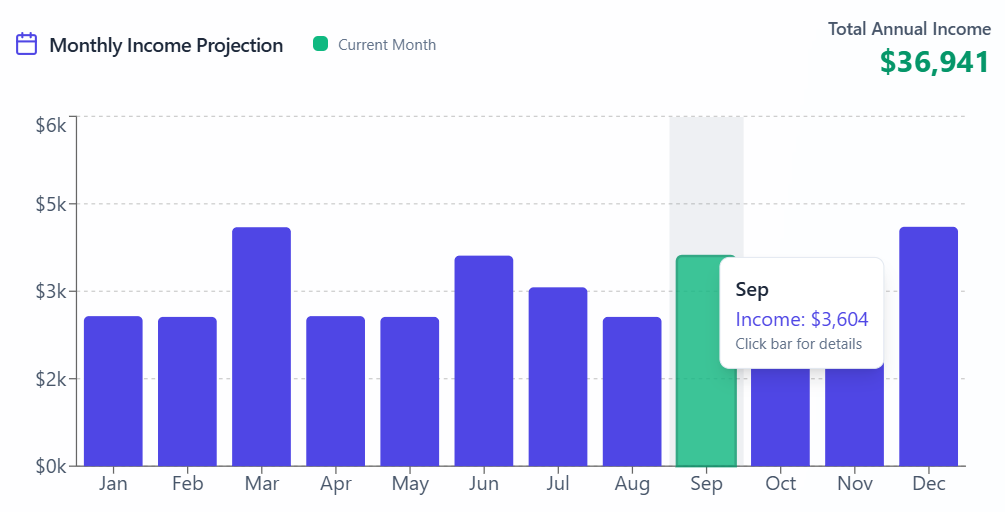
The cadence matters too. Bills arrive constantly rather than quarterly, so income that shows up at the same rhythm covers life the way it’s actually lived.
A fund like QDTY, the YieldMax Nasdaq 100 0DTE Covered Call Strategy ETF QDTY 0.00%↑, sells zero-days-to-expiration calls on the Nasdaq 100 against synthetic exposure to the index and aims to distribute what it collects every week. Weekly payments turn a portfolio into something closer to a paycheck, and a paycheck you don’t have to show up for is the most direct purchase of ataraxia available.
For instance, I collect roughly $132 a week from this position. I don’t have to work for it, report to a manager, or even be awake. Is it the best income position? Probably not. But the point is that it creates the absence of hum. An extra $6k-$7k in passive income reduces your vulnerability to the noise.
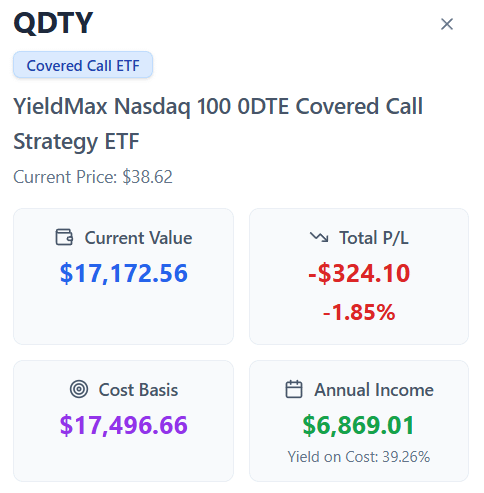
I hold this position as a buffer layer rather than as the whole structure, sized so that the weekly cash covers a defined slice of fixed costs while growth positions handle the compounding. I compared ten of these funds side by side in this piece if you want the mechanics rather than the philosophy.
👉 Want more high yield funds like these? Read this!
No One Is Coming, So Build
Epicurus didn’t wait for Athens to arrange a decent life for him. He bought ground, built a self-sufficient community on it, and stepped out of a status game whose rules he never agreed to. The modern version is accepting that no employer or market is arriving with the structure you need, which hands you total responsibility for the result and puts every lever back within reach.
Americans filed 578,926 applications to start a business in July 2026, according to the Census Bureau, up 8.1% from June. Most of those will never hire a single employee, but yet, trying is still the right instinct. Because the alternative is letting a 3% raise from a job decide what your work is worth.
Your portfolio needs the same treatment. An account on autopilot runs on default settings, and you get whatever those settings hand you. In plain English, it means you need to put effort and TRY to build your portfolio. Pay attention to how money works. Understand different ETFs. Put actual effort into building your wealth.
Do you really just want to be average and buy the S&P 500 without actually understanding how anything works? Just put money into your 401k without a purpose? Put some real effort in and do something that will increase the quality of your life.
The Garden Was The Whole Strategy
The most radical thing about that plot of land was how small the ambition looked from outside. Epicurus wasn’t trying to reform the city, he pulled a small group of people close and treated friendship as one of the few things worth organizing a life around, which read as retreat to a culture obsessed with standing.
Your compass should point the same direction. The duty you recognize should run to a short list of people, meaning you don’t have to change the world or have an obligation to some sort of bigger worldview. The Harvard Study of Adult Development has followed people since 1938, and its director Robert Waldinger says the finding that surprised researchers most was that the warmth of people’s close relationships predicted who stayed happy and healthy into old age better than anything else they measured.

The cash buffer exists so a bad year never becomes a conversation at a kitchen table, and multiple income streams exist so one breaking doesn’t take the house with it. If your only income is your job, you’re letting a company decide your fate and wellbeing. Get fired and now you’re on LinkedIn begging for an opportunity.
A small circle sounds cold until you notice that someone with a secure base gives away far more over a lifetime than someone permanently one repair bill from panic. How many of your parents can’t afford to leave you with anything? Don’t you want to change the cycle?
Your Hardware Is Running On Old Settings
Your own brain will try to talk you out of all of this the first time the market drops. Randolph Nesse, an evolutionary psychiatrist, argued in a paper for the Royal Society that we were never built to be happy, and that our good and bad feelings exist to push us into action rather than to be enjoyed or avoided. Fear kept your ancestors alive because panicking over nothing cost them a few wasted minutes while missing a real threat cost them everything, and that same wiring is now watching your account balance.
In short, I’m saying that panic is expensive. Especially panic around money.
Morningstar compares every year what funds returned against what the average investor in those funds actually earned, and the 2026 study found investors made 8.7% a year over the decade through 2025 while the funds themselves returned 9.9%. That missing 1.2 points came entirely from buying and selling at the wrong moments. Crypto ETF investors did far worse and lost around 5.8% a year while the funds gained 8.5%, because the money showed up after the run and left during the drop.
The fix costs nothing.
A UCLA team led by Matthew Lieberman scanned people’s brains while they put names to emotional images, and found that saying what you feel calms the brain’s fear center and wakes up the part that thinks in words instead. Say it out loud before you touch the account, something as basic as “I am scared right now,” and then ask the only question that actually matters, which is whether the fund or the business changed. A falling chart on its own tells you nothing about that.
Actions To Take This Week
Price your freedom. Add up one month of fixed bills, then divide by 0.08 for the capital that covers them at an 8% yield. That number is what autonomy costs, and it’s a target instead of a mood.
Match the cadence to the bills. Write down when your income actually lands against when the money actually leaves. Gaps in that calendar are where the anxiety lives, and weekly or monthly payers are the tool for closing them.
Automate one deposit. Treat it as a bill with a due date rather than whatever is left at month end. The figure matters less than it leaving without a decision.
Write down who the money is for. Names, not concepts. Then check that your beneficiaries, cash buffer and income streams match the list.
Name the feeling before you trade. Out loud, in plain words, every time the account moves hard. Practice it on traffic and rude emails first, because it’s useless the first time you try it at a market bottom.
Epicurus lost the public argument so completely that his name now advertises the behavior he spent his life warning against, and the system itself held up fine. Measure every pleasure against the bill that follows it, convert wealth into cash that shows up on a schedule, build the structure yourself because nobody is bringing you one, keep the circle small and make it secure, and treat the alarm in your chest as a suggestion rather than an order. That is the entire playbook, and it still works.
