

The S&P 500 is smashing all-time highs. The Nasdaq is relentless. Yet, if you look at your YMAX YMAX 0.00%↑ position, the story is likely different. Despite a roaring bull market, the NAV has slowly bled out.
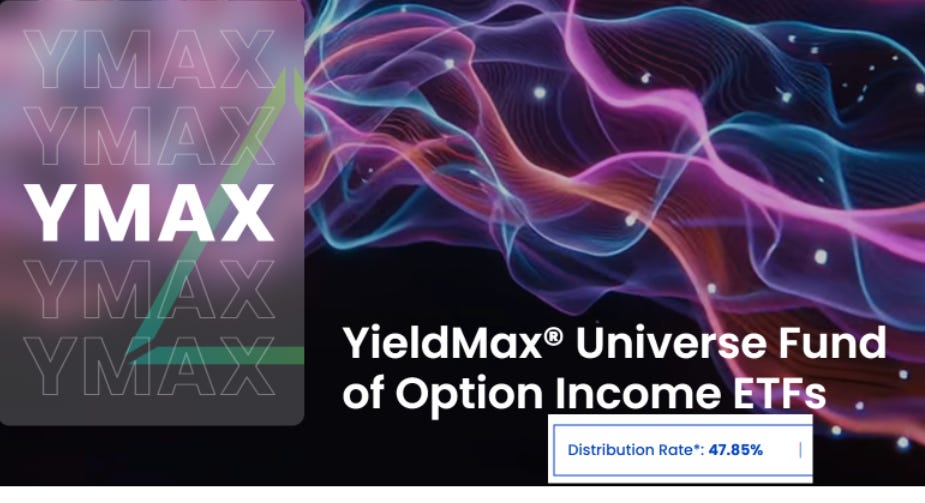
YMAX gains its fame for offering a massive dividend yield of more than 47%.
So $10,000 invested generates ~$4,700 in annual dividend income.
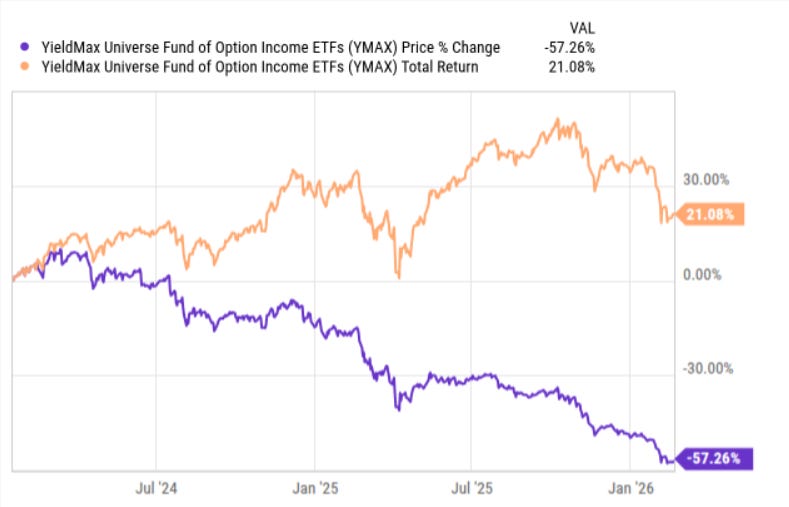
However, the performance has been terrible and the share price continues to erode. Since inception, the share price has eroded by more than 57%. When including all distributions paid, the total return sits above 21%.
For many income investors, this has been the ultimate frustration. You bought YMAX to get broad exposure to the YieldMax universe without the headache of managing individual tickers. Instead, you got a portfolio that was mechanically forced to buy losers. Every dollar made by the winners was essentially siphoned off to prop up struggling funds that had no business being in the portfolio at that size.
The good news is that YieldMax has finally listened.
Today, they announced a complete overhaul of the YMAX strategy. They are abandoning the passive “equal weight” approach that caused this erosion and are pivoting to an active, momentum-based strategy.
This is the most significant update in the history of the fund.
In this breakdown, we are going to cover:
Why the “Equal Weight” strategy failed you.
The new “Momentum” framework and how it protects NAV.
The massive expansion of the fund’s universe (including Short and Ultra ETFs).
My honest take on whether this makes YMAX a buy again.
Return Of Capital Update for 2025 - Tax Free Dividends
1. Why the “Equal Weight” Strategy Failed You
The fatal flaw in the original YMAX design was the math.
To maintain an “equal weight” balance, the fund was mechanically forced to sell its winners (like NVDY) to buy more of its losers (like TSLY).
In traditional investing, this is called “buying low.” But in the world of capped option income funds, it is a trap.
Because these funds have a capped upside, a fund that drops 50% cannot easily recover that lost ground. By constantly rebalancing, YMAX was effectively throwing good money after bad—siphoning cash from the winners just to prop up the losers.
The result was inevitable NAV erosion. The winners were cut down before they could run, and the losers were given more capital to burn.
2. The New Strategy: Buying Strength, Selling Weakness
The fix for this problem is simple but radical.
YieldMax is shifting YMAX to a “Positive Momentum Methodology.”
Instead of blindly buying every fund in the YieldMax universe, the portfolio managers will now actively scan for strategies that are demonstrating strong relative performance trends.
Old YMAX: “We own everything, good or bad.”
New YMAX: “We own what is working right now.”
This allows the fund to double down on sectors with strong trends—like the recent crypto or semiconductor run—while cutting exposure to sectors that are chopping sideways or bleeding NAV.
Crucially, this is an active overlay. The managers are no longer bound by a rigid algorithm. They have the discretion to overweight the winners and leave the losers on the sidelines.
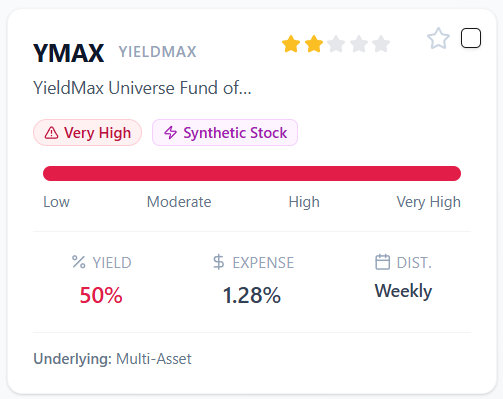
For now, the high yield database gives YMAX a two-star rating. I will closely assess the fund’s strategy after these shifts and perhaps it will get upgraded to a three-star rating.
👉 Upgrade To A Paid Membership To Get Access To The High Yield Database
3. The Expanded Universe: Gas & Brakes
The second major change is the “toolbox.” Previously, YMAX could only buy standard single-stock YieldMax ETFs. The new mandate blows the doors wide open.
The fund can now hold:
YieldMax Ultra ETFs: These are leveraged funds designed for higher volatility and potentially higher yields. This is the “gas pedal” for bull markets.
YieldMax Portfolio ETFs: Funds of funds like YMAG or YBIT.
YieldMax Short Strategies: This is the game changer.
YieldMax explicitly stated they are evaluating the inclusion of Short Single Stock Option Income ETFs.
If implemented, this gives YMAX a “brake pedal” for the first time in its history. In a sustained market decline, the managers could theoretically swap a long position for a short position, potentially protecting the NAV from the kind of erosion we saw in 2022.
4. The Risks of “Going Active”
While this is a massive upgrade, it is not a magic bullet. Active management introduces new risks that you need to be aware of.
Not ready to upgrade? That’s fine! You can still get a shortcut on your investing journey with this starter guide. You can get the dividend starter bundle so that you can skip the mistakes that I made.
👉 Here is what’s included:
✅ The Dividend Blueprint (ebook)
A step-by-step guide showing how I structure my portfolio, grow monthly cash flow, and reinvest for long-term income.✅ Monthly Dividend Map
50+ hand-picked tickers that pay monthly so you can ladder your income all year long.✅ Dividend Tracker (Google Sheet)
The exact spreadsheet I use to track yield, forward income, reinvestment, and portfolio growth.✅ Dividend Growth Legends: 50+ Stocks
50 stocks that have an established history of dividend increases.✅ List of ETFs for Beginners To Start With
