

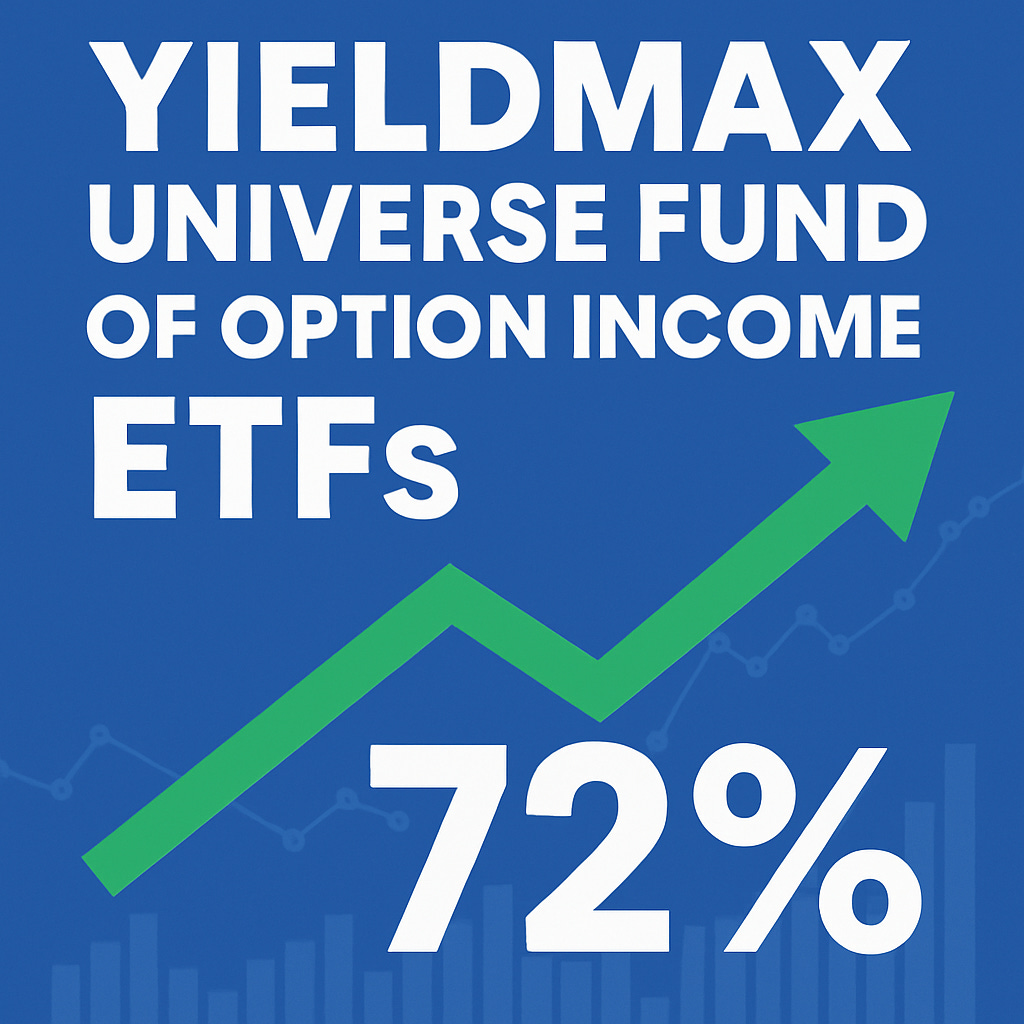
Only a year ago, most investors had never heard of YMAX. Now, YieldMax Universe Fund of Option Income ETFs is one of the most closely followed funds in the weekly income world. Why? Because it sends cash to your brokerage account every seven days with an estimated 72% distribution rate based on current weekly payouts.
I originally bought YMAX at the end of 2024 and issued a buy rating based on its high income utility. While my entry timing wasn’t perfect due to a short term market pullback, the fund’s weekly cash flow proved incredibly useful, and I’ve kept it as part of my income portfolio ever since.
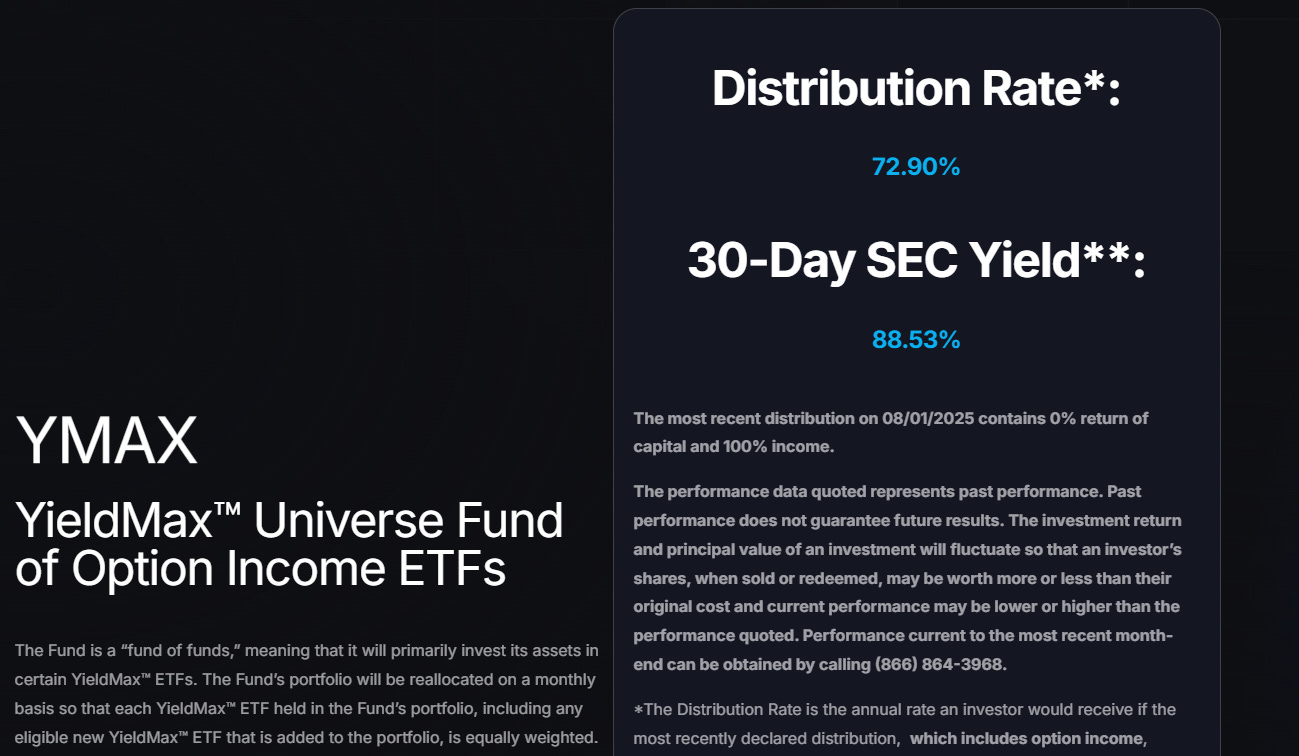
The distribution rate changes each week based on market conditions and how successful the fund's option strategy is. But in 2025, the payouts have remained consistent and YMAX currently yields an estimated 72% annually, calculated using the most recent distribution.
If you’re serious about building steady, predictable cash flow from dividends, this guide is the best place to start.
I’ve put together a curated, research-backed list of WEEKLY & MONTHLY paying option ETFs, designed to help you create reliable income every single month:
✅ ETFs that actually pay WEEKLY and monthly, not quarterly
✅ Estimated yields commonly above 30%. Dividend yields can be as high as 100%.
✅ My top picks for consistent income engines
✅ Includes newer, high-yield option income funds from the YieldMax suite, Roundhill, NEOS, Kurv, and Goldman Sachs

What YMAX Actually Does
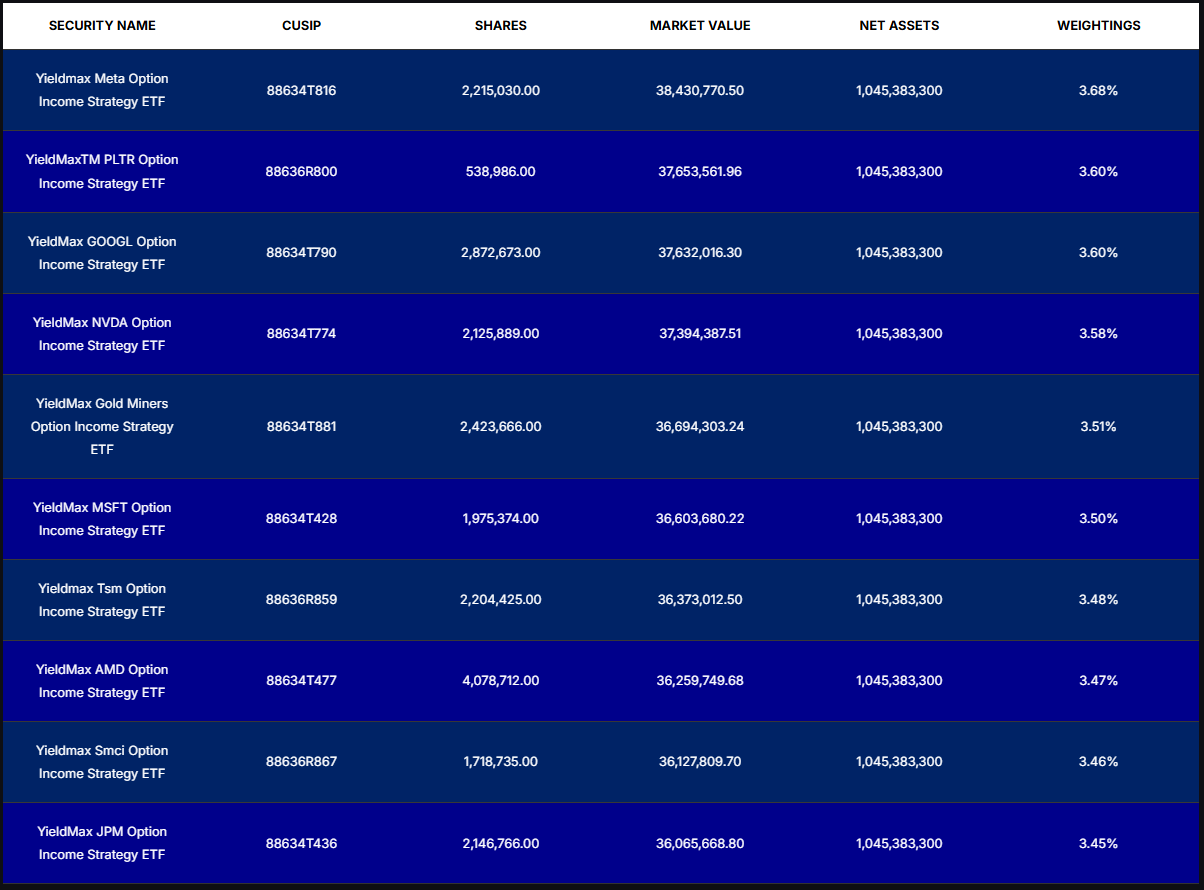
YMAX is a fund of funds ETF that invests across multiple YieldMax option ETFs. These underlying funds use synthetic covered call strategies to generate income by writing options on highly volatile tech stocks.
But here’s the twist. YMAX doesn’t actually own the stocks. It holds the YieldMax ETFs that use swap contracts to mirror the stocks. Think of it as a layered options strategy built on top of other layered options strategies. The upside is capped, but the premium income is massive.
Current top holdings include
TSLY (Tesla) TSLY 0.00%↑ & TSLA 0.00%↑
FBY (Meta Platforms) FBY 0.00%↑ & META 0.00%↑
NVDY (Nvidia) NVDY 0.00%↑ & NVDA 0.00%↑
AMDY (AMD) AMDY 0.00%↑ & AMD 0.00%↑
PLTY (Palantir) PLTY 0.00%↑ & PLTR 0.00%↑
CVNY (Carvana) CVNY 0.00%↑ & CVNA 0.00%↑
SNOY (Snowflake) SNOY 0.00%↑ & SNOW 0.00%↑
TSMY (Taiwan Semi) TSMY 0.00%↑ & TSM 0.00%↑
MSFO (Microsoft) MSFO 0.00%↑ & MSFT 0.00%↑
This structure helps YMAX tap into high implied volatility across tech, converting that volatility into weekly distributions.
Performance Snapshot
Since its launch in January 2024, YMAX’s share price is down about 33%. But when you factor in the total income it has paid out, the total return jumps to 36.4%.
This is why I continue to emphasize that YMAX is an income tool, not a growth asset.
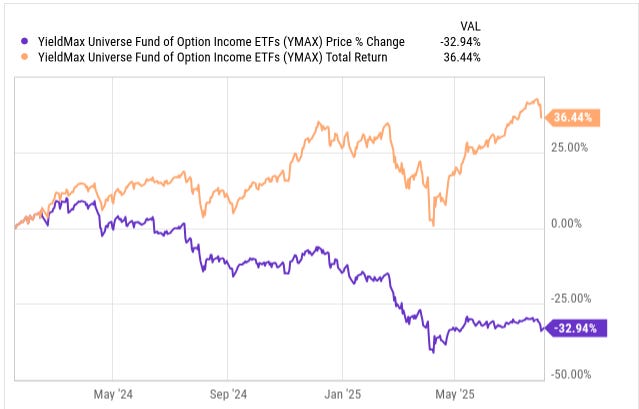
If you focus purely on price, YMAX looks broken. But if you treat it like a high yield rental property, one that prints income weekly, then the perspective changes entirely. Also, please remember to calculate the total return of these funds, which includes all dividends paid.
Here’s the simple math:
You invest $10,000.
With a 72% yield, you collect $7,200 per year.
In under two years, you’ve collected your full investment back.
From that point forward, you’re playing with house money.
That’s why many income focused investors use YMAX not as a total return play, but as a way to rapidly convert capital into weekly cash flow.
Most people will never experience what it feels like to get paid without clocking in. But you can. And once you do, you will never go back.
Want to get a well-rounded idea of where to start your investing journey? I have you covered here as well!

📊 Tool: Track Your Progress
Want to keep track of what you're earning, how much your portfolio yields, and where to reinvest?
📥 Dividend Tracker Template – $5
Simple, powerful Google Sheet to track your holdings, income, yield-on-cost, reinvestment, and more.
📘 Full System: Go From $0 to $500/Month in Income
If you’re ready to build a scalable dividend income portfolio from scratch, with real structure, strategy, and support. You can start here:
🚀 The Dividend Income Blueprint – $25
My complete guide that shows how I built over $3,000/month in passive income using a three-layer dividend system, reinvestment strategy, and sustainable yield portfolio design.
It includes:
The strategy I use
Portfolio structure breakdown
Real examples + reinvestment tactics
Income planning + risk controls
Bonus: Checklist, glossary, & asset filters
Book A Call
Get a Professional Second Opinion on Your Dividend & Income Portfolio.
The Power of Return of Capital
A big part of YMAX’s appeal is tax efficiency. The fund distributes most of its dividends through return of capital, which means
No tax due in the year received
ROC lowers your cost basis
Taxes are deferred until you sell
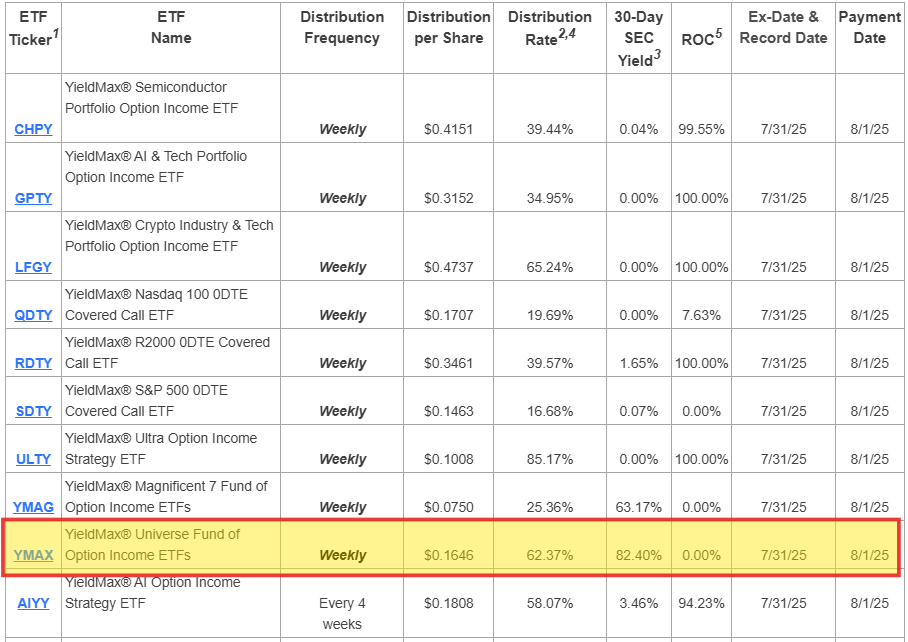
However, this latest week has been an exception since the distribution contained 0% return of capital.
This makes it a particularly smart tool for:
Retirees drawing income
Investors building a yield ladder
Those looking for weekly cash flow in a taxable account
Just to demonstrate how return of capital works, let’s image you buy a stock at $10 per share and it pays out a $1 dividend using ROC. Once the dividend is paid out, your cost basis gets reduced to $9 per share. So you’re technically able to hold YMAX for a long enough period until your cost basis reaches $0 per share. At this point, all dividends received would be classified as long-term capital gains.
How $1,000 Per Month in Passive Income Actually Works & How Long It’ll Take You

Most people assume that making $1,000 per month in passive income requires millions of dollars or some complex strategy that feels out of reach. You don’t need to watch another bullshit Youtube video about opening a storefront on Shopify or about dropping products on Amazon
What To Watch Out For
YMAX is not for everyone.
Because the strategy caps upside and pays out most of its NAV through dividends, the share price naturally trends lower over time. This isn’t a flaw. It’s how the fund works. You trade long term capital appreciation for immediate, consistent income.
The strategy also relies heavily on volatility in tech stocks to generate high option premiums. If volatility drops or those names rally too hard, YMAX could face challenges maintaining current payout levels.
Also, because the fund of funds structure stacks fees, the expense ratio is 1.28%, which is relatively high. But for many, the income utility justifies the cost.
Outlook for 2025 and Beyond
Despite market volatility, YMAX has continued sending cash to shareholders every single week. Even in the first quarter of 2025, when the market faced pullbacks, the ETF delivered uninterrupted income.
I expect this to continue as long as:
Volatility remains elevated
Options markets remain liquid
YieldMax continues refining its strategy mix
For me, YMAX plays a specific role in my portfolio. It is part of my Tier 3 tactical income bucket. I use it to supercharge my income, which I then sweep into core long term holdings like Google (GOOG 0.00%↑) , ASML (ASML 0.00%↑), and dividend growth funds.
With so many drivers of uncertainty in the market today, I believe that YMAX is positioned to continue delivering these amplified levels of distributions for shareholders. However, the full ripple effects of tariffs on different sectors are yet to be determined and consumers are still trying to gauge how we will feel the impact of increased costs.
We also have uncertainty related to the future of interest rate cuts, as the Fed has kept rates unchanged for their fourth meeting now. Inflationary data is still coming in higher than anticipated as well, which contributes to the Fed's uncertainty. Unemployment rates have also trended upward over the last twelve months, further adding to the uncertainty. Therefore, I believe that YMAX can continue to be an efficient income position over the remainder of 2025.
Margin Strategy
I own approximately ~$9.3K of YMAX, all of which was purchased on margin. Here are some relevant metrics and what the end game is for me:
Cost of margin: 11.13% - (~$1,090 annually)
Estimated annual income: ~$6,500
Net profit: $5,410
Every time I receive a distribution from YMAX, I essentially let that cash automatically pay down the margin. I receive a payout from YMAX every Friday and if markets are on the decline, I may reinvest half of the YMAX distribution into another growth position. Since holding YMAX, I have received $1,747 in total dividends, which means I have only received 19% of my initial investment back in dividends.
I also implement this strategy with several other YieldMax funds, which help boost my total dividend income for July up to $3,345.
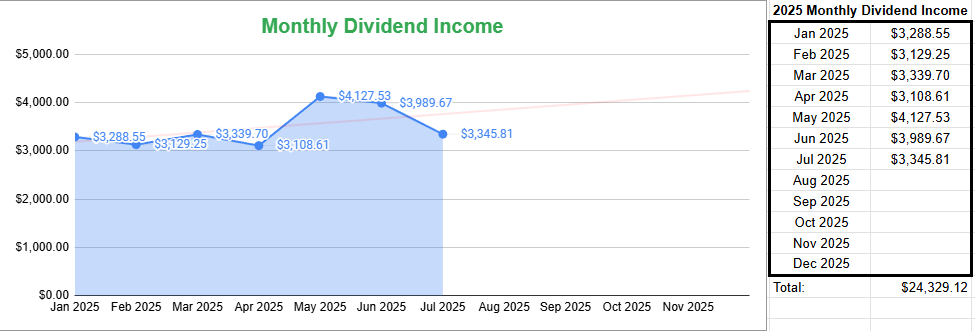
I release updated dividend reports every single month. If you missed my last one, you can see that below.
July 2025 Dividend Report

For the month of July, I’ve been able to collect $3,345 in dividend income. This was an increase of 7.6% from the prior quarter’s amount (April). I was able to passively increase my dividend income by reinvesting portions of the dividends received, back into different high-yield funds. This growth could have been more aggressive if I chose to roll dividends back into income positions, rather than growth.
Final Takeaway
YMAX is not a total return machine. But if you need cash flow now, it’s one of the most aggressive income tools available. With a 72% distribution rate, weekly payments, and tax efficient returns, it can play a powerful role in a layered income strategy.
I continue to hold YMAX in my tactical income sleeve, using the weekly income to fuel long term growth purchases, stacking yield and reinvesting every month.