

We are taught to obsess over income but most people fail to understand that they can disconnect their income from their time. Dividends are the easiest form of passive income in the world because there is no barrier to entry. Simply open an account and buy dividend paying companies.
You cannot pay your mortgage with a stock chart. You cannot buy groceries with unrealized gains. This is why dividend investing is so critical. It decouples your financial survival from the stock market’s daily mood swings.
But building an income portfolio from scratch is a full-time job. The process can require you to spend hours analyzing balance sheets and chasing dangerous yields, often losing money in the process.
There is a smarter way.
One specific ETF acts as a silent partner in your portfolio. It cuts out the guesswork. It provides instant diversification. It filters for quality automatically. It is the closest thing to an “Easy Button” for building wealth.
The Performance: Outperforms Peers
The Vanguard Dividend Appreciation Index Fund VIG 0.00%↑ is the ETF I will be reviewing today. When running a quick performance comparison, we can see that VIG outpaces some relevant peer dividend ETFs over the last decade.
This ETF ($VIG): 243.4%
Schwab US Dividend Equity ETF SCHD 0.00%↑: 197.6%
State Street SPDR S&P 500 Dividend ETF SDY 0.00%↑: 155.7%
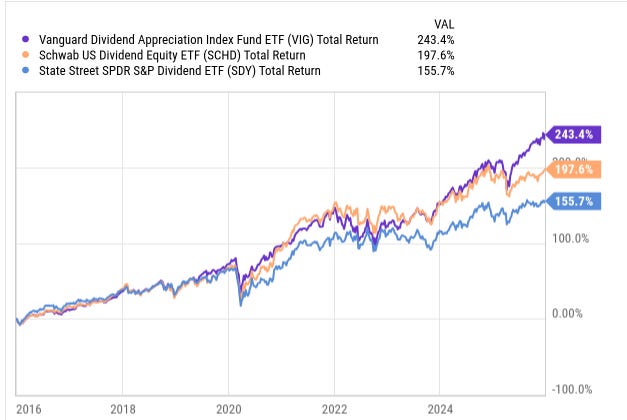
VIG isn’t designed to be a “get rich quick” scheme. It is designed to participate in the market’s upside while strictly filtering for quality dividend companies.
Expense Ratio: 0.05% (One of the cheapest on the market).
Yield: Typically hovers around 1.5% - 2.0%.
The Goal: Reliable, inflation-beating dividend growth.
While the starting yield might look modest compared to high-yield income traps, the magic of this fund isn’t in the starting yield. It is in the consistency.
Instant Diversification To Quality Dividend Companies
Building a diversified portfolio manually usually requires thousands of dollars and dozens of trade executions. VIG does it in one trade.
How It Works: VIG tracks the S&P US Dividend Growers Index. It holds roughly 300+ different positions. But it doesn’t just buy any stock that pays a dividend. It filters for Quality.
The Rule: It only selects companies with a history of raising dividends over time (typically 10+ years).
The Result: You automatically avoid “yield traps” (bad companies with unsustainably high yields) and focus on cash-rich businesses with low debt and resilient business models.
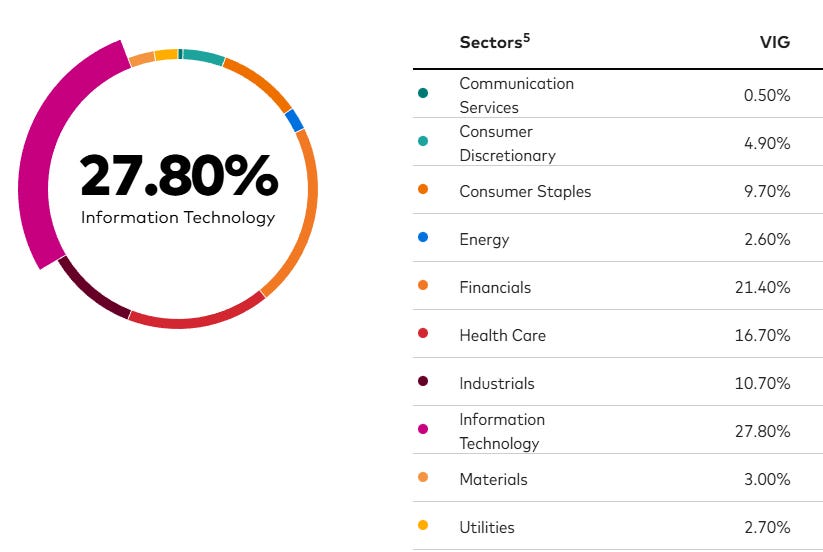
Most dividend funds are stuffed with slow-growing utility companies and telecom stocks. VIG is different. Its largest allocation is often Information Technology. By holding VIG, you aren’t just getting boring value stocks. You are getting exposure to massive growth engines that also happen to pay growing dividends.
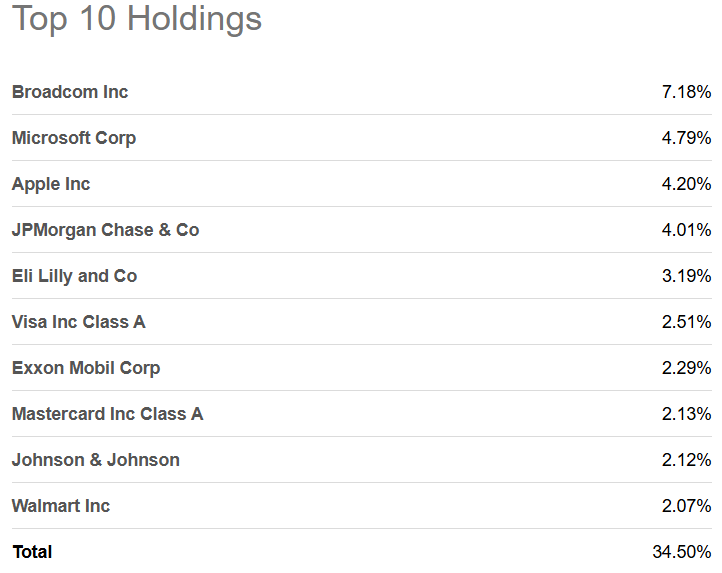
Top Holdings Often Include:
Broadcom AVGO 0.00%↑
Microsoft MSFT 0.00%↑
Apple AAPL 0.00%↑
JPMorgan Chase JPM 0.00%↑
Eli Lilly LLY 0.00%↑
Visa V 0.00%↑
In one click, you own a slice of all these giants.
⚠️ The Growth Trade-Off (The “Mag 7” Problem)
No fund is perfect, and VIG has one specific weakness investors need to understand.
Because VIG requires a history of dividend growth, it often excludes the “hyper-growth” tech stocks that either don’t pay dividends or just started paying them recently.
Missing in Action: Companies like Amazon AMZN 0.00%↑, Tesla TSLA 0.00%↑, Meta Platforms META 0.00%↑, and Google GOOG 0.00%↑ are often underweight or absent.
The Consequence: In a year where the “Magnificent 7” tech stocks rip higher, VIG will likely lag behind the S&P 500 (SPY) or the Nasdaq (QQQ). It is a “stable floor” investment, not a “high ceiling” aggressive growth play.
💸 The Hidden Power: Dividend Growth Rate
If you are a long-term investor, your “Yield on Cost” matters more than the current yield.
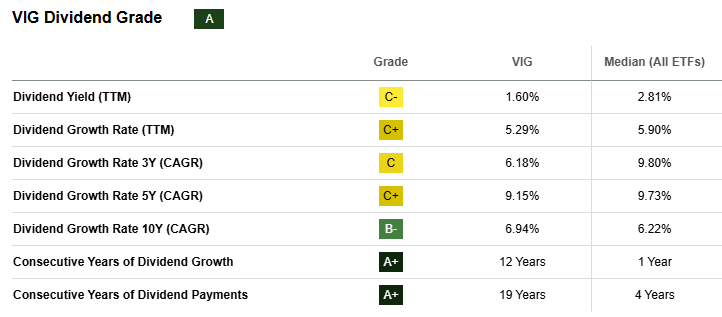
VIG is a compounding machine. Historically, it has raised its dividend payouts at a rate that beats inflation. This means your “paycheck” from this fund effectively gets a raise every single year without you lifting a finger.
As we can see below, VIG has averaged a 9.15% annual raise over the last five years.
Tax Efficiency Bonus
Because of its ETF structure and focus on quality US companies, VIG’s dividends are generally “Qualified Dividends.” This means they are taxed at the lower capital gains rate rather than your ordinary income tax rate, making VIG an excellent tool for taxable brokerage accounts.
Want to find the highest quality compounders in the market? The Yieldly Dashboard can help you. You can visualize your monthly dividend income and get personal portfolio analytics.
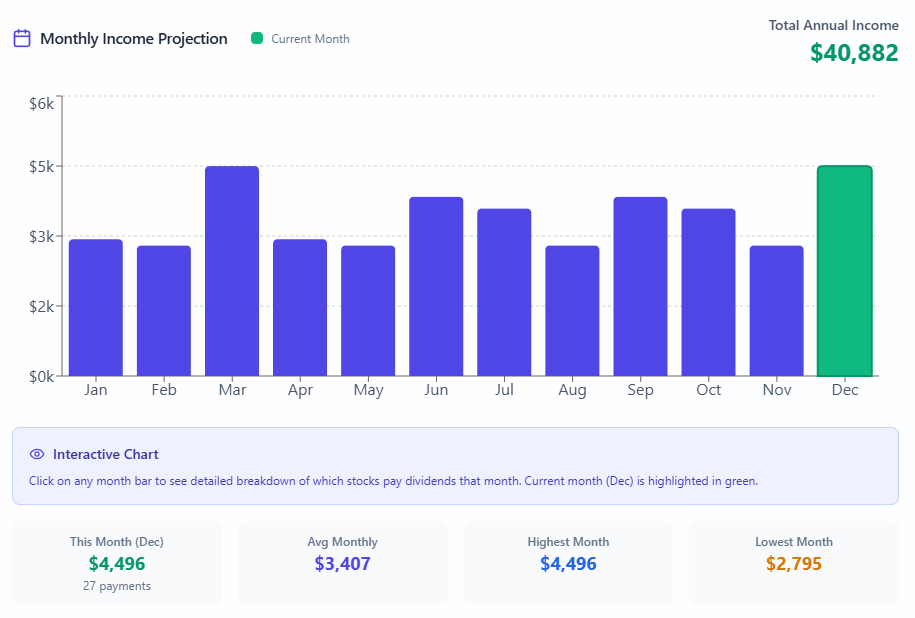
Access to Yieldly comes with instant access to Yieldly Dashboard.
👉 Get 5% off the Yieldy Dashboard!
🏁 Final Takeaway: Who Is This For?
Verdict: The Core Foundation
VIG is the foundation of a “sleep well at night” portfolio.
Buy It If: You want instant diversification, you have a long time horizon (10+ years), and you want to avoid checking your portfolio every day.
Skip It If: You need high immediate income to pay bills tomorrow (look at SCHD or JEPI instead), or if you want maximum aggressive exposure to AI tech stocks.
The Bottom Line: You don’t need to be a stock-picking genius to retire wealthy. You just need to own great companies for a long time. VIG makes that easy.