

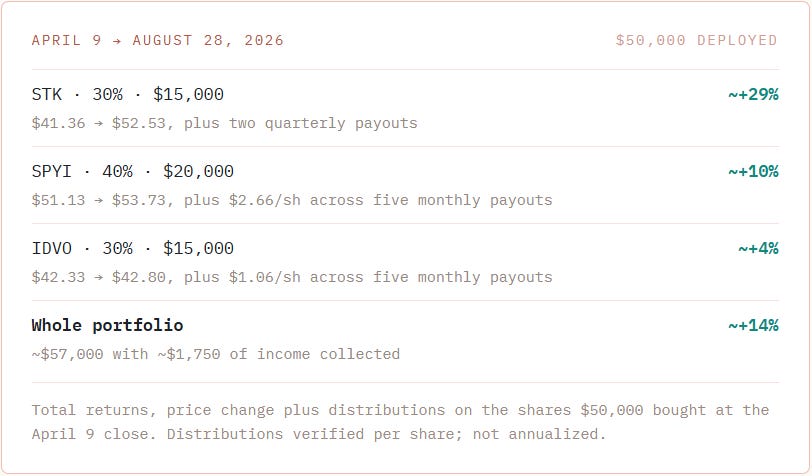
Back in April I gave paid subscribers a complete $50,000 starter portfolio built from three income funds. Five months later that portfolio is up roughly 14% and has paid about $1,750 in distributions along the way, which means the person who copied it in April has already collected more income than most savings accounts pay in three years.
So this article will be a part 2, which refines the strategy further! I’ve heard a lot of feedback about how income ETFs lack growth potential, so this article addresses that.
I’ve been able to strike a balance so that the portfolio now pays a high income AND delivers appreciation over time.
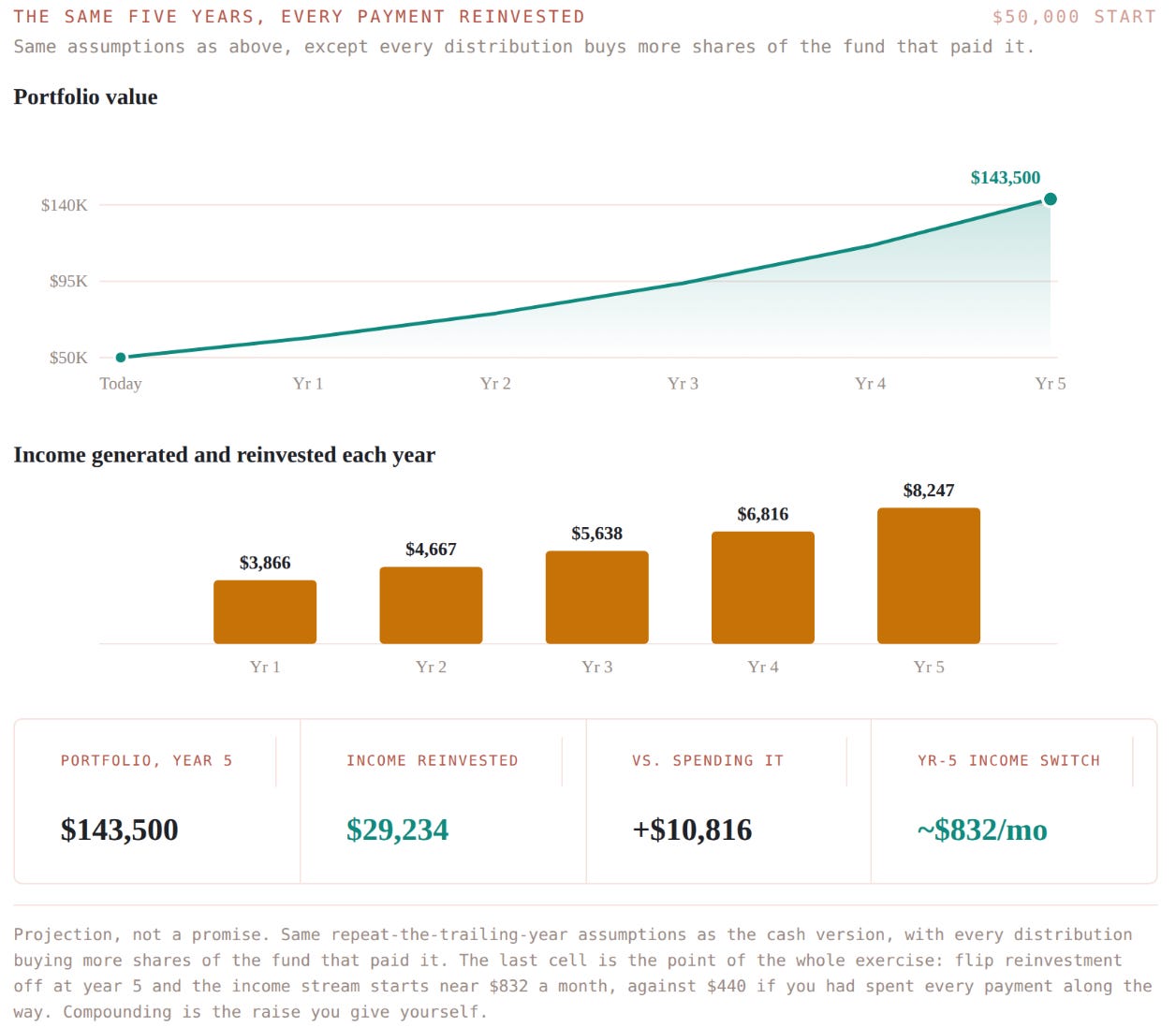
Here’s a forward looking projection of this updated portfolio of five funds, assuming the market rally continues. 5 position position that can triple in value if you reinvest dividends.
So this post does two things: it shows you exactly how each April position performed, fund by fund, and then it shows you the version I’d build if I were starting today.
👉 What you’ll get out of this
The April portfolio’s full report card, position by position. What I’d keep, what I’d cut, and why my own rotation toward growth changed the recipe. And the new five-position $50K build with exact weights, including what it pays from day one.
The April Report Card
Every position finished green, and one of them ran.
The April build was 30% Columbia Seligman Premium Tech STK 0.00%↑, 40% NEOS S&P 500 High Income SPYI 0.00%↑, and 30% Amplify International Enhanced Dividend IDVO 0.00%↑.
Three funds with the goal of paying as much as possible, as reliably as possible, WHILE GROWING CAPITAL.
Here’s what $50,000 deployed on publication day looks like as of the August 28 close:
Okay let’s improve this now…
What I’d Build Differently Today
The April portfolio was built to maximize income, and that’s exactly what I’d change. This year I rotated my own money toward growth, sold the funds that paid the most but grew the least, and let covered call income replace some of what the high yielders used to pay me. Every monthly report since June has shown that shift working.
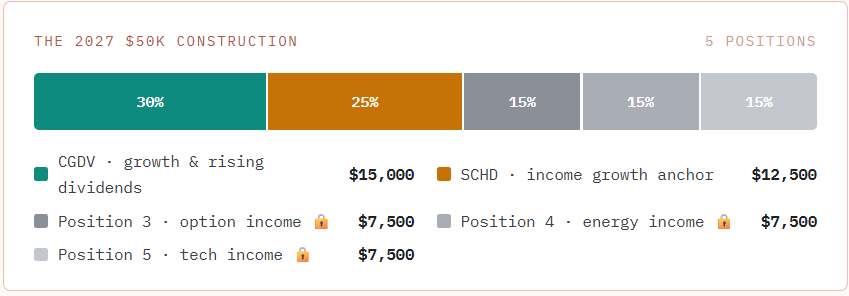
So the 2027 version fixes the ratio without shrinking the paycheck. It puts 55% to work in growth and rising dividends, then loads the other 45% into double-digit monthly payers, and the result is about $322 a month from day one, roughly 85% of what the April build paid, while more than half the portfolio now compounds. That’s the upgrade in one sentence: nearly the same income, and the growth engine April never had.
The New Allocation
Five positions, two jobs: 55% grows, 45% pays monthly. Here’s the full 2027 construction, with the two anchor positions named up front and the other three behind the paywall:
Nothing here carries a 40% yield, nothing uses leverage, and nothing needs babysitting, because a first portfolio's main job is to still exist in five years.
Position One: CGDV — 30%
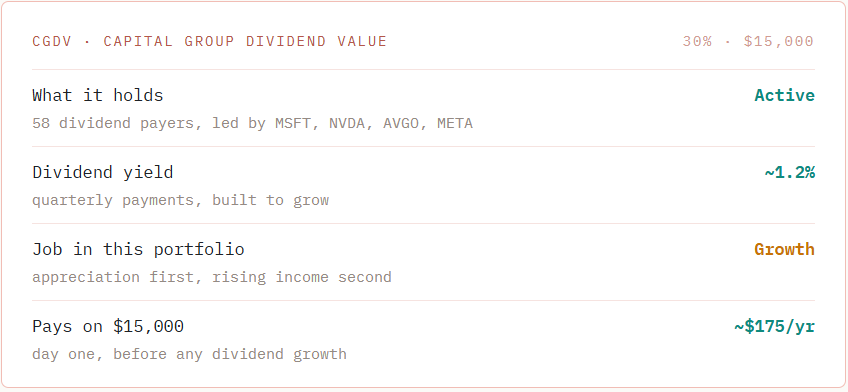
The biggest slot goes to the fund that does both jobs at once. The Capital Group Dividend Value ETF CGDV 0.00%↑ is an actively managed fund holding 58 companies that pay dividends today and are built to keep raising them, and its largest positions are Microsoft, Nvidia, Broadcom, and Meta. That mix is exactly why it anchors this portfolio: you’re getting the companies driving the market’s growth, filtered through a manager who insists on getting paid along the way.
The yield is small, a little over 1%, and that’s fine.
This slot isn’t here for the income it pays in year one. It’s here for what a growing stream of dividends attached to appreciating companies turns into by year ten, and for the fact that it has beaten the plain S&P 500 while paying you quarterly. I own CGDV myself alongside my direct positions in Amazon, Meta, and Microsoft, and it’s the single fund I’d hand a beginner first.
Position Two: SCHD — 25%
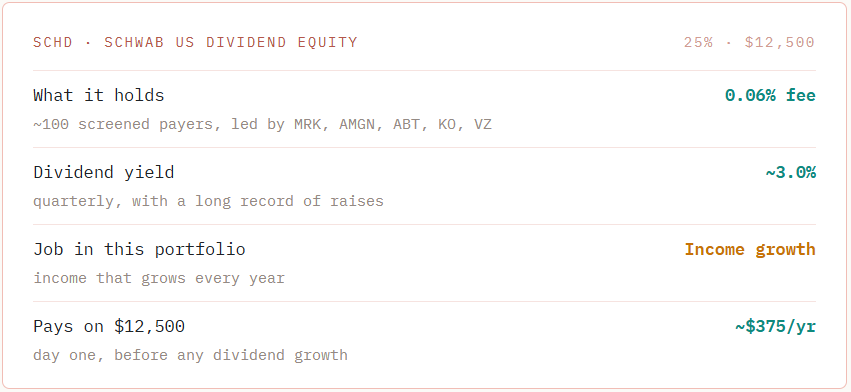
The second slot is the raise machine. The Schwab US Dividend Equity ETF SCHD 0.00%↑ holds roughly 100 companies screened for a decade of consecutive payments, cash flow to cover the dividend, and a track record of growing it. It yields about 3% today, and the number that matters more is what it does to that payment over time: SCHD has raised its dividend at a high single digit rate for years, which means the income on this $12,500 roughly doubles every eight to nine years without you adding a dollar.
SCHD also fixes a problem most beginners don’t know they have. If your only holding is an S&P 500 fund, your retirement is riding on a handful of mega cap tech names, because that’s what the index has become. SCHD holds essentially none of them. Merck, Amgen, Abbott, Coca-Cola, Verizon.
These are boring companies that offer durable cash flows and almost zero overlap with the growth side of this portfolio.
Position one and position two should never have a bad year for the same reason.
📊 Positions three and four come from the same watchlist I maintain in The High Yield ETF Database, where I track every income fund I follow with the risk notes I actually use.
The next three positions are for paid subscribers
The monthly payer running the same engine as one of the April funds on a richer index, and why that beats keeping the original
The monthly payer built on the energy behind the AI buildout, which I alerted earlier this year and still buy today
The pure growth fund that rebalances itself into whatever’s working, and why it beats stock picking for a beginner’s growth sleeve
Why each of the three April funds lost its slot, including the one I still rate highly
The full payout table: what all five positions pay on $50,000, position by position.
