Every other Friday a paycheck lands in your account, and by the next Thursday most of it has gone to rent, the car payment and groceries, which leaves you waiting on the next one. That paycheck also only keeps coming as long as you keep showing up to earn it.
Dividends flip that around, because when you own a fund that pays them, the companies inside it send you a slice of their profits every month or quarter, whether you worked that week or not. Most people hear “$5,000 a month in dividends” and assume it’s only for people who already have money, but getting there comes down to two phases anyone can follow.
The build: you pay the account. Every month you add money to growth funds that pay you almost nothing, so the balance can get big. This is how most of the world invests.
The switch: once your balance hits one number, which you’ll find in the table below, you move the money over.
The payout: the account pays you. The money sits in income funds built to send cash, and they send you a check every month.
👉 By the end of this post you'll know how much to invest each month, roughly how many years it takes, and the exact point where you stop building and start getting paid.
What $5,000 A Month Actually Takes
Income funds pay you a percentage of what you own every year, called the yield. At a 10% yield, every $100,000 you own pays about $833 a month, so $5,000 a month ($60,000 a year) takes about $600,000 invested.
I call that balance your switch number, because it’s the point where you flip from building to getting paid.
A higher yield lowers the switch number, so 8% needs $750,000 and 12% needs $500,000. For scale, $60,000 a year is about 92% of what the typical full-time worker earns, based on the BLS median of $1,251 a week in the second quarter of 2026 ($65,052 a year), so hitting your switch number replaces most of a normal paycheck.
I am currently sitting under that number but gradually working my way to $60k.
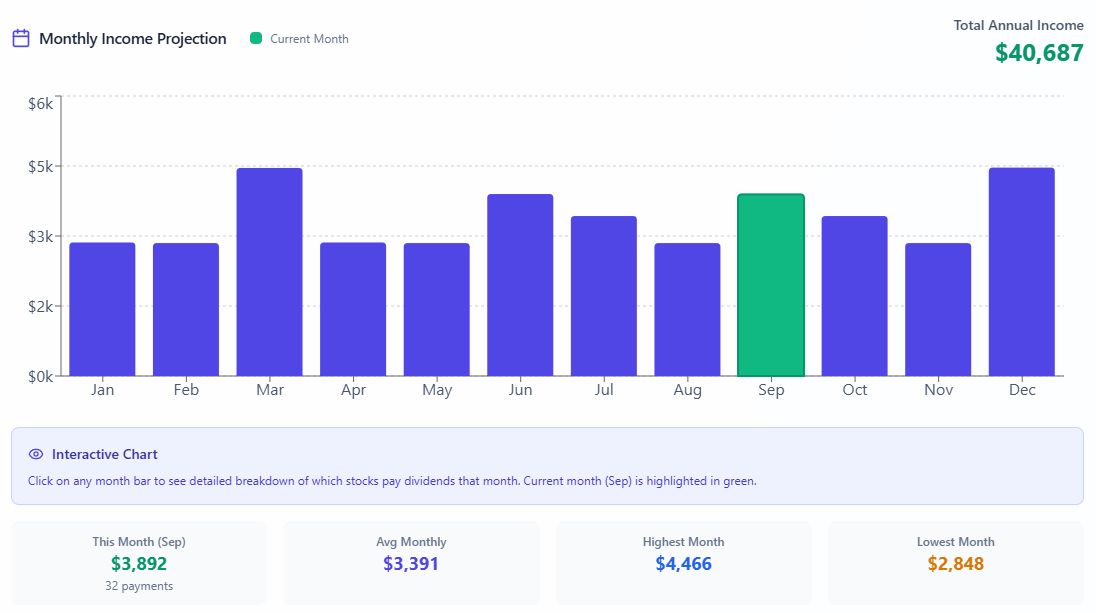
Find Your Row
Pick the amount you can realistically invest every month on the left side of the table, then read across to the yield you expect your income funds to pay, and the number in that box is roughly how many years it takes to go from $0 to your switch number.
You may think this process takes a long time. It does. That’s why I encourage folks to invest as much as they possibly can, as quickly as possible. Who wants to sit around for 20 years doing this?
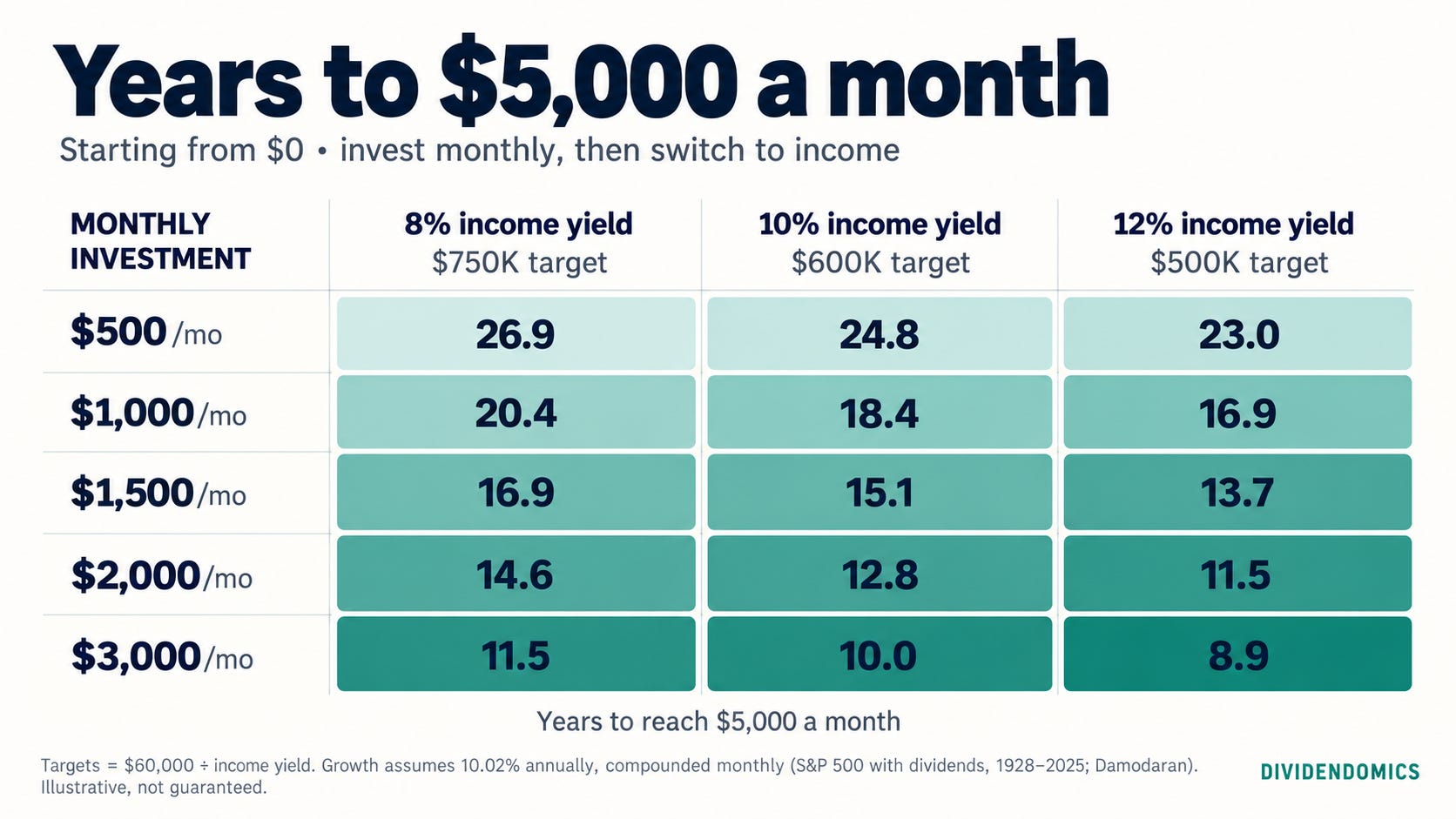
At $1,500 a month and a 10% income yield, you're looking at about 15 YEARS from a $0 balance. Push the deposit to $3,000 and it drops to 10 years, while $500 a month still gets you there in just under 25. Every cell uses the S&P 500's long-run pace, where $100 invested in 1928 grew to $1,157,599 by the end of 2025 with dividends reinvested, which works out to 10.02% a year compounded using NYU Stern's data.
💬 Find your row and drop it in the comments, along with the cell you're aiming for. If you're already partway there, tell me your current balance and I'll show you how much of the table you've already skipped.
Let The Market Do More Than Half The Work
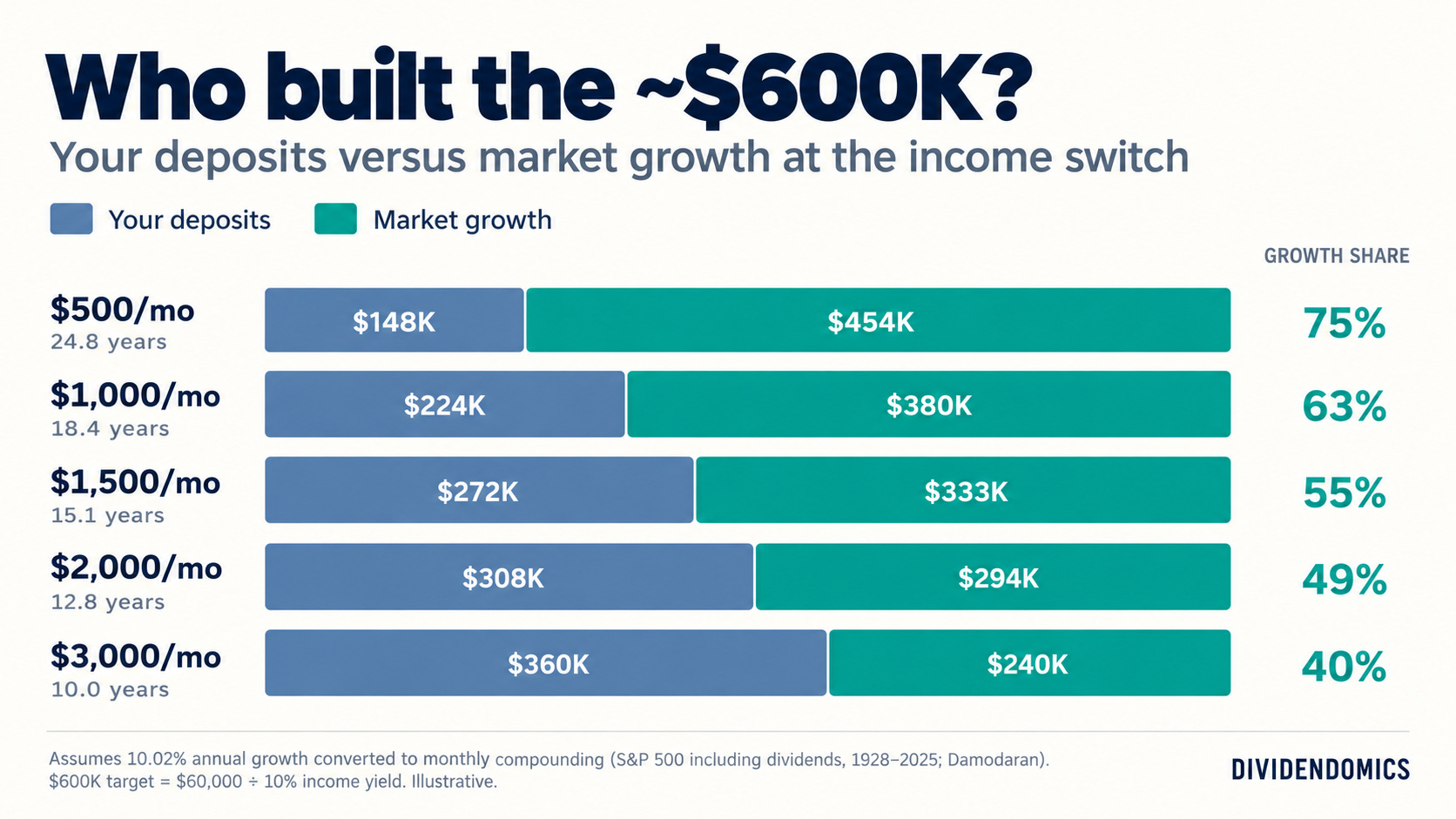
At $1,500 a month, you’ll have deposited $271,500 by the time the balance crosses $600,000, and the other $333,448 came from growth. The growth barely shows up for the first decade because the balance is still small, and then around YEAR 13 the market’s contribution passes everything you’ve put in yourself.
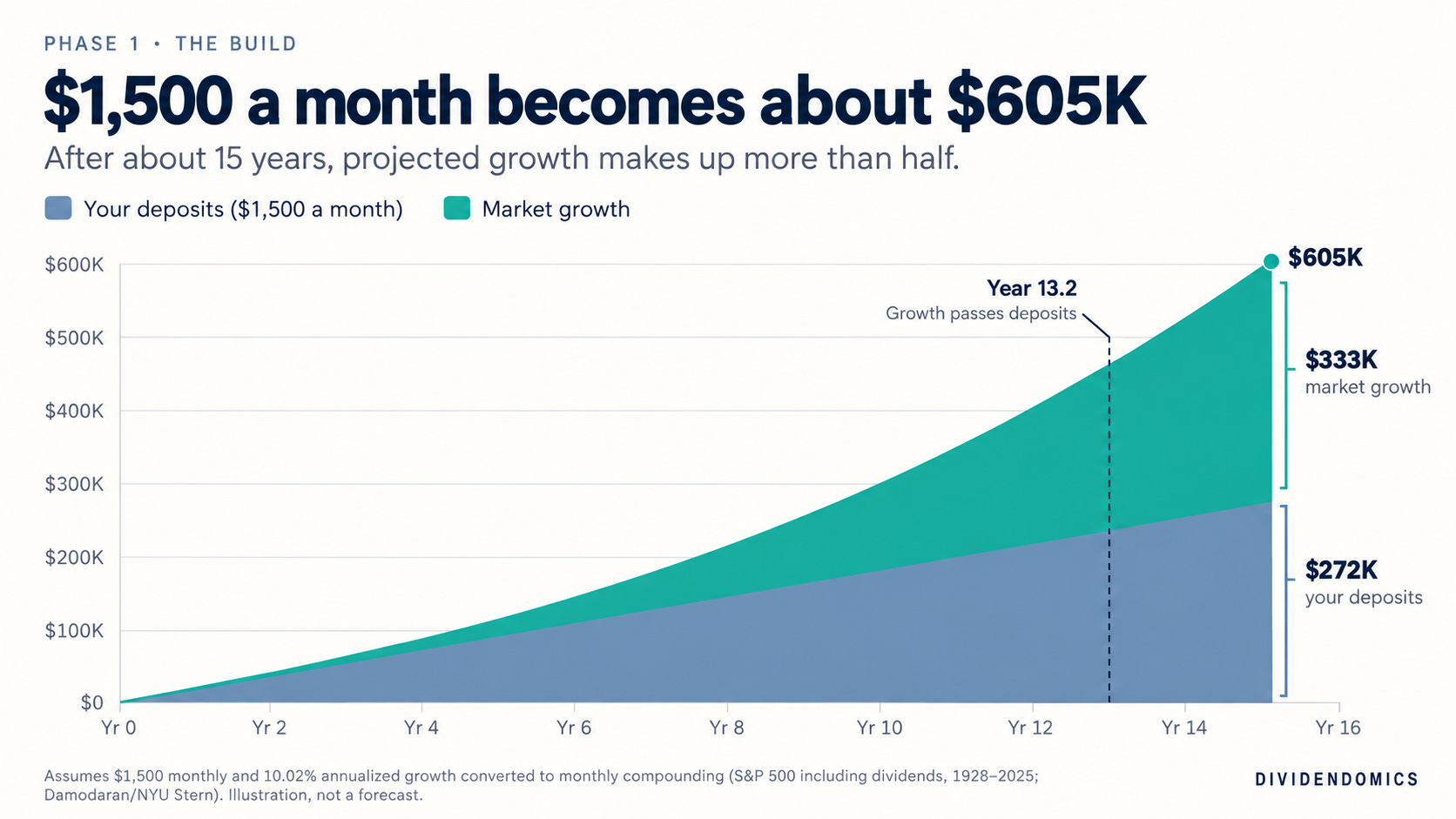
The same pattern runs through every row of the table, and the smaller your deposit, the bigger the share the market covers, because a longer runway gives compounding more years to work. At $500 a month the market ends up supplying 75% of the $600,000.
That’s why the build belongs in growth funds that pay out almost nothing. While you still have a paycheck you don’t need the income, and every dollar paid out early is a dollar that stops compounding and, in a taxable account, gets taxed along the way. I laid out which layers to own over time in How To Build A Portfolio That Eventually Produces $5K A Month, and the table above puts a timeline on it.
The income side is where the switch number gets smaller, because the pair of income funds I’d use pays a blended 10.7%, which pulls the switch number down to about $560,000 and takes roughly seven months off the $1,500 row.