

Fidelity’s latest estimate says a 65-year-old retiring in 2026 will spend an average of $185,500 on healthcare through retirement, up 7.5% in a single year, and that figure leaves out long-term care entirely. Most people never save a dollar towards healthcare because it’s weird to think about us getting old. They reach their sixties, the medical bills start arriving on a schedule, and the money comes out of whatever retirement savings were supposed to cover everything else. When those savings run thin, the insurance company becomes the person you negotiate your health with.
I never wanted to feel like I was begging an insurance company for coverage. Whether a treatment happens should not depend on whether an adjuster approves it, and the only way I know to remove that dependence is to show up at 65 with a dedicated pile of money that answers to nobody.
So I am building that pile now, inside my HSA (Health Savings Account), with a dividend ETF. The account gives me three tax breaks on the same dollars, the fund raises its payment nearly every year, and every distribution buys more shares. This article walks through the account, the fund, what it holds, and what $3,000 a year turns into over 25 years when nothing gets spent along the way.
This will be the second fund within my HSA, focused around total return and income growth.

Open A Health Savings Account ASAP
A health savings account is the only account in the tax code with three separate breaks on the same money. It’s the only account that allows you to grow your capital without any TAXES paid.
Contributions go in before tax.
Growth inside the account is never taxed.
Withdrawals for qualified medical costs come out untaxed too.
A 401k gives you the first two and taxes you on the way out. A Roth taxes you on the way in. The HSA skips all three, and for 2026 an individual can put in up to $4,400, so my $3,000 fits with room to spare.
Every dollar inside gets invested and stays invested. By buying a fund that produces me dividends, I can pay for healthcare expenses with DIVIDENDS, rather than capital I contributed or capital gains, which would force me to sell investments.
One feature makes this even better, and almost nobody knows it. There is no deadline on HSA reimbursements. If I pay a $500 medical bill in cash today and keep the receipt, I can reimburse myself from the account in 2049, tax free, after that $500 spent twenty years compounding. The receipts folder is effectively a stack of future tax-free withdrawals that grow until I want them.
The Specific Fund I Am Using
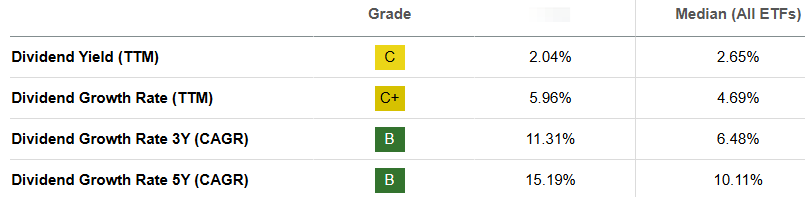
The fund I use charges 0.05% a year, which rounds to nothing. It holds 385 companies, so no single business failing can hurt the plan. Its dividend has grown about 15% a year over the past five years, and it has paid for eight straight years without interruption. Its starting yield sits near 2%, which looks small next to the double-digit payers I write about elsewhere, and for this specific job the small yield with fast growth beats the big yield with none.
Looking at the table below, this fund has been able to provide an average annual dividend raise of 15.19% per year, for the last FIVE years. Does your job give you a 15% raise every year?
The selection methodology is what separates this fund from the dividend funds everyone already owns. Most dividend indexes rank companies by yield or by years of consecutive raises. This one ranks them by the total dollars a company returns to shareholders through dividends and share buybacks combined, then applies quality screens to both. That single design choice pulls in a different set of companies than the usual suspects, and it is the reason the fund looks the way it does inside.
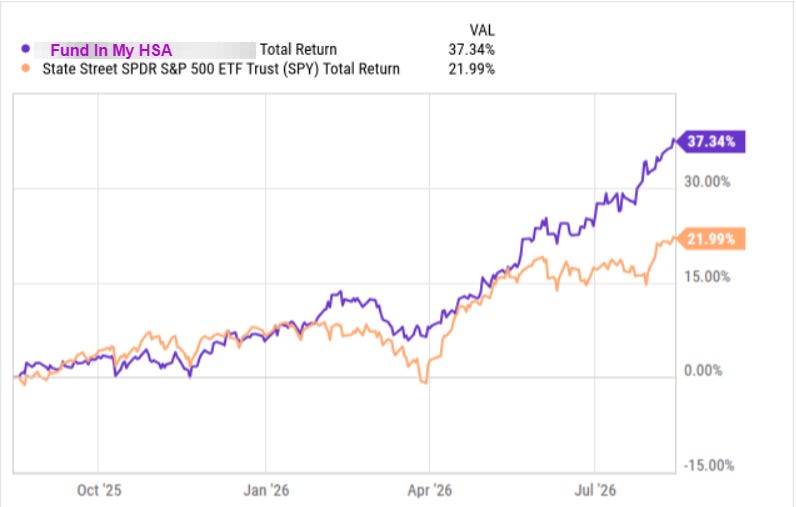
It has also outrun the market while doing it. Over the past year it returned 37.3% with every dividend reinvested, against 22% for the S&P 500 SPY 0.00%↑. Since 2018 it has compounded at roughly 15% a year and finished ahead of the three most popular dividend ETFs in the country over that stretch. Past results guarantee nothing about the next 25 years, and a record like that is still the right starting point for a fund being asked to carry a healthcare bill.
The fund I am talking about is the…
