

A few weeks ago, I put together an article that highlighted how money was rotating out of the semiconductor and memory space. I estimated that capital would start to flow into the hyperscalers as the market finally realized that the concerns around capex spend was dramatic.

Well, it looks like that process is being sparked by the latest earnings season. Investors enthusiastically rewarded the capex of Microsoft MSFT 0.00%↑ and Amazon AMZN 0.00%↑ because their cloud driven AI demand is easy to model.
Conversely, when Meta Platforms META 0.00%↑ reported, the market reacted with an 8% sell-off. The mainstream financial media assumes Meta is falling behind. The underlying data shows the exact opposite and I want to explain why META is actually the king of AI right now.
Here are the segments of AI simplified for you.
1) Distribution Through Software: This includes the consumer-facing apps that we are all familiar with. Think Microsoft Office, Google Workspace, Meta family of Apps.
2) The Actual AI Models: Gemini, Claude, ChatGPT
3) Infrastructure: Encompasses the chips, data centers, power, and networking systems.
I like to hold the companies that have a stake in ALL the layers. Right now the narrative and momentum has been driven by companies in one of these layers. META has a direct stake in all of these layers.
Over the last six months, we can see how the momentum has played out for these large-cap leaders. META is trailing behind peers but I think this provides us with an opportunity to accumulate.
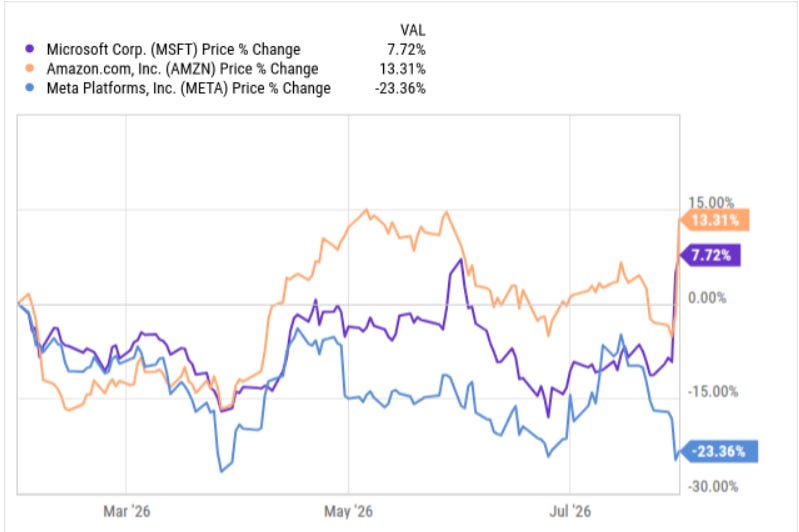
META is one of my largest positions. Here’s what it looks like:
👉 Become a paid subscriber for access to my portfolio of holdings & priority buy alerts.
Monetization Without the Cloud
The hyperscaler business model is simple for analysts to track. Microsoft Azure and Amazon AWS buy GPUs, and analysts model the resulting rental revenue from enterprise clients.
The issue has been that META does not sell public cloud computing like its competitors. However, when Meta buys GPUs the actual monetization path is integrated directly into its consumer ecosystem instead. This is achieved through its massive ecosystem and family of apps. However, this argument won’t hold up for much longer as META explores ways to monetize its AI infrastructure.
The market is pricing META as if Zuckerberg is stupid and doesn’t have a plan.
Meta Platforms Chief Mark Zuckerberg said the company is considering building a cloud business to offer access to its artificial intelligence infrastructure, Bloomberg reported, citing an exclusive interview.
Zuckerberg said Meta was evaluating whether some of its AI infrastructure could be used for external customers, including through renting out computing capacity or providing access to AI models hosted on Meta’s systems.
“The offers that you get for using the compute are so high that it may make sense, in some cases, to rent out or consider those kind of deals instead of your own internal uses,” Zuckerberg told Bloomberg. He also said Meta does not have excess computing capacity and is currently using all of the computing power available to the company. However, he added that a cloud business was “certainly there any time we want to build it.”
The hardware supercharges content recommendation algorithms, dynamic ad targeting, and internal infrastructure. Critics argue Meta is hiding the return on investment of its AI spend because there is no isolated AI revenue line item on the balance sheet.
That argument ignores how Meta actually generates revenue though. Meta is monetizing its AI investments faster and more effectively than anyone else right now and that narrative is being clouded by incorrect assessments.
The primary reason Meta’s advertising segment is growing faster than Google’s is its AI integration. AI directly drives growth by:
Lowering campaign friction for advertisers through automated creative generation.
Increasing advertiser ROI via predictive targeting.
Driving user engagement to record levels through curated video algorithms.
The proof is the top line revenue. Meta hit $60.8 billion this quarter, representing a 28% year over year increase. Adding more ad revenue in a single quarter than any other company is the ultimate proof of AI monetization.
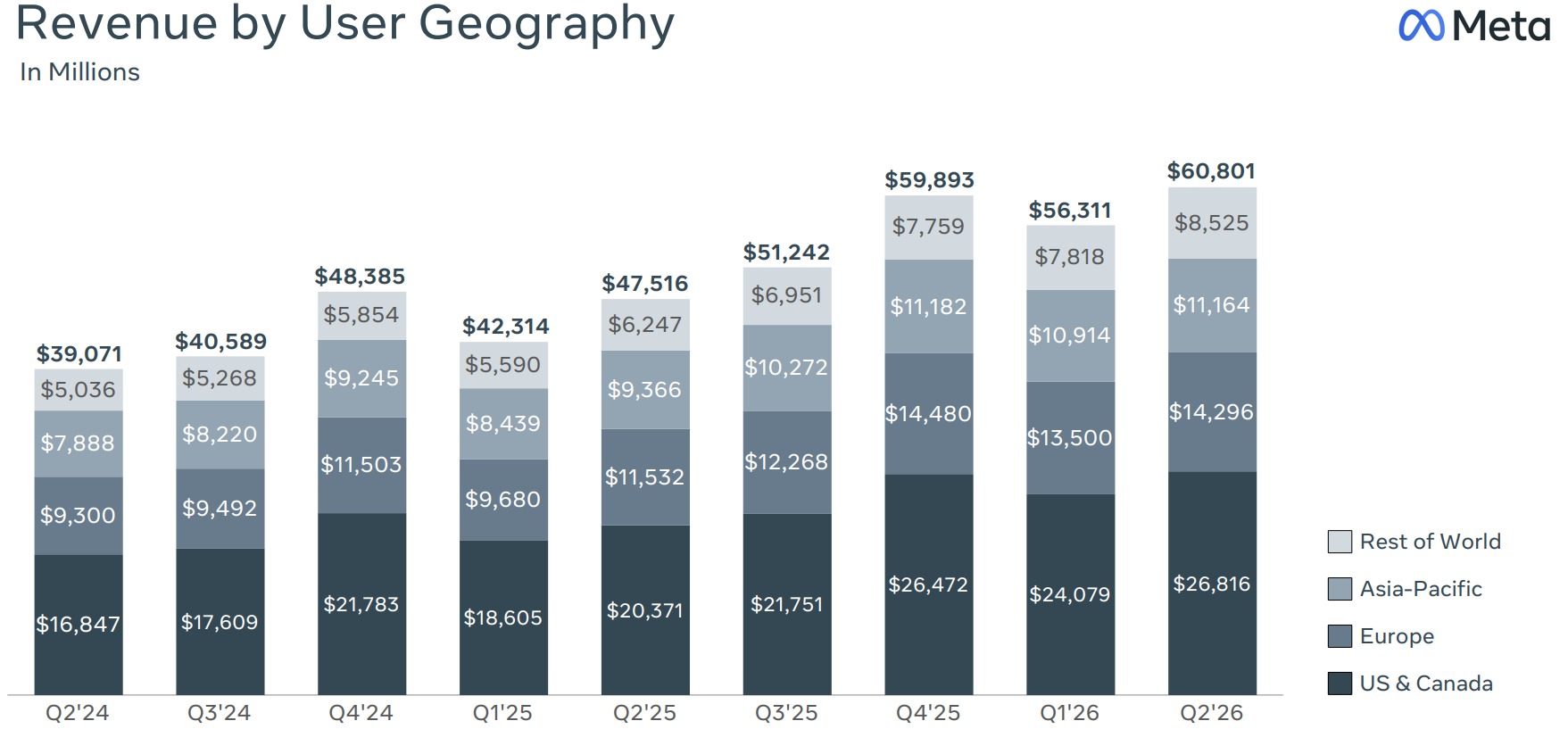
Okay so if earnings are strong, then why the hell did the share price tank?
Well, I think it can be mostly summed up the same as it was last quarter: one-time expenses clouding earnings per share.
Deconstructing the Earnings Miss
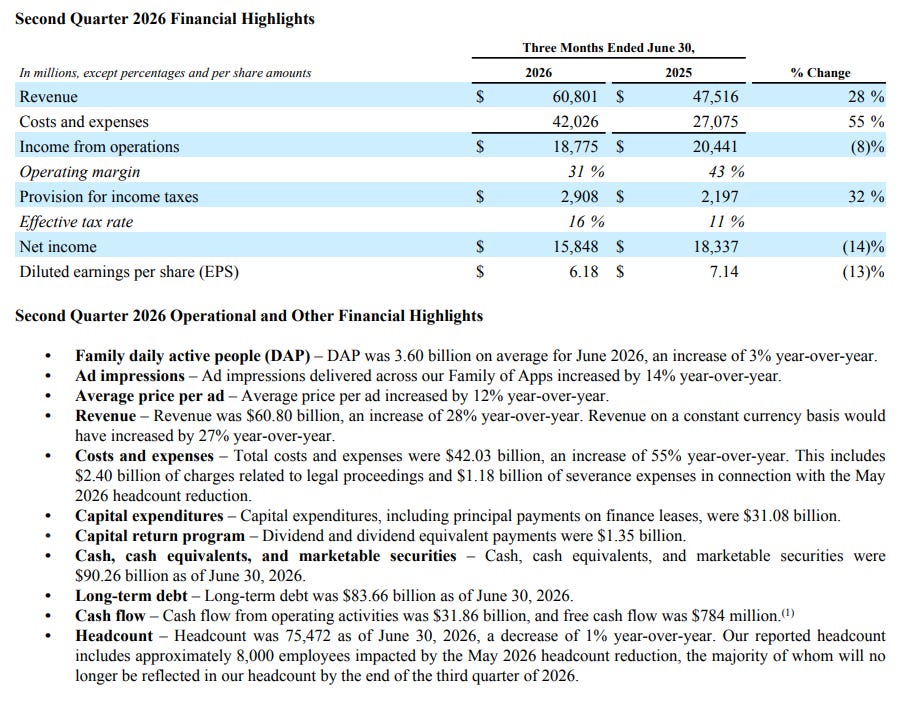
The catalyst can simply be explains by a 14% miss on Earnings Per Share data. The media headlines will milk this and make the entire picture seem a lot worse than it really is. But here’s the reality:
META had to allocate capital towards legal settlements and these were one-time expenses. Additionally, they had severance costs related to all of the layoffs that were initiated over the last few months. Lastly, depreciation of its assets were lumped into this.
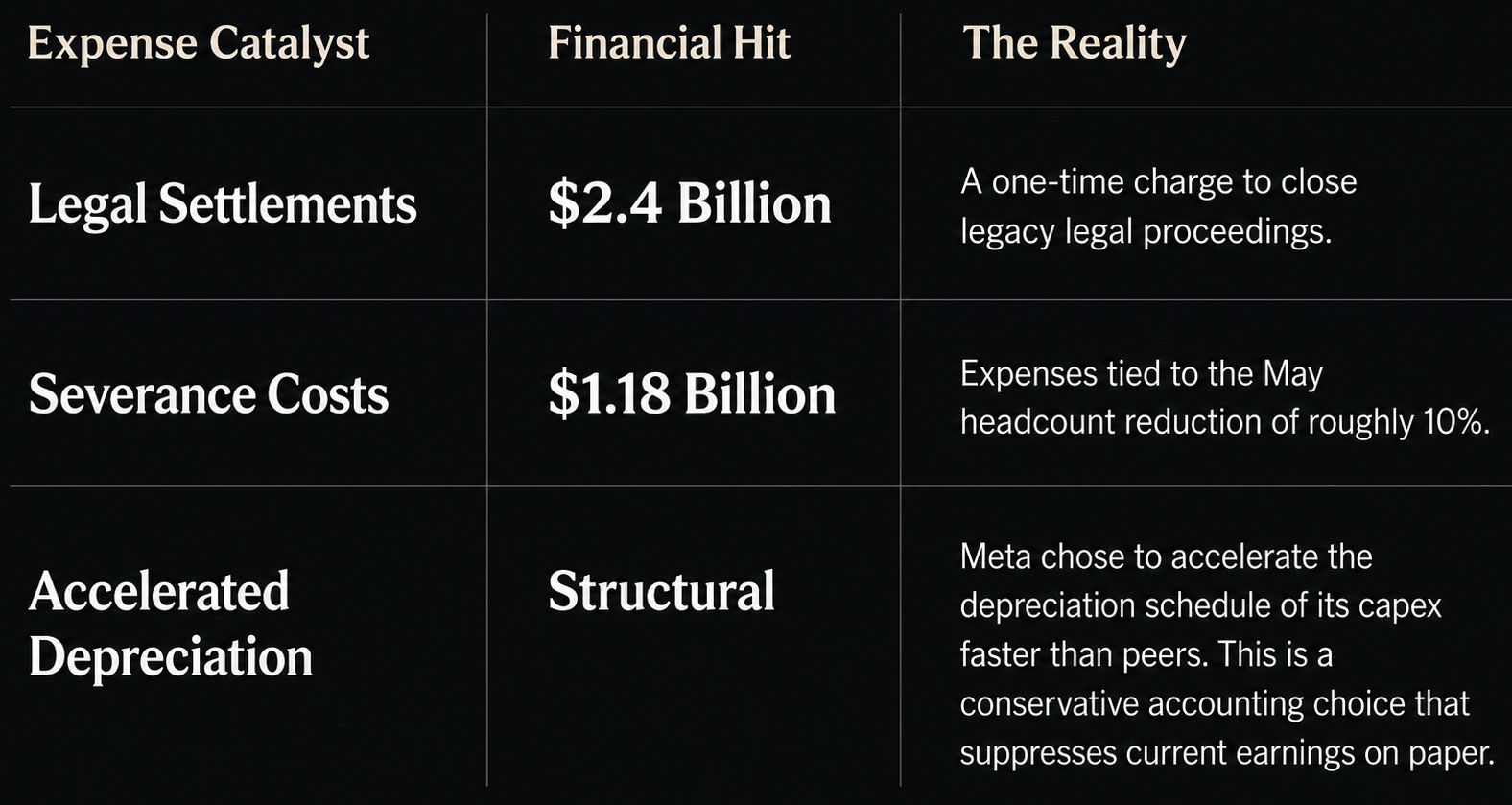
When you adjust for these one time hits and accounting choices, Meta’s operational profitability remains completely intact and actually met expectations.
With these costs, it caused META’s overall costs and expenses to increase 55% YoY. The market seems fixated on the one-time costs, rather than the income that is being produced.
The Flaw in the Peak Social Narrative
Financial bloggers have pushed a “Peak Social Media” narrative for years. They routinely extrapolate temporary dips in Meta’s user base as a permanent structural decline. For instance, a popular narrative would be that Facebook is only for old people.
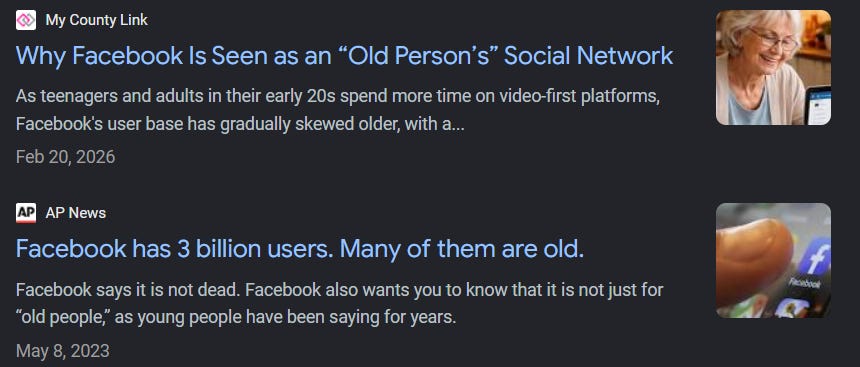
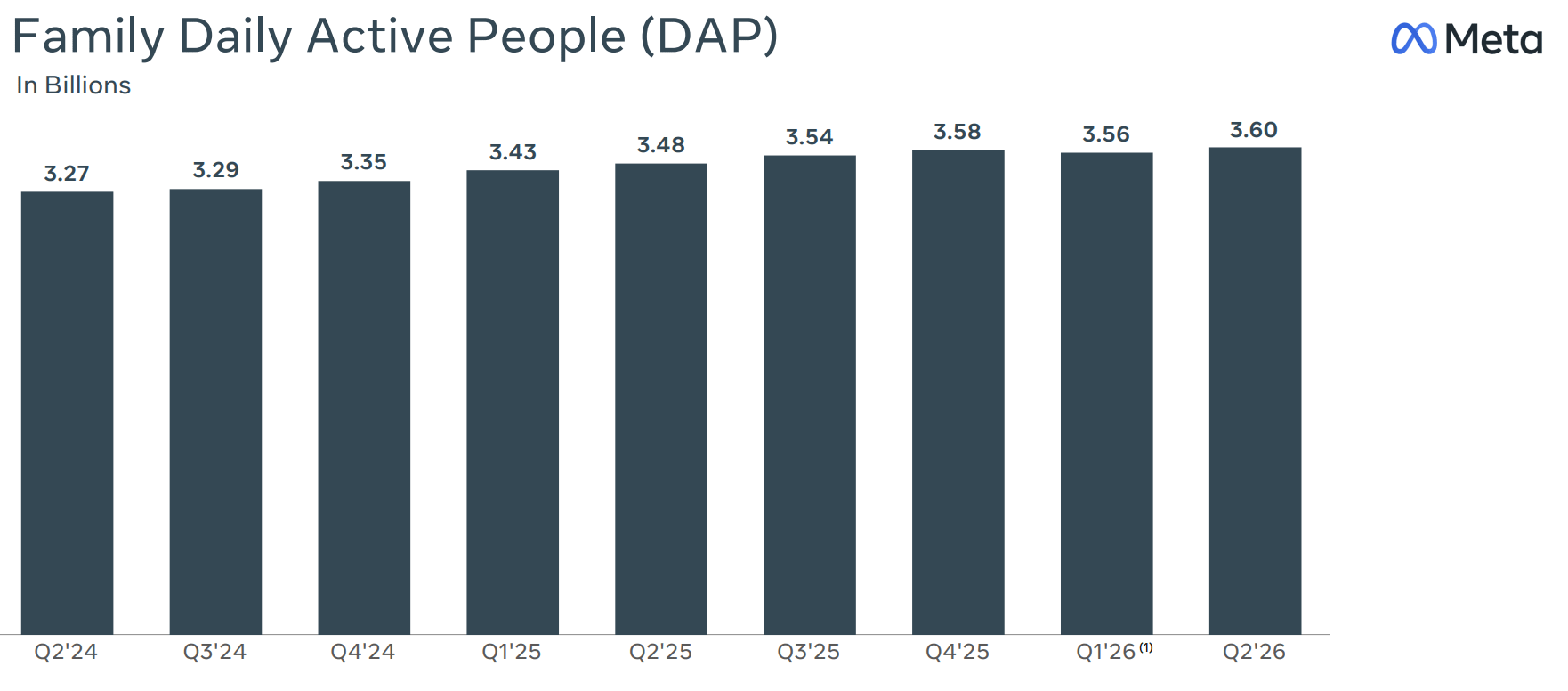
But META isn’t only for old people. The latest earnings report disproves that thesis. Meta’s family of Daily Active Users reached an all time high of 3.6 billion. The trend has continued to rise over the last two years, which means that a lot of the narratives are completely false. As more people are within META’s ecosystem, the business is better ablet to monetize and expand earnings over time.
Engagement metrics increased across all applications. Facebook is seeing 10% increases in video consumption, which easily outpaces traditional streaming growth. Meta is successfully building an ecosystem where businesses can launch and scale without leaving the platform.
Value & Outlook
We currently have an opportunity to accumulate these businesses at attractive valuations. The main reason the hyperscalers sold off initially is because their management continued to raise forward capex guidance. On a forward price to earnings basis, many of these businesses trade at some of the most attractive levels in years.
Meta Platforms: Trades at a forward P/E of 17.97x, which is well below its 5Y-average of 22.28x.
Microsoft: Trades at a forward P/E of 22.42x, which sits below the sector median of 30.98x.
Alphabet: Trades at a forward P/E of 15.87x, which sits below its 5Y-average of 23.39x.
For reference, META is much cheaper than the S&P 500 Index’s forward price to earnings ratio of 20.81x.
CFO Outlook Commentary
We expect third quarter 2026 total revenue to be in the range of $61-64 billion. Our guidance assumes foreign currency is an approximately 1% headwind to year-over-year total revenue growth, based on current exchange rates. We are raising the lower-end of our expense outlook to incorporate the $2.4 billion charges related to legal proceedings recognized in the second quarter. We now expect full year 2026 total expenses to be in the range of $165-169 billion. We continue to expect to deliver operating income this year that is above 2025 operating income.
We anticipate 2026 capital expenditures, including principal payments on finance leases, to be in the range of $130-145 billion, narrowed from our prior outlook of $125-145 billion. Absent any changes to our tax landscape, we expect our tax rate for the remaining quarters of 2026 to be between 15-17%, an increase from our prior outlook of 13-16%. Finally, we continue to monitor active legal and regulatory matters that could significantly impact our business and financial results. For example, we continue to see scrutiny on youth-related issues in several markets and have a number of youth-related trials scheduled for this year in the U.S., which may ultimately result in a material loss.
The Bottom Line
The market is mispricing Meta because its AI infrastructure does not mirror an enterprise cloud provider. Wall Street is treating Meta’s capex as a liability rather than a competitive moat.
If critics are correct and the AI spend is not driving this growth, it implies Meta has a core business organically growing at 28% entirely on its own. That would make the billions in AI spend discretionary cash flow waiting to be unlocked. Either way, the math heavily favors the long term holder. Meta has record user numbers, accelerating revenue, and an advertising system successfully scaled by artificial intelligence. This sell-off provides an ideal entry point to exploit the market’s misunderstanding.
META's operating margin of 30.9% as of August 1 looks solid in isolation, but it trails MSFT's 45.1% by a meaningful gap. The counterargument the author would need to address: META's capex is being absorbed into ad infrastructure rather than a separately billable cloud line, so margin compression during the build phase is expected. ROE of 29.8% and debt-to-equity of 0.43 suggest the balance sheet can absorb continued spending without structural risk.
What's your opinion on META "Ad-Break" unskipable ad feature?