

Where We Are With Semiconductors
I have been watching the semiconductor rally with a fair amount of skepticism lately. Chips have led the market for most of 2026 on the back of AI demand, and for a long time the earnings backed up the move. Over the past few weeks, though, the price action has started to pull away from the fundamentals, and in my experience that gap is worth paying attention to.
I was quick lucky with the timing but I initiated a buy alert on CHPY 0.00%↑ at the market bottom. Since then, CHPY has outperformed the S&P 500 at a wide margin. As we can see below, the semiconductor sector has crushed the rest of the market.
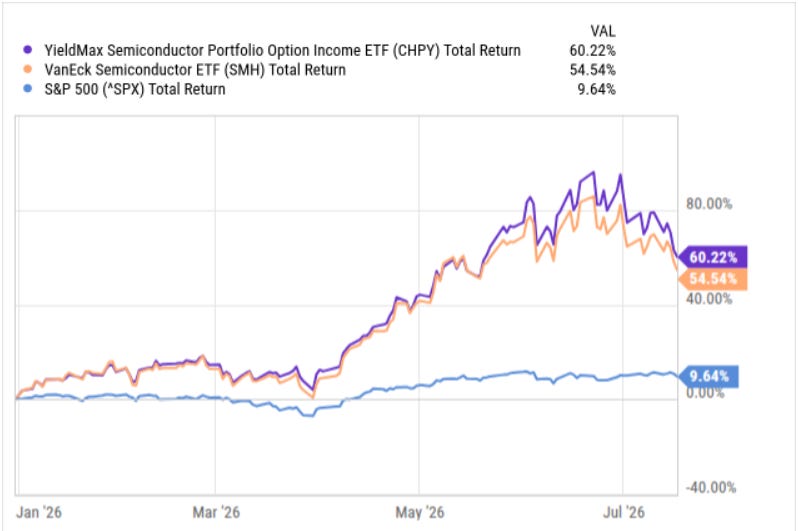
However, I believe we are at the beginning stages of a market shift. Money is still pouring into the sector, valuations are stretched, and the group is priced for everything to go right. At the same time, the stocks have started to shrug off strong earnings, which is usually one of the first cracks to appear in a crowded trade.
ASML Holding ASML 0.00%↑ reported strong earnings, but the stock sold off.
Broadcom AVGO 0.00%↑ crushed their earnings, but the stock sold off.
Taiwan Semiconductor Manufacturing TSM 0.00%↑ delivered strong earnings, but the stock sold off.
See the trend?
When capital eventually leaves a trade like this, it tends to rotate rather than exit the market entirely, and it usually favors large, profitable businesses that were ignored during the run. A lot of those names are trading at valuations we have not seen in a while.
👉 This is the basis around my latest buy alert.

This piece walks through three things. First, the fund flow and price data that tell me the chip trade is topping. Second, where that capital is most likely to rotate. And third, the two funds I would pair together to collect income while positioning for it.
The Fund Flow Data
Here is the data that got my attention, with the sources linked so you can check it yourself. In April, money was flowing into US semiconductor ETFs at a normal pace. Through late June, roughly $12 billion poured in over a single month, a 1,200% jump from the April rate.
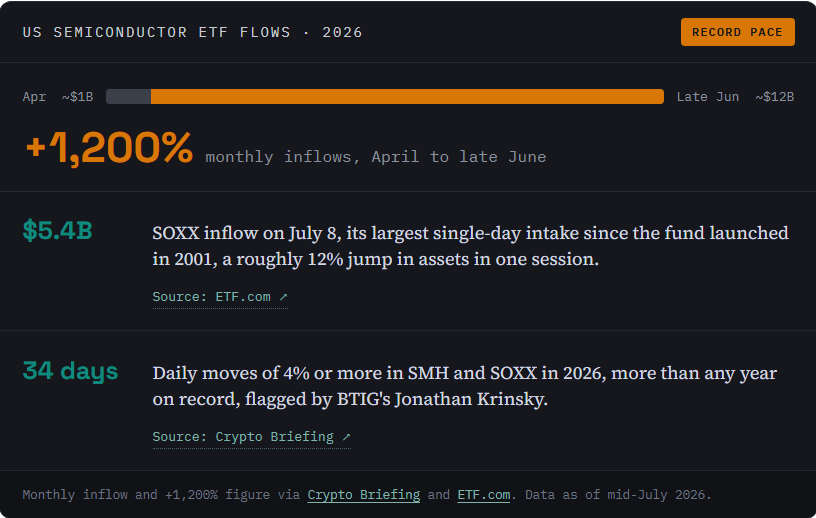
The single-day numbers are the part that stands out most. A haul of $5.4 billion in one session, the largest for that fund since 2001, is the mark of a crowd rushing the same door at once rather than steady, patient accumulation.
The volatility says the same thing. Thirty-four separate days of 4%-plus moves in a single year is the churn of a crowded position changing hands, which is why a BTIG analyst flagged it as a record worth watching.
As we can see below, the market has consistently provide more volatility than the average over the last three year period. Investors are simply CHASING returns at this point.
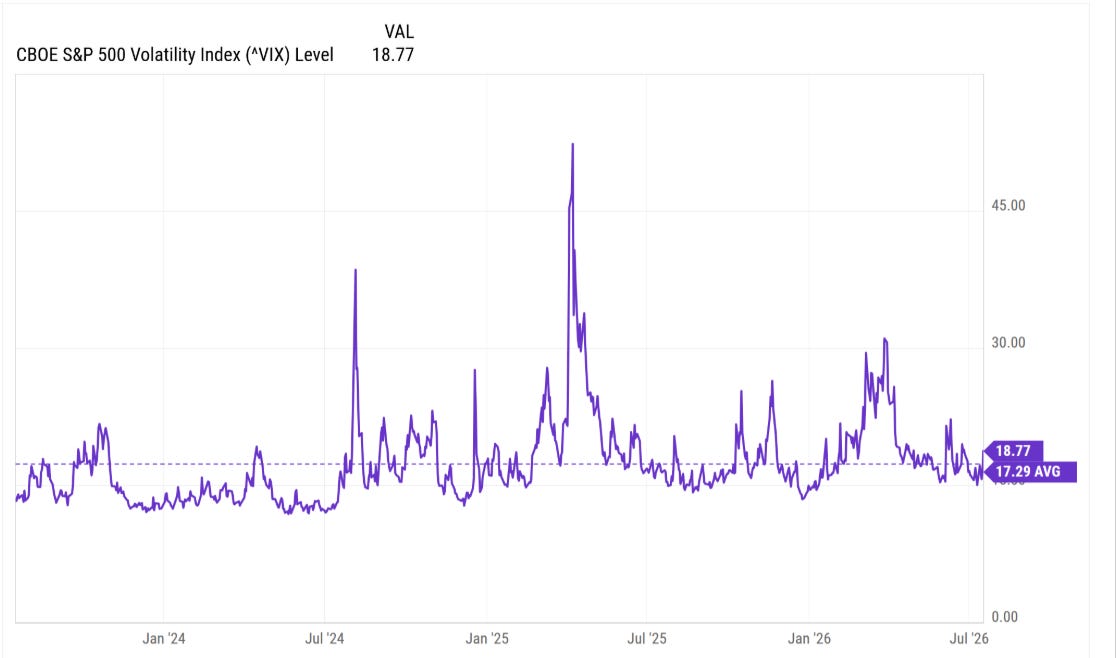
Here is the part worth sitting with. Buying like this clusters at moments of peak enthusiasm, and large inflows at the top have historically been a contrarian signal that the easy part of the trade is already priced in. Pair that with a market that has stopped rewarding strong chip earnings, and you have the profile of a top forming. It does not guarantee a crash, but the easy money in chips has almost certainly been made.
Where The Capital Rotates Next
When money leaves an overheated group, it rotates toward quality that got left behind. Right now, two of the largest names in the market fit that description, and their valuations have compressed while everyone focused on chips.
The first trades at a forward P/E of roughly 18. That is below its own ten-year average and about 35% under the average technology stock. For a business with its margins and cash generation, that is a price the market usually only offers during a scare.