

Owning a home is part of the American Dream for a large percentage of the country. I grew up hearing phrases like “your home is the most important investment you’ll ever make” so naturally, becoming a homeowner was an item on the check list of milestones I wanted to accomplish. I always loved the idea of owning a portfolio of cash flowing properties across the country because I genuinely thought houses were pretty cool, the financial benefits aside.

Then, I actually became a homeowner and I learned that it all seemed a lot cooler than it actually was. For instance, the idea of paying a mortgage isn’t exactly exciting. How can any self proclaimed ‘money guy’ that loves investing, be okay with paying a mortgage where 70% of the payment goes to interest instead of principal? It legit feels like I’m getting robbed every month.
Don’t get me wrong, I still love the idea of owning homes but I learned that homeownership isn’t all that it’s hyped up to be. I quickly learned there are a lot of downsides of owning a property that shifted my perspective. Rental properties require an elevated level of attention because you are ultimately providing a service for others. So it requires attention to detail, such as making sure the dryer vents are clean and the HVAC system is functional, all while ensuring that the numbers continue to make sense. Then there’s the stress of knowing that someone else won’t take care of your property the same way that you will.
While rental properties have proven to be an efficient blueprint for growing your wealth in America for hundreds of years, I find myself slowly adding more capital towards REITs instead. There are such an abundance of REITs in the world that provide a unique edge against a traditional real estate investor trying to own a portfolio of single-family homes. REITs can make you the partial owner of malls, data centers, the Amazon warehouse around the corner, or even the cash wash you visit every weekend.
I wanted to share some thoughts about the differences between rental properties and REITs. I believe that REITs are arguably more attractive investments in this current economic climate. Especially during a time where the average person even struggles to buy their first primary residence, REITs provide us with an opportunity to participate in the property game at any income or net worth.
Efficiency, Effort, & Time
One of the clear benefits of physical properties is the tangibility of them; this is a physical thing that you own and you know that it will always be here. You have control of a house and you can put in sweat equity to increase the value of your home quite rapidly. While the payoff of value-add renovations can be substantial, it ultimately requires time and effort. As someone that owns multiple businesses, it can be hard to find enough time in the day. So if you own a rental property that nets you $400 in cash flow, but it also requires 5 hours of your time every month, you essentially have a job that pays you $80 an hour.
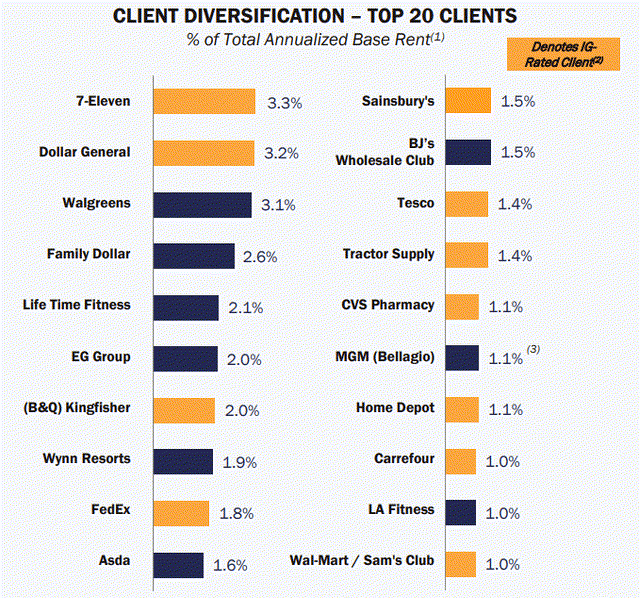
While it is true that the property is also being paid down by the tenant and your net worth is growing through equity, I have discovered that pursuing efficiency can be a lot more rewarding in terms of quality of life. For instance, buying a world-class REIT like Realty Income O 0.00%↑ means that you are delegating the management process to professionals that take care of all the physical work involved with setting up the infrastructure of collecting rent from tenants. The efficiency aspect of REITs allows all of your capital to work on your behalf to produce income, while you aren’t committing a single minute to managing these properties. Not only that, you are getting instant diversity across dozens of tenants.
REITs are also more efficient because these large institutions typically have a better WACC (weighted average cost of capital). As a retail investor, you are at the mercy of retail mortgage rates, while these REITs have access to the institutional debt markets. Therefore, REITs are capable of obtaining spreads that are simply inaccessible to you and I. While the rest of the retail market waits for the Fed to reduce interest rates, REITs continue to have access to capital that we do not have.
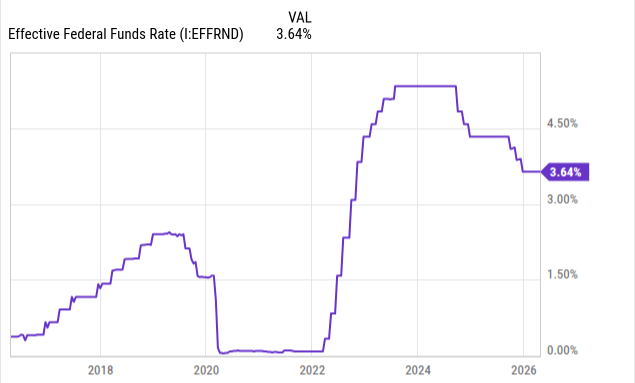
Another benefit is the liquidity that REITs offer investors. If you own rental properties, the process of selling it can be drawn out over months depending on what the real estate market looks like. With a REIT, investors can sell in and out of them instantly and it costs nothing nowadays. If you have $100,000 laying around, this means you can instantly trade in or our of REITs, whereas you $100k down payment is locked into a physical property.
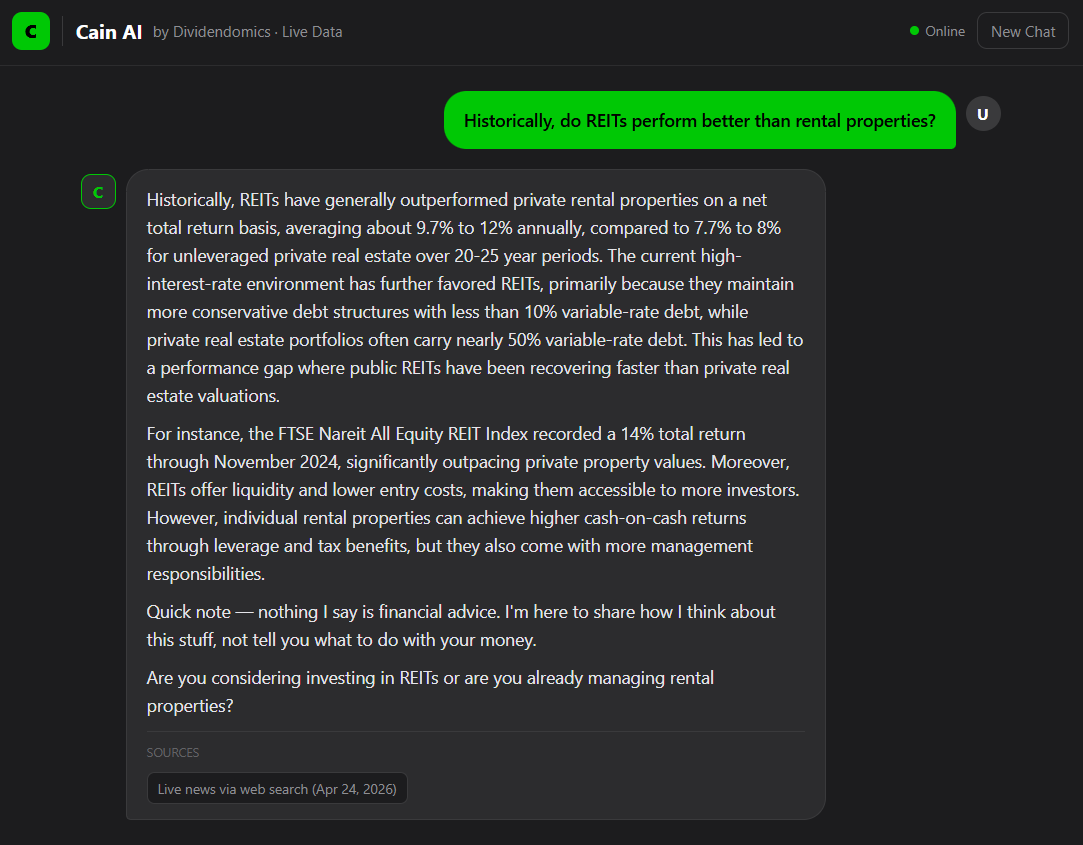
👉 Founding Members gain access to their own personal AI bot - CainAI.
Structural Benefits & Outperformance Of REITs
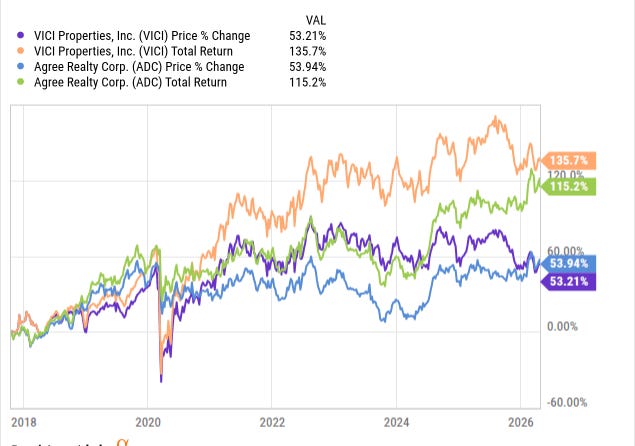
When you own a rental property, you are still responsible for the taxes, insurance, and maintenance of that lot. However, REITs introduce us to the concept of the triple-net lease. This is a structure that makes the tenant of a REIT’s property responsible for all of those things. The triple-net lease structure means that your distributions are essentially being shielded from the rising costs of labor or materials. Two notable REITs that implement the triple-net lease structure would be VICI Properties VICI 0.00%↑ and Agree Realty ADC 0.00%↑.
VICI Properties: owns some of the most notable real estate across the Las Vegas Strip. This allows us to get instant exposure to casinos and collect the cash flow without having to lift a finger.
Agree Realty: allows us to own the buildings that service companies like Walmart WMT 0.00%↑ and Home Depot HD 0.00%↑. The REIT provides exposure across all 50 U.S. states, which is a level of exposure that almost all retail property investors cannot achieve.
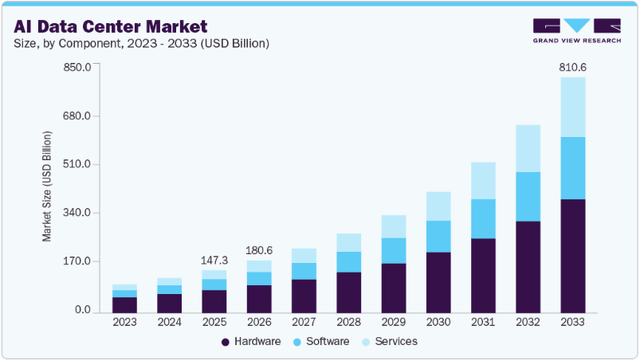
Building on this concept of diversity, REITs also allow us to participate in the sub-sectors of real estate that are directly aligned to participate in the growth of AI. While the majority of the market focuses on the software side of AI, there is a growing demand for physical real estate to house the rising number of data centers required to power AI growth. As the AI data center market expands, there are several REITs that are directly positioned to participate in this growth.
For instance, Grand View Research estimates that the size of the AI data center market can increase to $810.6B by 2033. This represents a CAGR (compound annual growth rate) of 23.9% through the next few years. Even in a scenario where this data is over-estimating by a 50% margin, it would still represent a double-digit upside potential of the market. The following REITs can instantly allow investors to participate in this growth, which is a clear benefit over physical properties:
Digital Realty Trust DLR 0.00%↑
Equinix EQIX 0.00%↑
Iron Mountain IRM 0.00%↑
Prologis PLD 0.00%↑
So not only do REITs have the ability to provide a greater sense of diversity, but they can also increase the rate at which we grow out wealth. With physical properties you are at the mercy of the residential markets. Whereas these other sub-sectors of real estate can remain a lot more resilient or provide more growth through periods of uncertainty.
If you aren’t interested in these other sectors of real estate, there are plenty of REITs that still provide exposure to residential markets. For instance, AvalonBay AVB 0.00%↑ and Mid-America Apartment Communities MAA 0.00%↑ both provide investors with exposure to a portfolio of diverse residential real estate that is a lot more straight forward. These REITs allow you to get exposure to the residential market without the stress of dealing with tenants, which is just another structural benefit.
Dividends Vs. Rent
When it comes to collecting rent from rental properties, your income is pretty static. When you have a tenant in your property, you are collecting 100% of the rent and then using that money to pay down your mortgage, if one still exists. If that tenant moves out, you now need to go through the process of finding a new tenant or else your vacancy drops to 0% and you are stuck paying that mortgage out of pocket. Before you get a new tenant, you may have to repair the different areas of the property that the initial tenant may have damaged.
The benefit of owning a rental property is that you can manually set your rent amount. You have complete control of your potential cash flow, while operating within the limits of your local market. However, there’s always a level of uncertainty when it comes to managing tenants that can become stressful for some investors. For instance, dealing with rent collection can sometimes be a stressful process, especially when it comes to dealing with tenants that are behind on rent.
For instance, here is a prior article I published about a real estate fund offering an 8% dividend yield.
Beyond the Chip: The 8% AI Income Strategy

If you type “AI Investing” into Google right now, you get the same advice: Buy Nvidia. Buy Microsoft. Buy Broadcom.
REITs have such a large portfolio of properties that when a unit is vacant, it won’t impact the level of income that you receive when distributions are paid. In fact, there are a handful of REITs that also issue dividends on a monthly basis, which can replicate the process of collecting income from a rental property. Furthermore, REITs can implement annual rent increases, which can then translate to higher income for investors. For instance, Realty Income has consecutively increased its dividend since 1994. With physical properties, you risk a tenant being upset about a $100 rent increase and having to deal with them moving out.
While a lot of investors are familiar with the specific tax breaks that physical properties offer investors, there are also tax benefits for REIT investors. For instance, we can refer to the Section 199A Deduction, which allows investors to deduct up to 20% of their REIT dividend income from their taxable income. When you combine this with the fact that you aren’t paying for hidden costs like property management fees or value-add renovations, the net yield for investors is often much higher than the cap rate on a house in your local town.
Takeaway
While some investors may still get the pleasure of owning a portfolio of physical properties, it is hard to ignore the many benefits that REITs offer investors. While owning properties has a proven track record of building wealth and cash flow, the modern efficiencies of REITs have the potential to provide similar cash flows, rapidly grow invested capital, and make the whole process of being a landlord a lot more hands off. REITs allow retail investors to participate in the growth of AI data centers or own a portfolio of retail properties.
While investing in physical properties puts you at the mercy of interest rates, REITs tend to operate with better spreads that aren’t accessible to us. REITs offer us instant diversity across the globe and a better liquidity profile than physical properties as well. My goal isn’t aimed at dismissing the perks of physical rental properties. I simply wanted to provide some thoughts about how the American Dream of owning properties can still be achieved with REITs. These instruments provide a scalable version of real estate that also offers cash flows that have some tax benefits.