

If you’re trying to get wealthy, you must get in the habit of investing most of your income. Every dollar you invest acts as an employee on your payroll; they go out to work for you and generate cash flow without your actual labor or effort.
In September I had twenty of those employees on payroll, and together with the covered calls I wrote they paid me $3,220.01.
For instance, Microsoft MSFT 0.00%↑ paid me $56.95 to support my Xbox habit, Meta META 0.00%↑ paid me $33.30 from everyone doom scrolling, Simon Property Group SPG 0.00%↑ paid me $161.77 out of the rent it collects on its malls.
I didn’t send an invoice, take a meeting, or ask anyone for a raise to get a single dollar of it.
This month’s report breaks down every payer, how much came in each week, the covered calls that added to it, where the money went next, and the two positions I’m building at these levels. I’m also sharing my outlook on the memory chip shortage, because I think it’s the most important supply story heading into 2027. Last month’s numbers are in my August 2026 dividend report.
👉 I’ve decided to make this report mostly free. Upgrade Your Subscription for $0.82 a day and get every buy alert as I place it, plus the tools I use to track all of this.
September 2026 Passive Income At A Glance
Dividends paid me $2,106.77 from twenty different positions this month, and covered calls on AST SpaceMobile ASTS 0.00%↑, Amazon AMZN 0.00%↑, and Uber UBER 0.00%↑ added $1,113.24 in premium, for a September total of $3,220.01. Dividends made up 65.4% of it and option premium the other 34.6%.
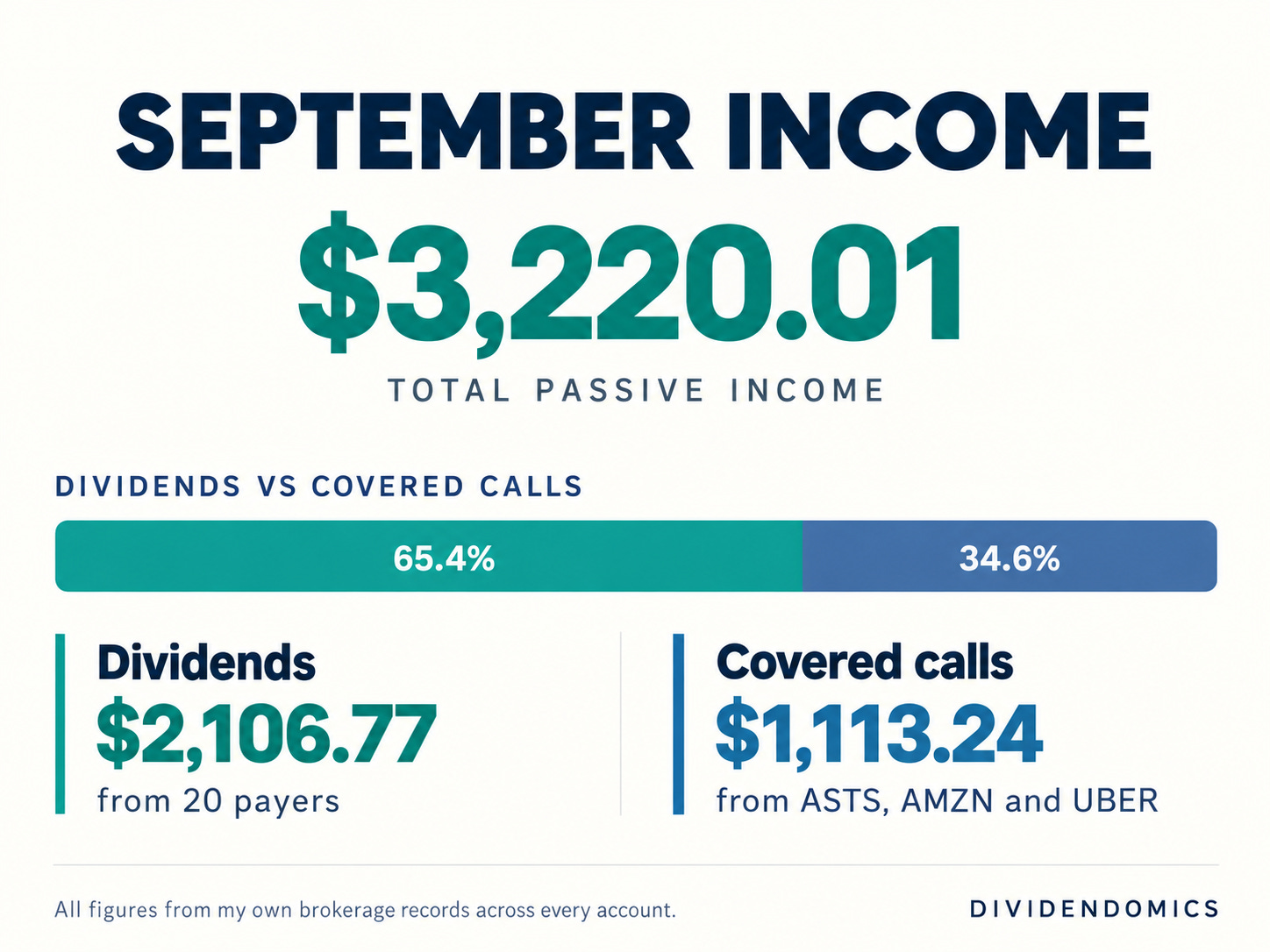
That's down from August's $4,918.01, and I expected it to be. I sold four income positions last month and moved that capital into growth on purpose, which pulled dividends from $2,600.45 down to $2,106.77, and August also carried an unusually large covered call month at $2,317.56.
I'm trading some income today for positions I expect to grow into much bigger income later. I track exactly where that leaves my forward income in the Yieldly Dashboard, which updates every time I add or sell a position.
Only Paid Subscribers Can See What Stocks Issued A Dividend Below
What I’m Buying At These Levels
Two positions get the bulk of my new money through the end of the year, and they do completely different jobs. Amazon is my growth engine, funded by option income. CGDV is the dividend core I’m building to $50,000.
Amazon: still dollar cost averaging
Amazon closed at $248.23 on October 1, according to StockAnalysis, which is 13.6% below its 52-week high of $287.20. The average analyst target sits at $329.54, 32.8% above the current price, and the next earnings report lands October 29 after the close. I laid out the full plan in Buy Alert: I’m Adding Another $15,000 To Amazon, and nothing about it has changed.
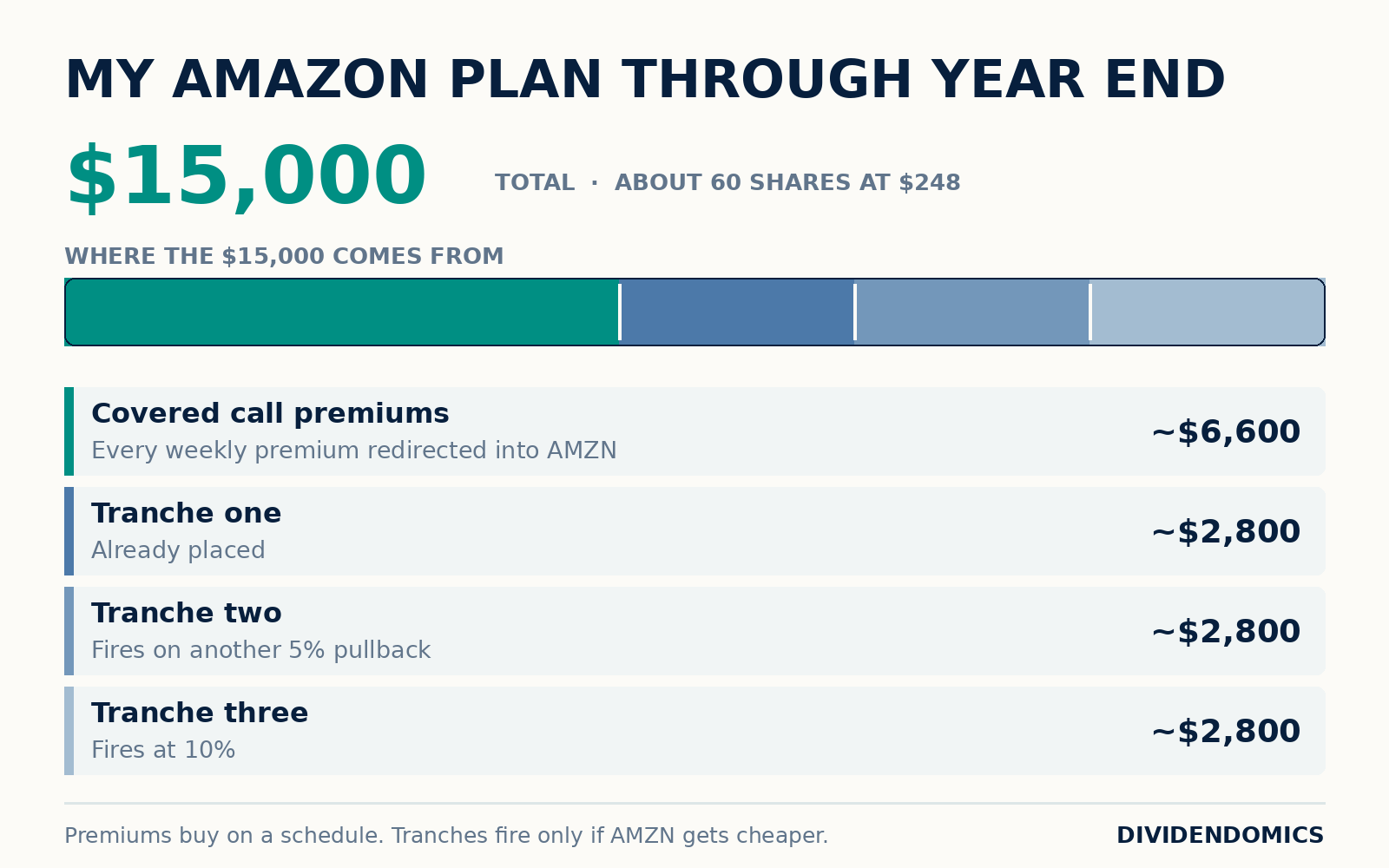
I’m adding $15,000 to Amazon by December 31. Every covered call premium I collect goes into the stock on a schedule regardless of price, which was $1,113.24 of premium in September alone, and three tranches only fire if the pullback deepens. I don’t need Amazon to pay me, since the positions writing the calls already do that, and its job is to compound the capital they throw off.
The one thing that would pause the tranches is the October 29 report. If AWS growth falls back into the twenties, or capex guidance climbs past $220 billion without matching revenue, I’ll stop the tranches and let the premium keep buying at a slower pace while I reassess.
Market Outlook: The Memory Shortage Into 2027
Every AI data center needs processors to do the computing and memory chips to hold the data those processors work on. Everybody talks about the processors. I think the memory side is where the more interesting supply problem sits heading into next year.
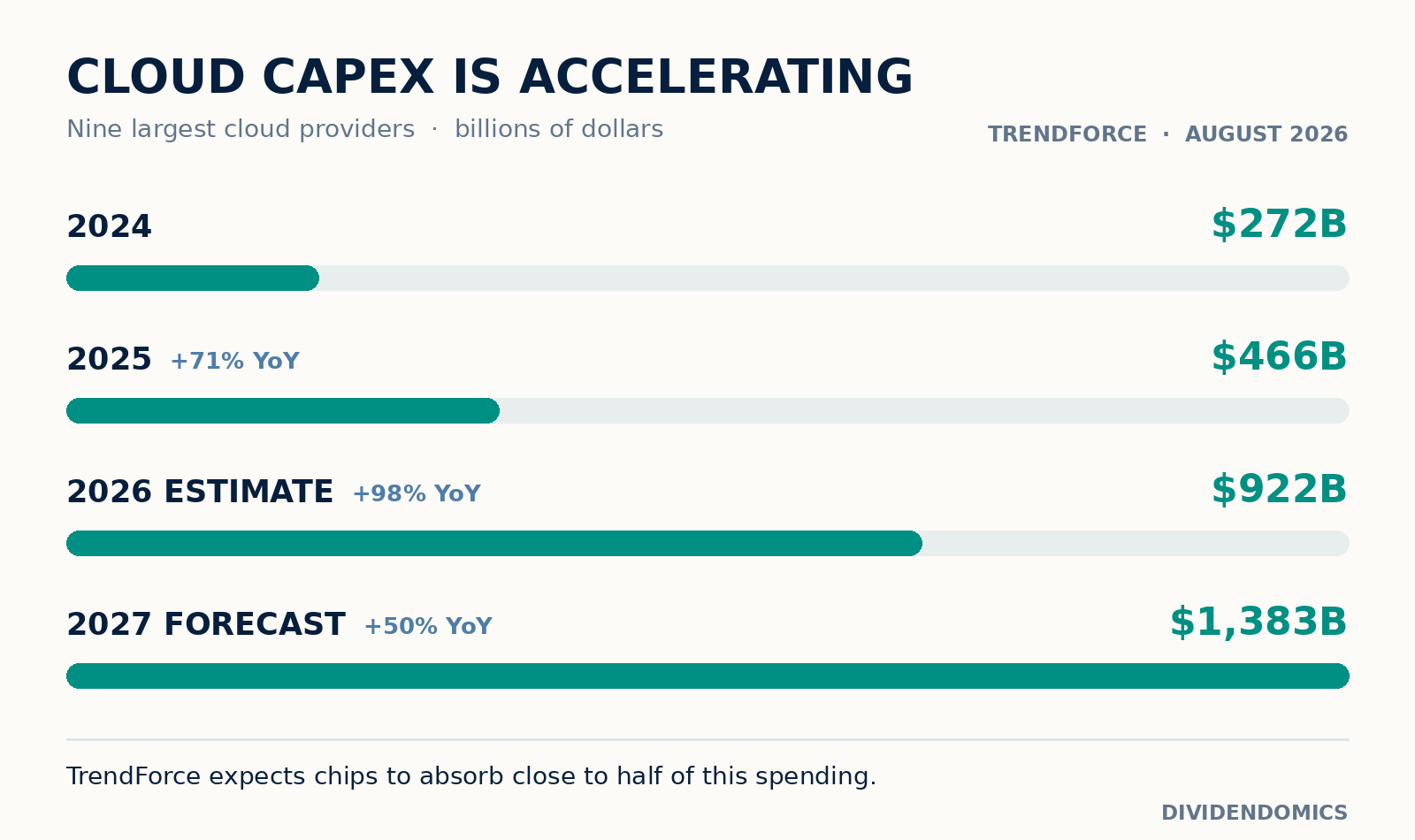
TrendForce expects capex at the nine largest cloud providers to grow another 50% in 2027 to roughly $1.38 trillion, after nearly doubling this year, with chips absorbing close to half of it. That spending runs straight into a market that's already tight. Regular DRAM contract prices rose another 13% to 18% in the third quarter, according to TrendForce, after roughly doubling earlier in the year, and the only reason the increase slowed is that PC and phone buyers hit the limit of what they could pay.
The bigger move is still ahead. High bandwidth memory, the kind stacked directly onto AI accelerators, reprices once a year, so the contracts most buyers are paying today were signed before the shortage fully hit. TrendForce's research says HBM contract prices could move multiples higher when the 2027 agreements land, and Nvidia's next platform carries 384GB of HBM per GPU against 288GB on the current generation.
Supply can’t catch up quickly. SK hynix’s major expansion projects target volume output in 2028 and 2029, according to this industry review, which means the gap between demand and supply stays open for roughly two more years. I made the case for why 2027 is the year this spending pays off in Buy Alert: I’m Betting On 2027 And Collecting 11%.
Two risks keep me from getting carried away. Memory stocks swing violently on guidance, even when earnings are fine, so position sizing matters more here than almost anywhere else. And China’s CXMT keeps gaining ground, and a fourth major producer scaling quickly would weaken the pricing power the big three have today. I’d rather own memory through diversified funds than bet on a single producer.
September Dividend Report FAQ
How much did I earn in dividends in September 2026?
I collected $3,220.01 in September, made up of $2,106.77 in dividends from 20 payers and $1,113.24 in covered call premium.
Which position paid me the most?
QDTY, the YieldMax Nasdaq 0DTE ETF, paid $288.95 across four weekly distributions, followed by Ares Capital at $275.02.
Do weekly dividend ETFs actually work?
For cash flow they absolutely do, since six weekly payers produced $872.96, or 41.4% of my September dividends, and paid me every week of the month. The tradeoff is that their payouts move with the market, so I size them as one part of a portfolio rather than all of it, and track them in the Yieldly Dashboard.
Why build CGDV to $50,000 if it only yields about 1.2%?
Because its job is growth plus a rising dividend rather than high current income. The weekly payers produce the cash, and CGDV is where some of that cash goes to compound.
The Bottom Line
Twenty positions paid me dividends in September and three more paid me option premium, for a total of $3,220.01. That’s lower than August by design, since I sold four income positions last month to fund growth, and there still wasn’t a single week where the portfolio didn’t pay me.
The money didn’t sit still either. $992.81 reinvested automatically, $499.98 went into CGDV on the way to $50,000, and $1,113.24 of covered call premium keeps flowing into Amazon through year end. The memory shortage is the supply story I’m watching most closely heading into 2027, and the stocks and funds tied to it are a big reason I’m comfortable holding through the volatility.
If you take one thing from this report, start hiring employees. Every share you own works for you whether you show up or not, and the first one is the hardest to hire.