

On July 30, Meta META 0.00%↑ fell almost 8% in a single session. The company had just grown revenue 28% to $60.8 billion, but earnings per share missed by 14% after legal charges and severance costs, and the story everyone ran with was that Mark Zuckerberg was pouring money into AI with no product to show for it.
The next morning I published Meta Platforms: The King of AI Monetization and argued the sell-off was driven by one-time charges while the AI inside Meta’s ad machine was already paying off, and that the market was pricing Meta like Zuckerberg didn’t have a plan. Paid subscribers also saw that Meta was one of my largest positions. Meta closed at $556.71 that day. On September 24 it closed at $777.59, which puts the stock up 39.7% in under two months by my math.
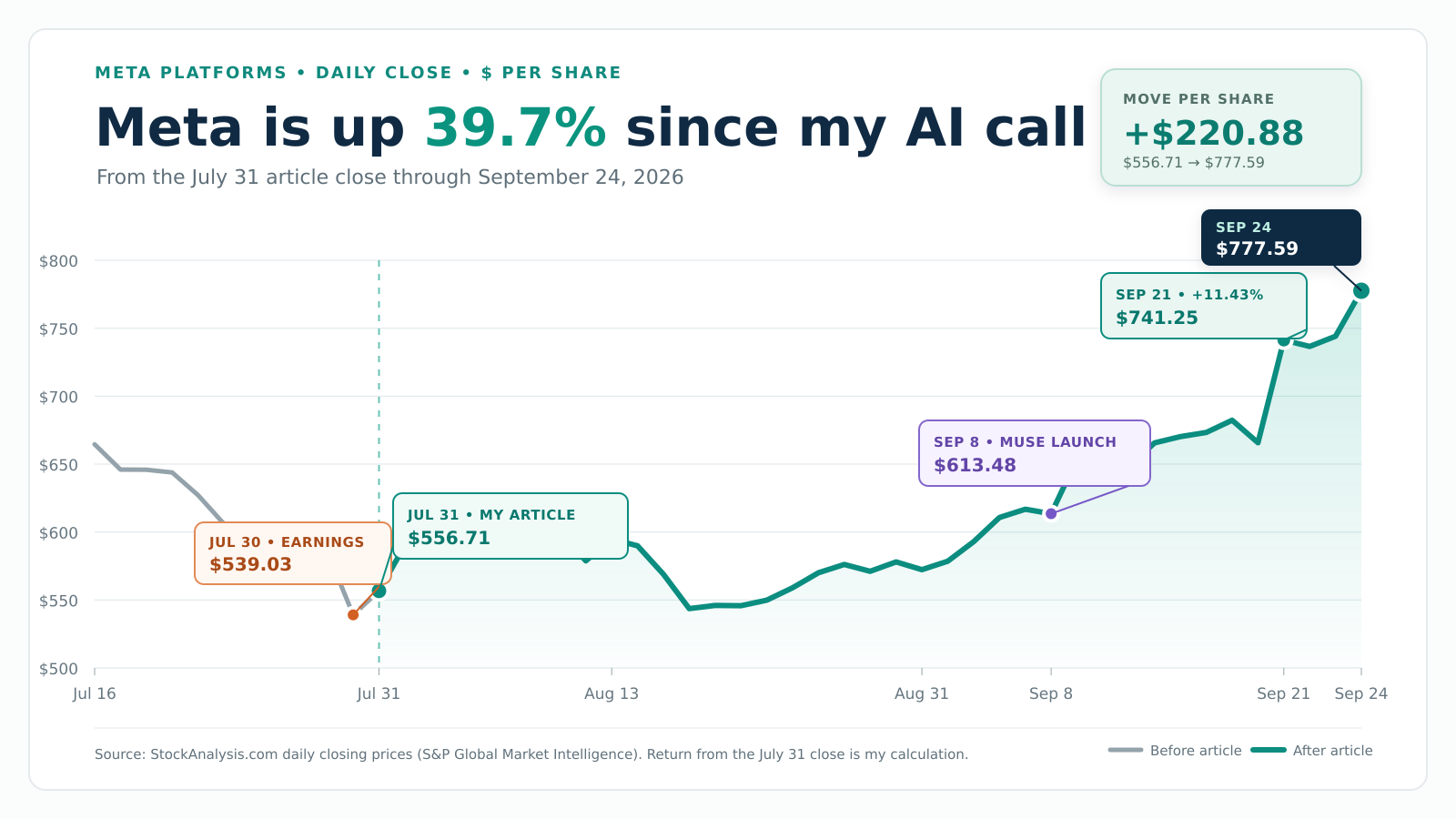
The plan I said the market was missing now has a name, and it's called Muse. Since it launched on September 8, Meta has gained 26.7% (my math), with a single 11.43% day on September 21 that added close to $190 billion in market value. I still own my shares, and I think the part of this story that matters most for the business hasn't shown up in the financials yet.
Key takeaways
Meta is up 39.7% from my July 31 call and 26.7% since Muse launched on September 8 (both my math on closing prices).
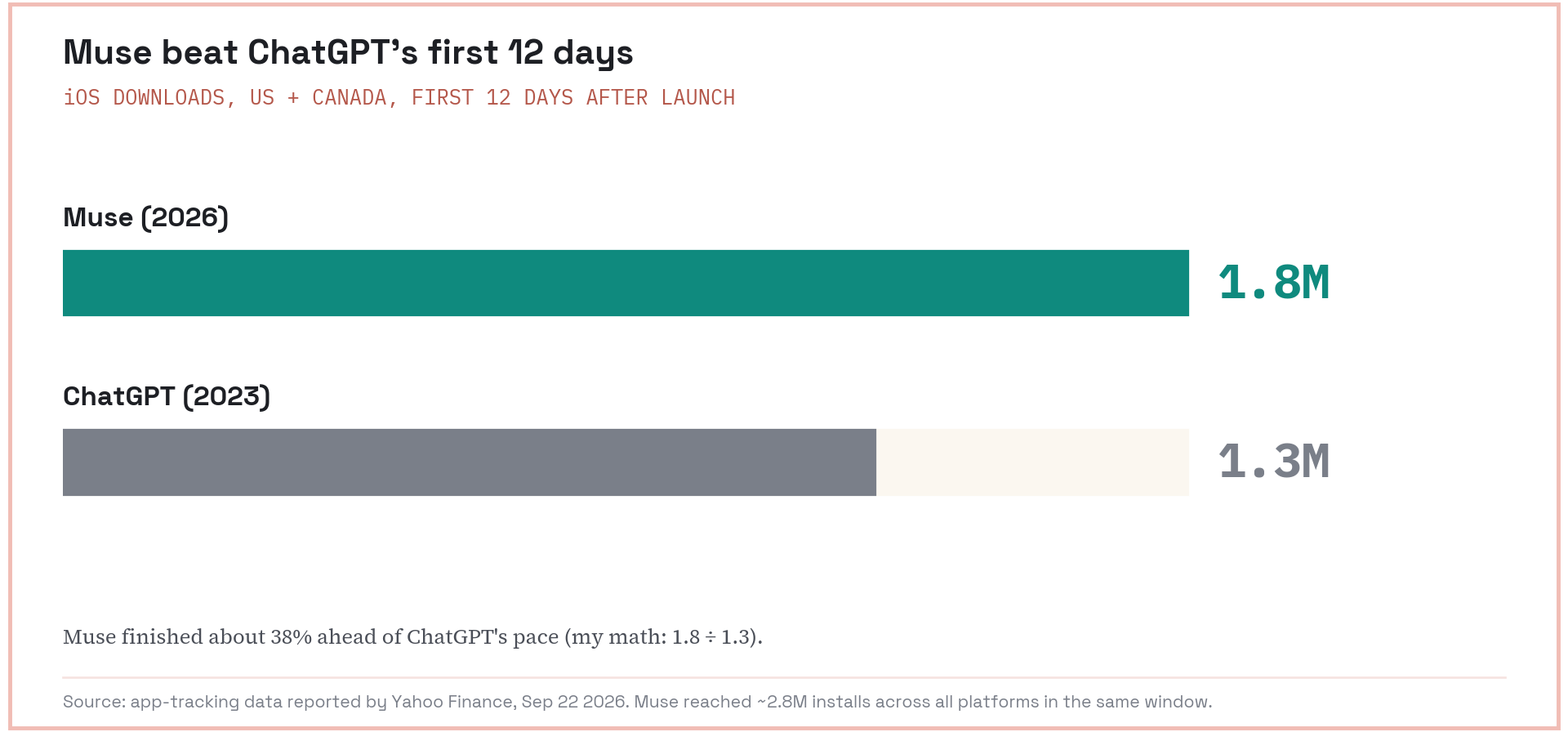
Muse logged 1.8 million iOS downloads in the U.S. and Canada in its first 12 days, ahead of ChatGPT’s 1.3 million over the same stretch.
Muse can earn money three ways: paid subscriptions at $20 and $100 a month, checkout on partner stores, and deeper engagement inside apps Meta already owns.
The agent gives Meta’s $130 billion to $145 billion capex budget something investors have been demanding since July: a consumer product people will pay for.
At $777.59, Meta trades at 22.3 times 2027 earnings, right on its five-year average, and $1,000 a share needs as little as 24.8 times if Muse lifts EPS toward the high-end estimate (my math).
What Is Meta Muse?
Picture telling your phone to find a dinner reservation for four on Friday, email the group the details, and put it on everyone’s calendar, then going back to whatever you were doing while it handles the whole thing. That’s the pitch for Muse, a personal AI agent that opens a browser, fills out forms, sends emails, books travel and pays for things through Stripe’s Link checkout, with you approving each purchase. TechCrunch reports it runs on Muse Spark, the model family Meta built specifically for this kind of multi-step work.
Most AI apps you’ve used still stop at the advice stage, where the chatbot drafts an email and you’re the one who hits send. Muse does the sending, and Meta made it available everywhere its users already spend time: a standalone app, the web, WhatsApp, and a Mac app that launched on September 17 and lets the agent work directly on your computer.

Then came Connect on September 23, where Zuckerberg called Muse the centerpiece of everything Meta is building. The company’s own Connect recap lists a wave of new shopping partners, including Walmart, Best Buy, Sephora, Ulta and Wayfair, plus Shop Pay and PayPal for payments, with Expedia and Instacart on the way and work tools like Notion, GitHub and Box already connected. Meta also showed off Muse Charm, a keychain-sized gadget for talking to your agent without pulling out your phone.
Every one of those partners is a place Muse can complete a purchase, and every surface Meta adds is another way to keep people inside its ecosystem for longer, which is where the revenue case for Muse starts.
How Fast Is Muse Growing?
ChatGPT is the benchmark every AI launch gets measured against, since it became the fastest-adopted consumer app in history back in 2023, and Muse beat its opening pace. Yahoo Finance reported that Muse picked up 1.8 million iOS downloads in the U.S. and Canada during its first 12 days, compared with 1.3 million for ChatGPT over the same window, and reached about 2.8 million installs across every platform.
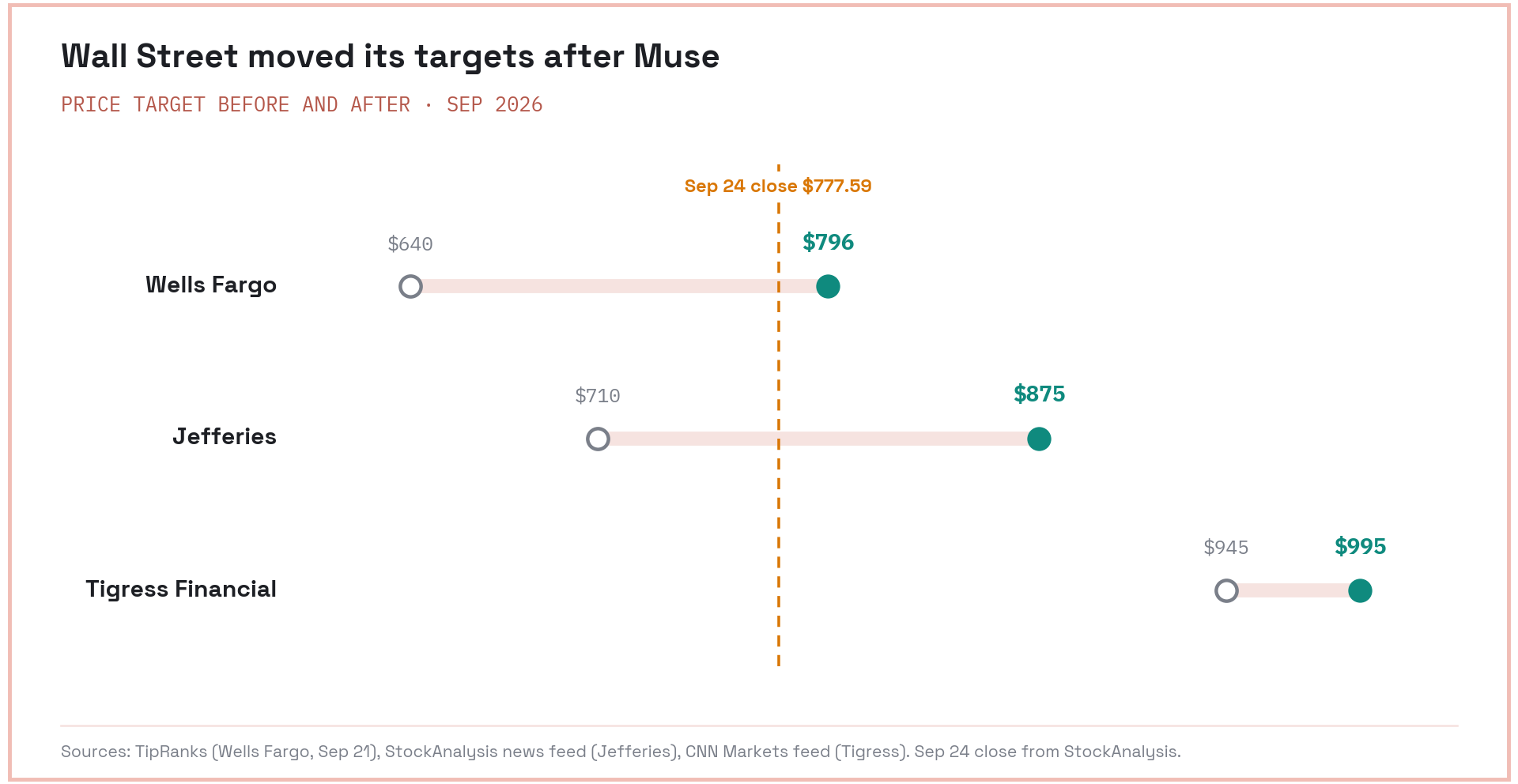
Muse also climbed to the number one spot on Apple’s U.S. App Store, and that’s what set off the September 21 rally. TipRanks reported that Wells Fargo analyst Ken Gawrelski raised his price target from $640 to $796 that morning, arguing that Meta’s AI launches are finally giving it a real story to tell after a year of delayed models and spending questions.
JPMorgan’s Doug Anmuth went further, writing that Muse has the potential to become “the most widely used consumer AI application since ChatGPT,” according to The Motley Fool. After Connect, Jefferies lifted its target from $710 to $875 and Tigress Financial went from $945 to $995, per the news feeds on StockAnalysis and CNN Markets.
Downloads and price targets tell you people are excited, and that’s worth something, but I own Meta for the cash flow it can produce five years from now, so what matters is whether Muse moves the revenue and margin numbers that drive it.
How Does Muse Make Meta Money?
In July I split AI into three layers, the apps that distribute it, the models, and the infrastructure underneath, and said Meta was the rare company with a real stake in all three. Muse is the first product where all three show up at once: Muse Spark is the model, Meta’s own data centers run it, and Facebook, Instagram and WhatsApp hand it to billions of people.
The bear case back then came down to one complaint: Meta doesn’t rent out cloud computing the way Microsoft and Amazon do, so there’s no clean line on the income statement that shows AI paying for itself. Muse gives Meta three new ways to fill in that line.
Subscriptions come first.
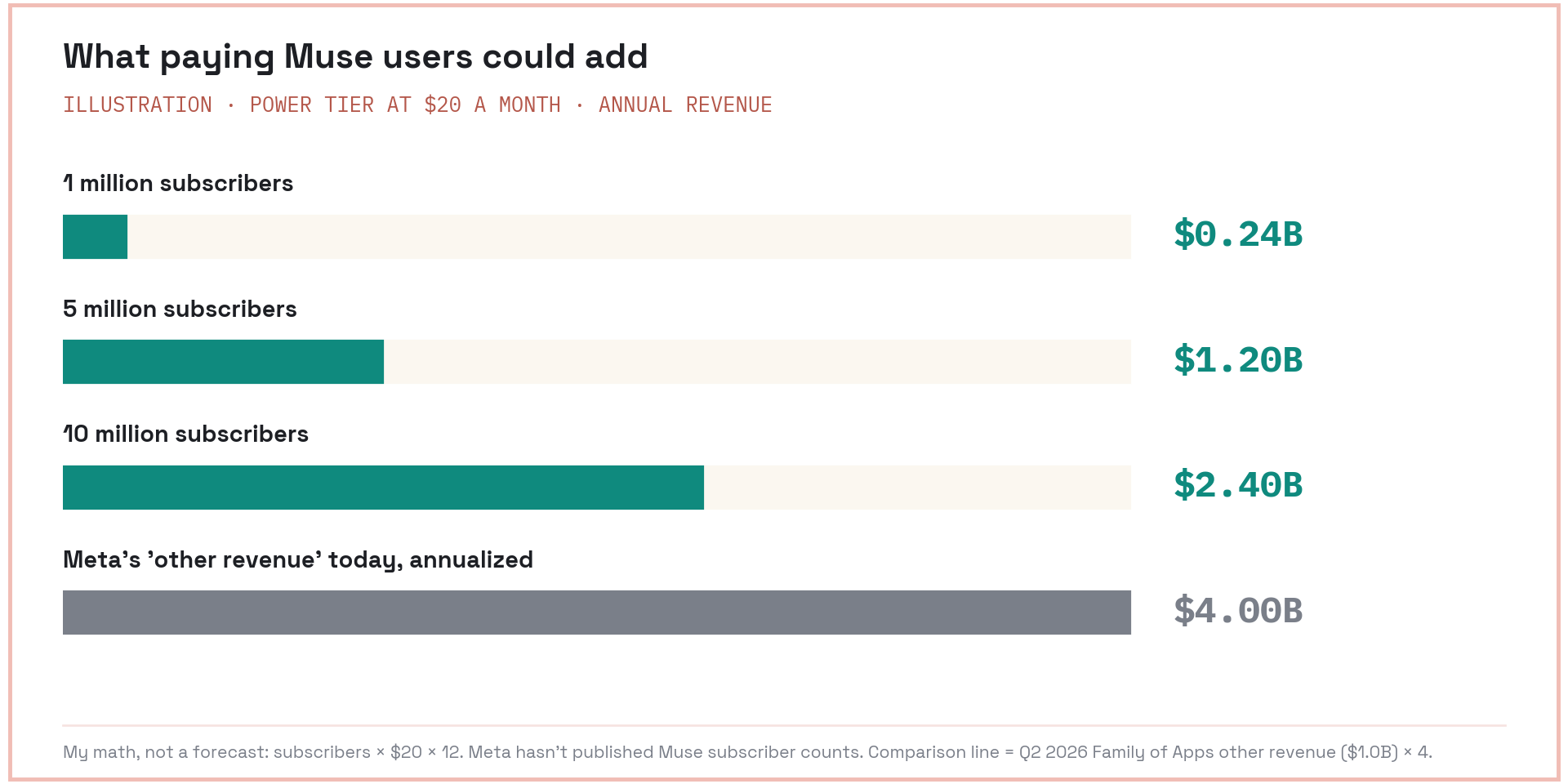
Muse is free up to a weekly usage cap, then moves to paid plans of $20 or $100 a month depending on how hard you work the agent, according to TradingKey. That’s a consumer revenue stream Meta has never really had, and the business line it lands in is already growing fast: Family of Apps “other revenue” hit $1 billion for the first time in Q2, up 73% year over year, driven mostly by WhatsApp paid messaging and subscriptions, per Meta’s Q2 earnings call.
Meta hasn’t said how many Muse users pay, so the chart below is my own illustration rather than a forecast. Every million people on the $20 Power plan works out to $240 million a year, and ten million would add $2.4 billion, which is more than half of what that entire “other revenue” line produces today on an annualized basis.
Commerce is the second lane.
Every partner Meta signed at Connect is a store where Muse can finish a checkout, and an agent that buys things for you sits right where advertisers want to be, at the exact moment someone is ready to spend. Meta’s ad business already runs on predicting what you’ll buy next, and Muse closes the loop by completing the purchase inside Meta’s own product.
Engagement is the third, and the biggest over time.
TECHi, citing Apptopia, estimates that more than 95% of Muse users also use Facebook and 63% use Instagram, which means Meta can put Muse in front of the record 3.6 billion people who use its apps every day, per 24/7 Wall St., without paying to acquire them, the same way it scaled Threads. More time spent in Meta’s apps means more ad impressions, and in Q2 ad impressions were already up 14% with the average price per ad up 12%, according to Investing.com’s breakdown of the Q2 slides.
Meta signing with AWS is part of why I'm putting every covered call premium into Amazon each week. Here's that full breakdown: Buy Alert: I'm Adding Another $15,000 To Amazon.
Owning the shares is only half of how I'm playing this. Meta pays me a tiny dividend, so this week I'm putting another $2,500 into an income position that pays me every single week, and at its recent payouts that's hundreds of dollars a year of new income landing in my account without selling a share of anything. The ticker, the math on what it pays, and why I picked it over buying more stock are below.
Paid subscribers get the rest
The $2,500 weekly income position I’m adding, and exactly what it will pay me
Why Muse finally answers the capex question that sank the stock in July
Why Meta is still a buy at $777, and the math on $1,000 a share
My position, and exactly what would make me add or trim
