

Every quantum computing company on earth earned about $1.9 billion combined last year, and that is the entire industry added together. I know lots of folks probably shy away from Quantum investments because the whole sector sounds complicated. So I will try to make it as easy as possible to understand.
We are early to this, and that cuts both ways. Being early means you can accumulate a position before the crowd arrives and before the prices reflect what the technology eventually does.
Keyword is: Eventually.
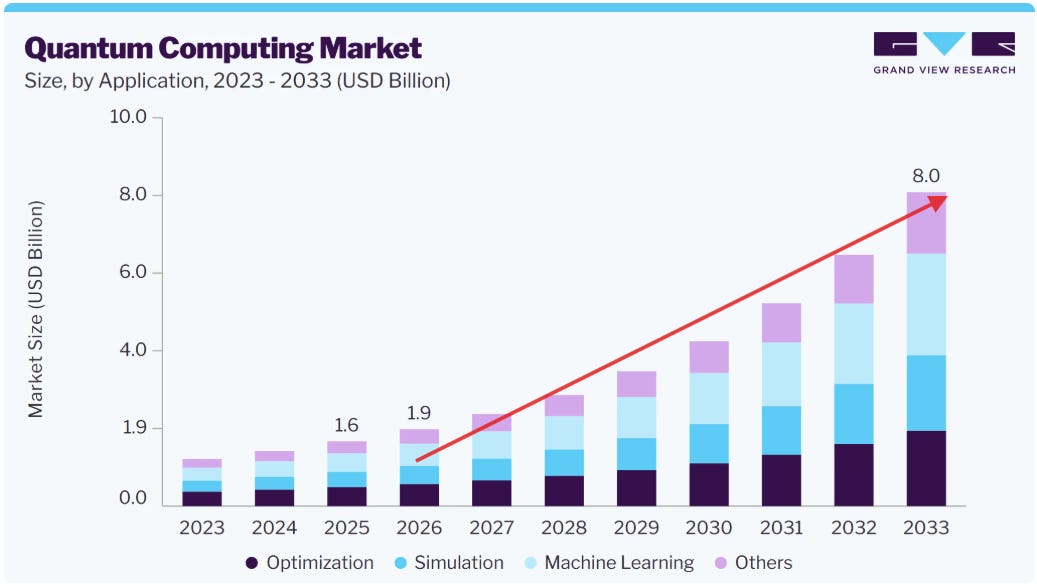
The size of the Quantum Computing Market is estimated to grow to $8B by 2033, which represents a CAGR (compound annual growth rate) of 22.3% over the next few years.
Being early feels exactly like being wrong, and it feels that way for a long time. I have watched enough people quit on a good idea in year two to know that how you size a position like this matters more than whether you picked the right one.
I added a quantum position to the growth sleeve this week anyway.
👉Here are my latest buy alerts. Paid subs get every alert first in the subscriber chat.
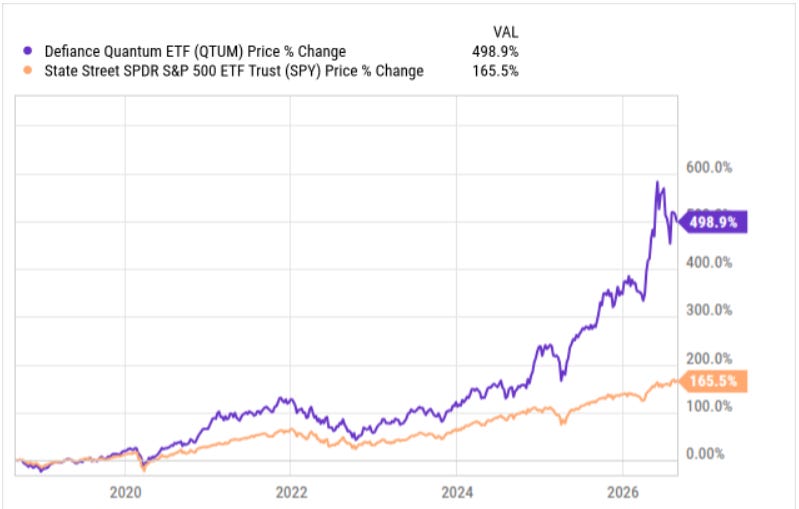
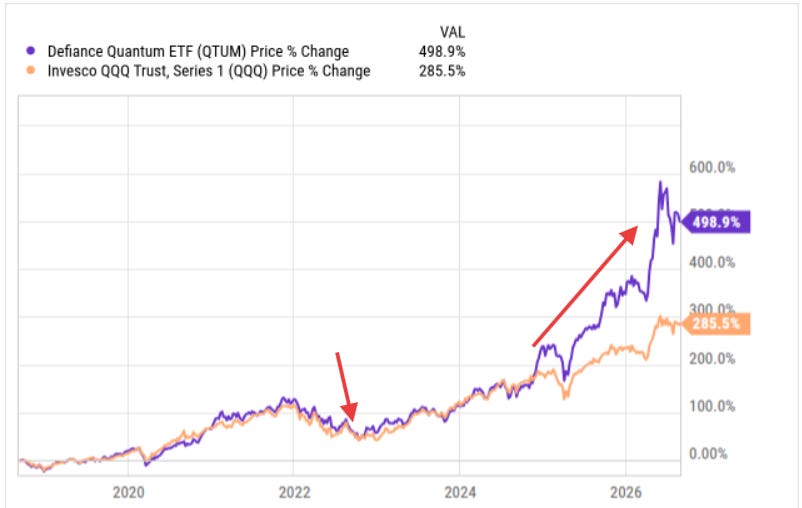
I collected $652 in dividends in last week of August and I rotated this capital into a specific fund. I also collected another $440 in option premiums this week that were reallocated to this Quantum ETF. The plan here is accumulating using dividends and covered call income, rather than using my own capital. The QTUM 0.00%↑ ETF has outperformed the S&P 500 SPY 0.00%↑ since inception, just as a point of reference. This doesn’t guarantee that outperformance will continue, but it helps visualize the potential here.
Buy income ETFs → Collect Dividends → Reinvest Into Growth → Outperform
Gift an annual subscription and earn 1-year of access for free.
Free subscribers get sent a list of ETFs that may be suitable for beginners.
What Quantum Computing Actually Is
Let’s make this super easy to understand.
Think about a maze. Your laptop solves it by walking one path until it hits a wall, backing up, and trying the next one, over and over until something works.
A quantum computer walks every path at the same time and tells you which one led out. That is the difference and why these machines can crack problems in hours that would take a normal computer thousands of years.
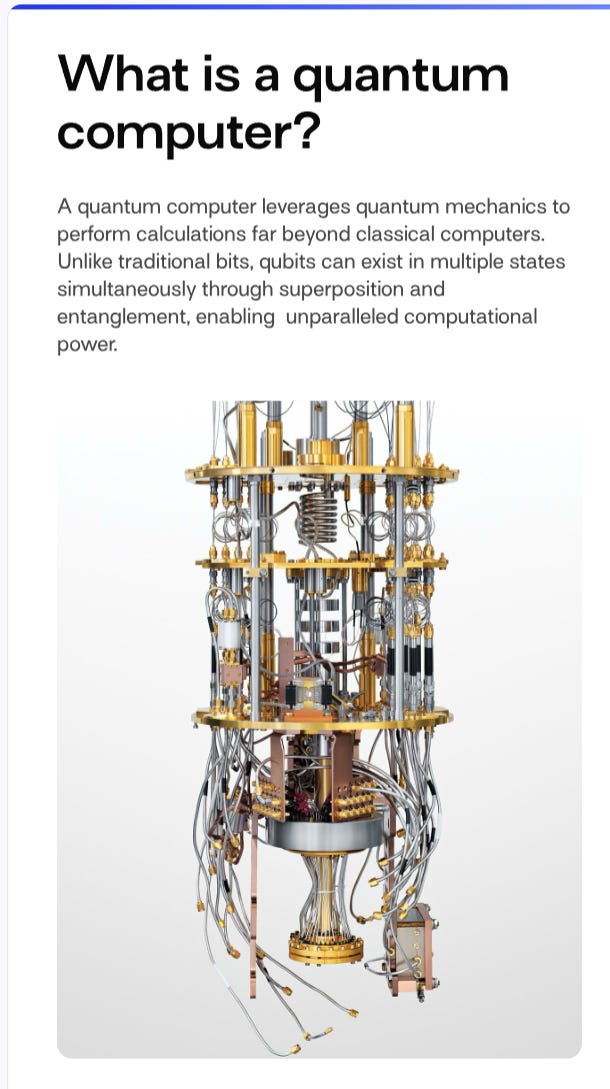
The catch is that they only work on maze-shaped problems, so a quantum computer will never run your email or your spreadsheets. It’s still a very niche thing right now.
Here is what matters for us as investors. Nobody is going to buy one of these.
They are room-sized machines cooled to near absolute zero, and the customers are governments, banks, drug companies and chemical giants signing contracts worth tens of millions each. There is no consumer moment coming where sales suddenly explode the way phones or AI apps did. Revenue arrives in a small number of very large deals, which is exactly why this sector earned $1.9 billion last year despite being on every magazine cover, and why the timeline matters more here than the actual technology does.
Who Actually Makes Money From Quantum
Forecasts believe that quantum computing will create between $1.3 and $2.7 trillion of economic value by 2035. This means there is still huge upside potential, despite Quantum being locked behind specialty groups. This estimated value is estimated to be created across the following industries:
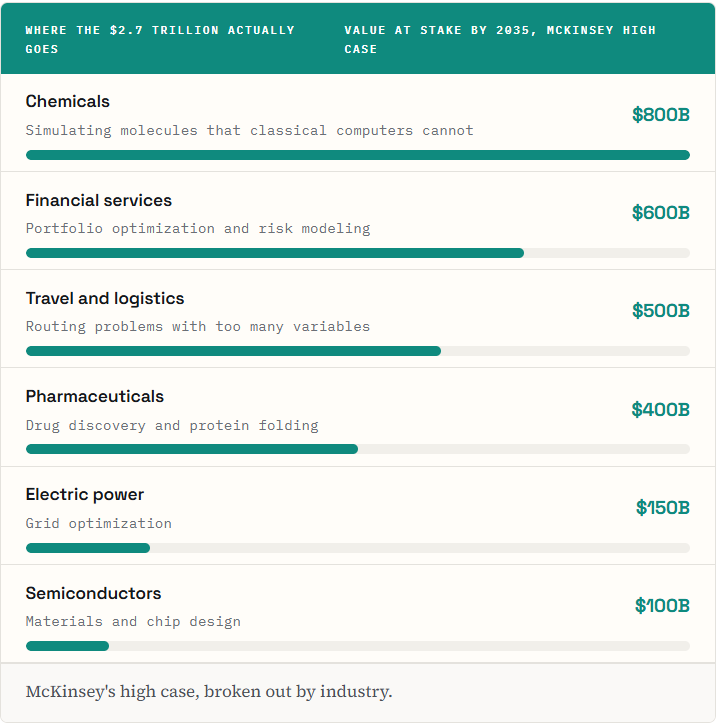
Probably not the breakdown you expected right? I also would’ve thought technology & semiconductors would be higher on that list.
Chemical companies designing materials, banks pricing risk, airlines routing fleets and drugmakers screening compounds all capture that value because they own the problems worth solving. Quantum will unlock the next wave of efficiency.
The companies building and selling quantum computers earned $1.9 billion in 2025. That is the entire vendor side of the industry against a $2.7 trillion headline, a gap of roughly 1,400 times.
So the technology can be exactly as transformative as promised and the companies selling it still keep a small slice of what it creates. Knowing that changed what I was willing to buy.
How To Get Exposure
I bought the Defiance Quantum ETF QTUM 0.00%↑. It holds 89 positions on an equal-weight basis with a tilt toward hardware and infrastructure, charges 0.40%, and has been running since September 2018, so it has a real track record behind it. Like I established at the beginning of this, QTUM has massively outperformed the S&P 500.
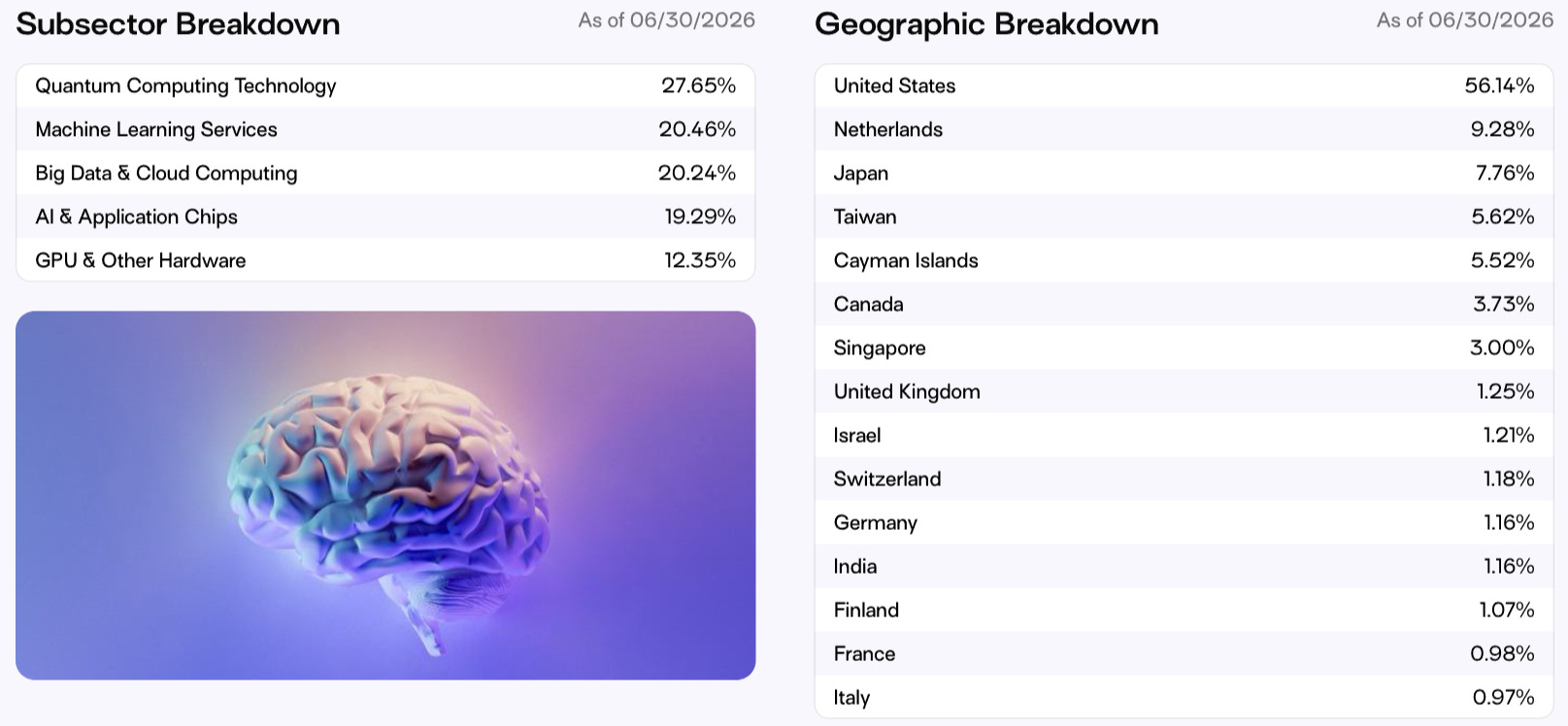
I like QTUM because it also provides global exposure. U.S. exposure is only a little more than half of the fund, so if the U.S. indices retreat, QTUM may hold up better than something like QQQ.
In fact QTUM outperforms QQQ 0.00%↑ AND held up better during the downturn in 2022. Therefore, I think that QTUM is a suitable way for me to get exposure to the growth of Quantum stocks without taking on concentration risks to those small-cap companies.
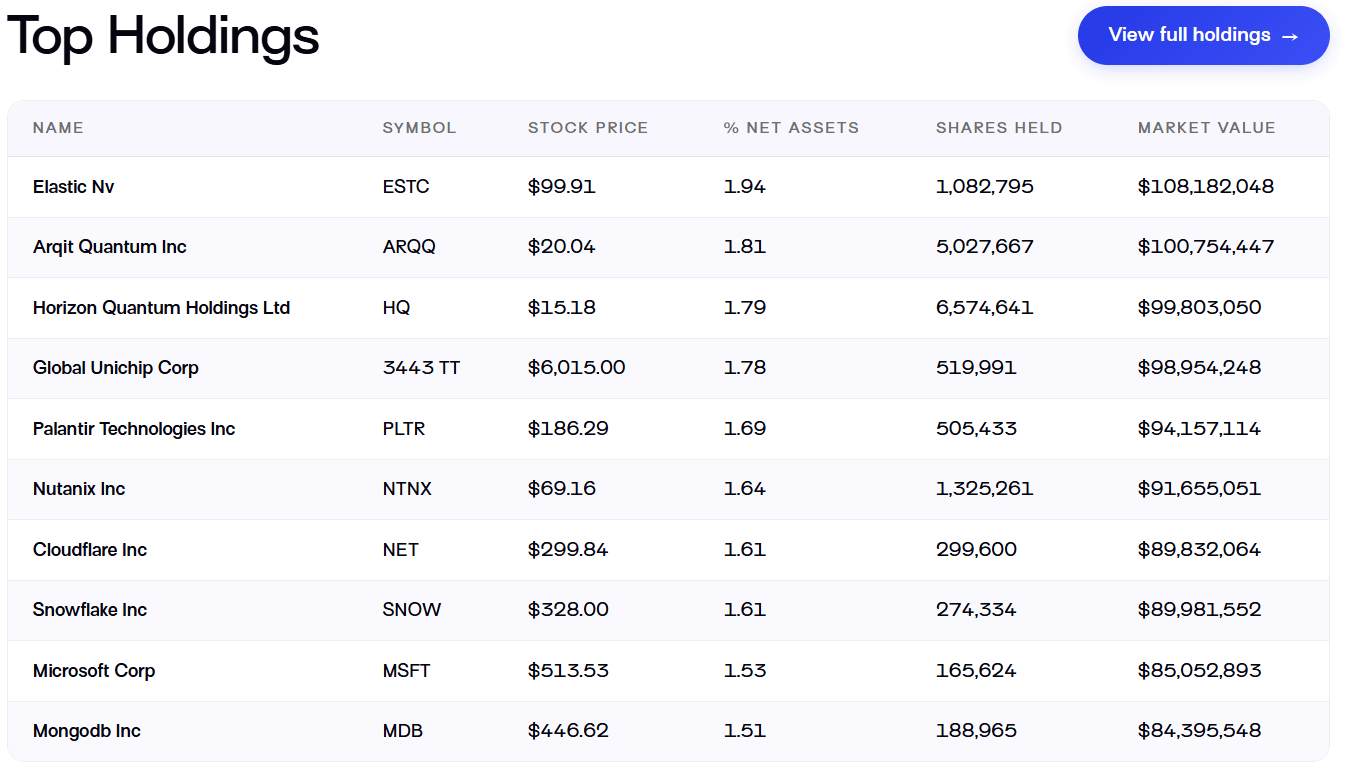
Not only are you getting exposure to Quantum companies, you are getting access to companies across the different operating segments.
Palantir PLTR 0.00%↑, Snowflake SNOW 0.00%↑, Nutanix NTNX 0.00%↑, and Microsoft MSFT 0.00%↑ make real money from businesses that have nothing to do with quantum.…yet. If quantum takes until 2032 instead of 2030, those holdings keep earning from their day jobs while the quantum piece develops.
Equal weighting means no single company can wreck the fund, which matters in a sector where roadmaps slip and companies run out of cash.
So here’s what I expect will happen over the next few years:
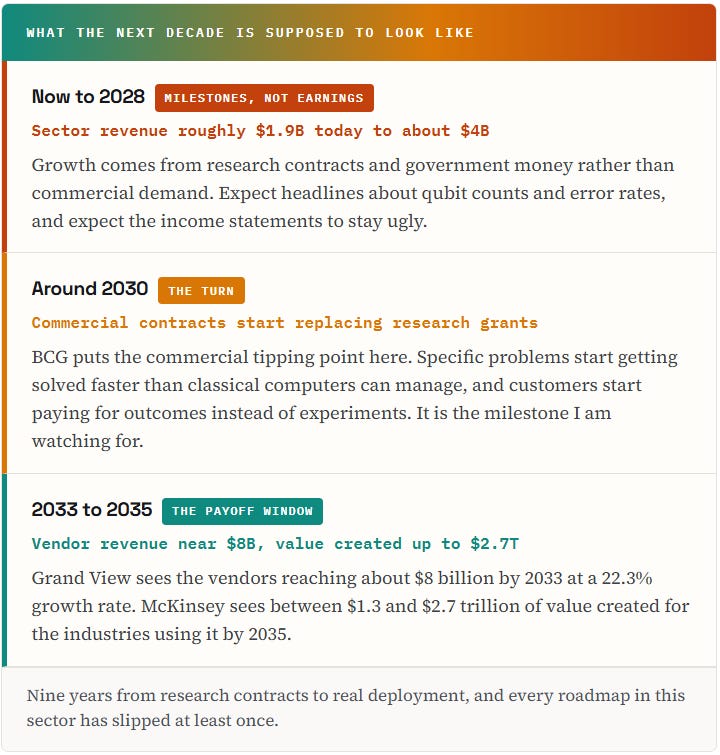
Between now and 2028, the sector goes from about $1.9 billion of revenue to maybe $4 billion, which is real growth and still a rounding error next to what these companies are valued at. Through 2030, progress shows up as technical milestones rather than earnings, so the stocks move on announcements instead of results.
The signal I am actually waiting for is commercial contracts replacing research grants. Right now most quantum revenue is governments and universities paying for experiments. When banks and chemical companies start buying outcomes because the machines solve problems their existing computers cannot, that is when this stops being a story.
Grand View Research sees vendor revenue near $8 billion by 2033, growing 22.3% a year. Cut that estimate in half and you still have double digit annual expansion, nine years out.
👉 Paid Subs Get Access To My Portfolio On The Yieldly Dashboard
Three Ways I End Up Wrong
The timeline slips from 2030 to 2035. Every roadmap in this sector has moved at least once and there is no reason to assume this one will not. If the tipping point keeps sliding, I hold a position that goes nowhere for years while other things run. I think that is the most likely outcome, and it is why the position stays small.
The adjacent holdings cut both ways. What I like about this fund is that Microsoft, Palantir and Snowflake give it a floor. That also means a chunk of what I own is ordinary tech exposure I probably already have elsewhere, so I am paying 0.40% for a mix that is less quantum than the name suggests.
The government changes its mind. Much of what makes this sector fundable is federal money, and federal priorities move with administrations and budgets. Equity stakes are stickier than grants and they are not permanent. If the CHIPS money slows, companies burning cash today have a much harder time raising more.
The Bottom Line
The $2.7 trillion headline describes value flowing to the industries that use quantum computing, while the companies selling it earned $1.9 billion last year. The gap between those two numbers is why I did not buy the pure plays, several of which are down this year despite triple digit revenue growth.
So I bought the diversified fund instead. 89 holdings, a largest position of 2.28%, and a portfolio where Microsoft and Snowflake pay the bills while the quantum piece develops. It is a satellite position funded by income from elsewhere, and I will add on weakness over the next few years rather than all at once.
None of this is a recommendation and my situation is not yours. This sector has almost no revenue, no profits, and a timeline that has slipped before. Early is not the same as right, and I am taking that risk on purpose and in small size.
I will update you as this develops. The thing I am watching is whether commercial contracts start replacing research grants, which is when this stops being a story.
