

The Rental Property in Your Portfolio: An Intro to Covered Calls
Most of you know my strategy is built on a foundation of tech infrastructure and dividend growth. While we love the long term compounding of companies like Microsoft MSFT 0.00%↑ or Amazon AMZN 0.00%↑ , there is a way to squeeze more utility out of these positions while we wait for the next leg up.
For instance, I hold roughly 150 shares of AMZN but the company does not pay a dividend. Therefore, I am stuck waiting for the price to rise in order to make a profit. Covered calls allow me to create my own dividend from my existing position, without adding any new capital.
A month ago, I was able to write a covered call against AMZN and collect a $284 premium before the stock took off. I essentially created my own dividend and got paid while the stock was trading sideways.
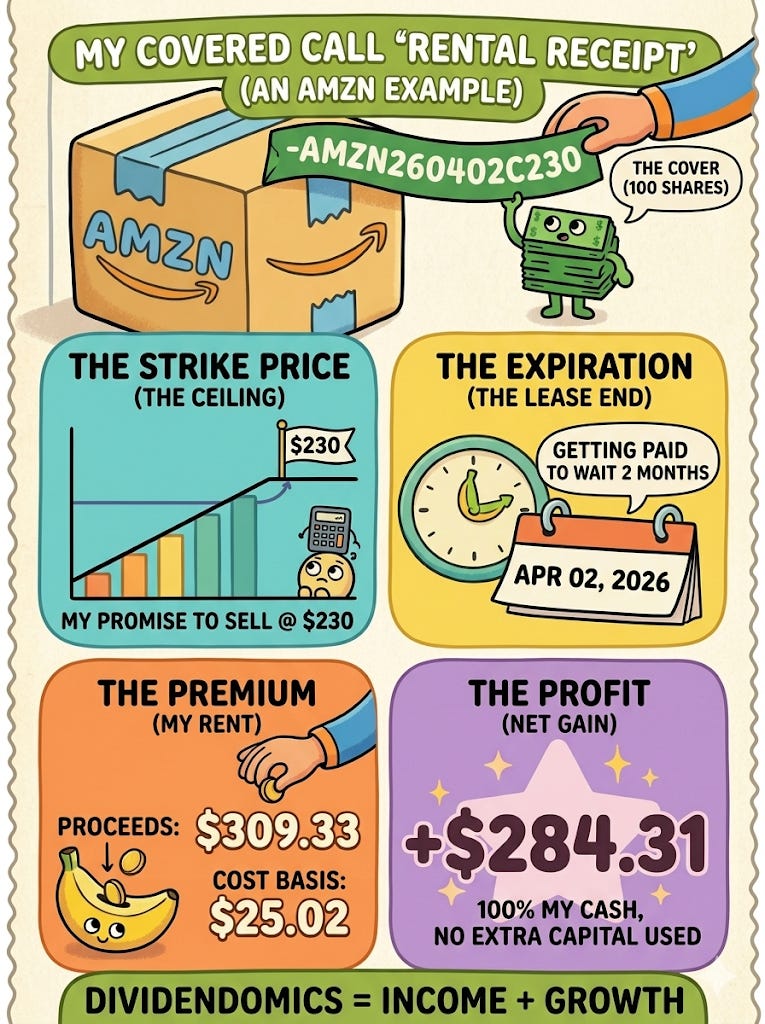
If you don’t understand how to read this image above, stick with me. By the end of this article, you will understand it. I promise you that it all seems more complicated than it actually is.
To write covered calls, you need to own at least 100 shares of a stock. This is much easier for stocks that track below $10 per share, while it is much harder to achieve for companies that trade in the hundreds of dollars per share.
Think of your 100 share blocks of stock as digital real estate. If you own a home and leave it empty, you are betting solely on the property value going up. But if you find a tenant and charge them rent, you have turned that asset into a cash flow machine. In the options world, selling a covered call is exactly like collecting that monthly rent check.
Why I Use This Strategy
In my own portfolio, I do not just sit and watch tickers move. By writing covered calls against my established positions, I can achieve three specific goals:
Manufacture my own dividends: I can create yield on stocks that pay low or no dividends, like Amazon.
Lower my cost basis: Every premium collected acts as a buffer during volatile weeks in the Nasdaq.
Complement my high yield holdings: This adds an active layer of income generation on top of the distributions I receive from my income positions.
Eliminate reliance on YieldMax: These funds have destroyed capital and I would like to eliminate my exposure to them eventually.
The goal is not to gamble on price swings. It is about turning growth into income without necessarily selling your favorite companies. If you have ever felt like your portfolio was stagnant during a sideways market, it is time to put those shares to work.
As many of you already know, I collected over $41k in dividends annually. This covered call strategy compliments these dividends and aren’t included in my income total.

This strategy is just another part of the wheel strategy that we use to build out wealth. If you want to track your monthly dividend income, consider using the Yieldly Dashboard, instantly available to all paid subscribers!
EXCLUSIVE TO FOUNDING MEMBERS → you can use CainAI to help determine what strike price is reasonable for your covered call strategy. I am working on building out a more dedicated covered call dashboard for you all! Will post updates on that later.

3 Mechanics: Strike, Expiration, and Premium
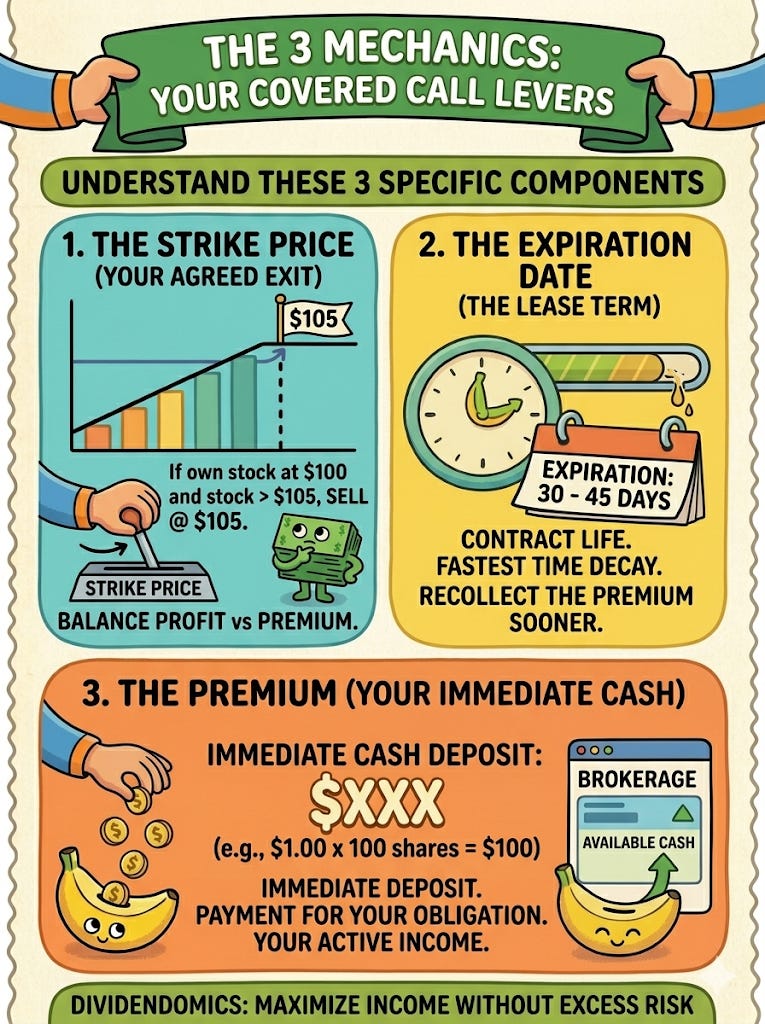
Before you place your first trade, you need to understand the three levers you can pull. Every covered call is a contract with these specific components.
1. The Strike Price
The strike price is the exit price you agree to. If you own a stock at 100 dollars and sell a 105 strike call, you are agreeing to sell your shares at 105 dollars if the stock price is above that level at the end of the contract. Choosing a strike price is a balance between how much profit you want from the stock and how much premium you want to collect.
2. The Expiration Date
This is the life of the contract. In my portfolio, I typically look at windows between 30 and 45 days. This timeframe captures the fastest period of time decay, which is when the value of the option you sold drops quickly, allowing you to keep the premium sooner.
3. The Premium
The premium is the cash deposited into your brokerage account immediately. It is your payment for taking on the obligation to sell your shares. This is the income component that we are looking to maximize without taking unnecessary risks.
How the Math Works
When you sell a covered call, you are essentially defining your maximum profit upfront. Your total potential return is the sum of the capital gains up to your strike price plus the premium you collected.
For example, if you own 100 shares of a stock at 50 dollars:
You sell (Sell to open) a 55 strike call for a 1 dollar premium.
Your maximum profit is the 5 dollar gain in stock price plus the 1 dollar premium.
That is a total return of 6 dollars per share, or 600 dollars.
If the stock stays below 55 dollars, you keep the 100 dollar premium and the shares. You can then repeat the process the following month, effectively lowering your cost basis to 49 dollars.
👉 *The ideal scenario is to collect the premium AND keep your shares*
The Three Possible Outcomes
Once you sell a call, the stock will do one of three things. Here is how each scenario impacts your wallet.
