

Most people assume you need millions to live off dividends. When you follow traditional investing advice, this may be true. However, dividends unlock a whole new route that most people don’t even consider.
Most dividend paying companies will provide a yield between 1% to 4%.
However, dividend investing isn’t limited to 3% yields. In fact, there are corners of the market where double digit payouts are the norm. The catch is that you have to understand how they work and the risks involved.
This is how I am able to collect more than $44,000 in dividends per year within my portfolio. My portfolio’s average yield sits closer to 8% at this time.
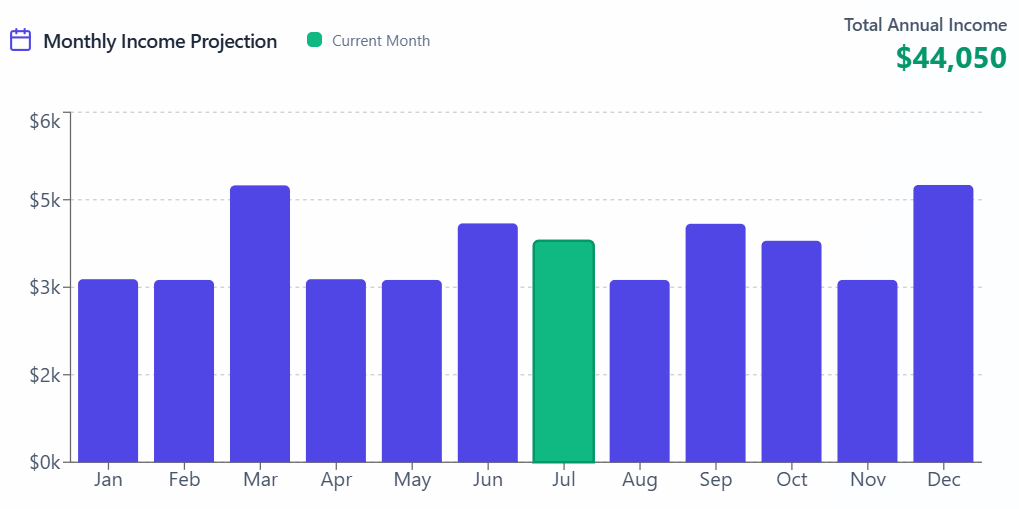
If I had $100K to work with today, here’s how I’d structure it to potentially generate $1,000 a month, or $12,000 a year, in dividends, WHILE still growing my capital over time.
The idea is that creating an extra stream of cash flow uncorrelated to your job is how you improve the quality of your life. I spent a month in Japan and collected $3,000 in dividends while there. The dividends effectively offset the cost of the trip, meaning I didn’t need to pay for travels with the money I earned from my labor.

In this article, we will consider a hypothetical $100,000 income sleeve built from just four funds.
Four funds is all you need to get exposure across hundreds of different companies that can provide risk-adjusted returns. Admittedly, there is one risky fund included that is tied to commodities.
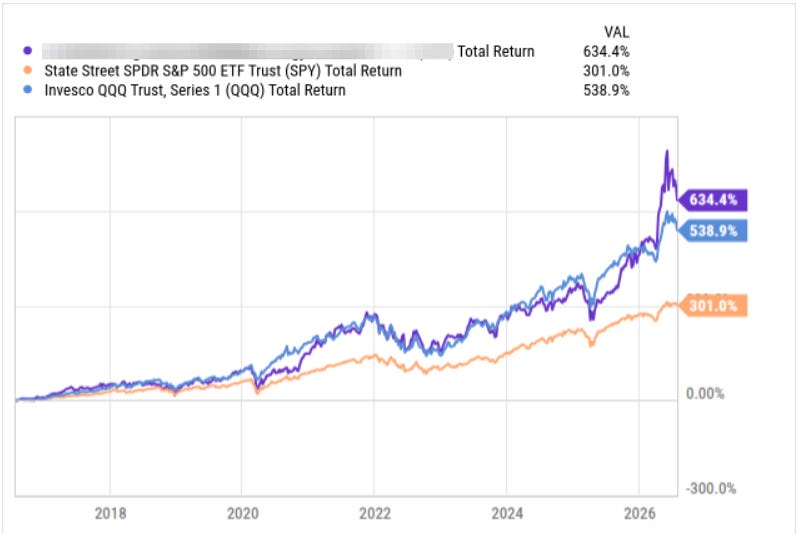
On a more positive note, one of these funds has a history of providing an average yield of ~7%, while crushing the Nadsaq-100 and S&P 500 in total return over the last decade. We will dive into why I believe the fund remains attractive today and for the next decade.
If none of that income is spent and all of it is swept into a variety of growth positions, then after ten years at a 10% annual return, the sweep alone would build a $204,200 position while the original $100,000 remains intact and continues paying.
In plain English, this means you would be able to fund brand new growth positions with the income collected, rather than using your own money.
This article is a conceptual illustration of how a portfolio structure behaves, built from publicly available fund and market data. It is not a recommendation to buy or sell any security, it does not account for any individual's circumstances, and the funds named later are used as examples of a category rather than as picks.
I believe we’ve reached a crossroads in the market. Equities are fatigued because of elevated capex spending. However, I think that we’ll see a recovery through 2027 once a deceleration in capex spending happens. While the rest of the market is fighting the volatility, this income portfolio continues to produce cash flow regardless of what’s happening on a macro level.
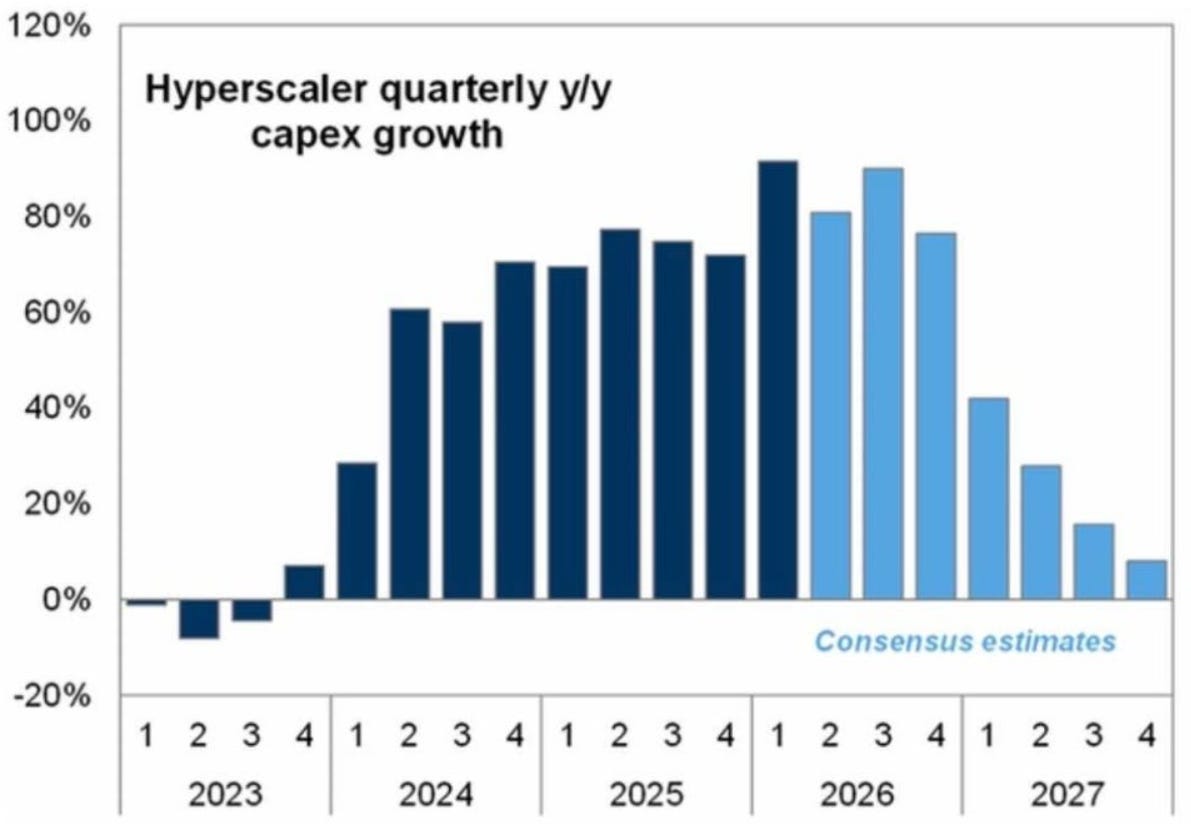
Hyperscaler capital spending has been growing at rates between 60% and 90% year over year since early 2024, and consensus expects that growth rate to collapse toward single digits by late 2027. When this happens, I think we’ll see much higher optimism in the market. Companies including Amazon AMZN 0.00%↑, Microsoft MSFT 0.00%↑, Alphabet GOOG 0.00%↑, and Meta Platforms META 0.00%↑ sit inside two of the three funds in this illustration.
What this piece covers
The overlap problem that breaks this structure, and how to detect it in any portfolio.
👉 Four example funds, why overwrite style decides the outcome, and the one whose falling yield is evidence the thesis is working.
The Reality Check
$1,000 a month in dividends is equivalent to $12,000 a year. On $100,000 that requires a 12% blended dividend rate.
No traditional dividend stock gets you there.
Even the highest-yielding quality dividend ETFs top out around 4% to 5%, and the ones paying 30% or more are handing back capital faster than they earn it.
The 12% zone sits in between, and it is populated almost entirely by option-income funds and a handful of technology closed-end funds. These funds will generate cash by selling call options against equity portfolios, which converts market volatility into monthly distributions.
So the higher the volatility, the higher the income we can collect. While we write our own covered calls here, the funds in this article makes it much easier for you.

The $100K Four-Fund Blueprint
The allocation below is built around one idea: three funds generate the cash, and the fourth exists to buy back some of the upside the other three sold away. It’s a fine-tuned balance that allows you to generate massive income levels, while also participating in the upside growth of the market over time.
Each step lists the position size, the current distribution rate, and what that produces in annual and monthly income.
STEP 1: Create The Cash Engine ($40,000 Allocation)
The Amplify CWP Growth & Income ETF QDVO 0.00%↑ holds a concentrated book of large-cap US growth names and writes calls tactically against part of the position rather than overwriting the whole thing. They key concept here is that the fund only writes options on a portion of its portfolio. This means that QDVO can experience uncapped growth over time.
The fund is also quite tech-heavy, which means that you are getting exposure to some of the highest quality businesses in the world. You are getting exposure to companies like Apple AAPL 0.00%↑, Nvidia NVDA 0.00%↑, and Microsoft MSFT 0.00%↑.
Historically, the returns of this fund has sat somewhere in between SPY and QQQ. There are periods where the fund has outperformed, but over a longer holding period I expect QDVO to fall behind QQQ.
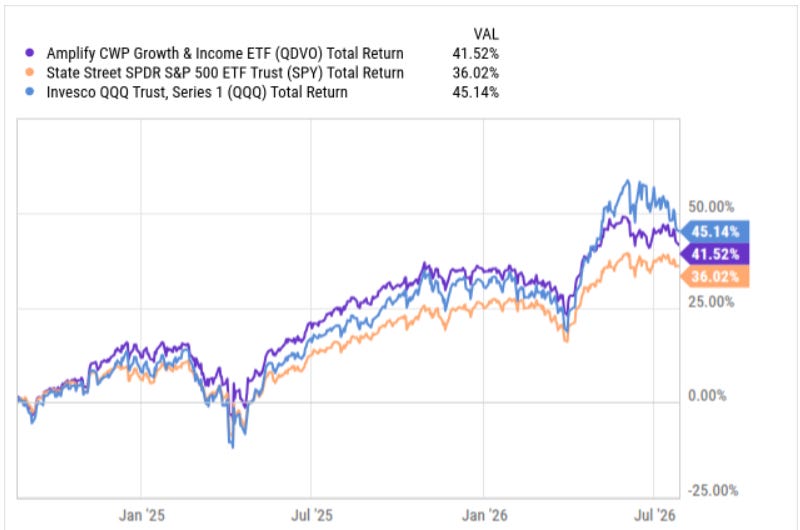
QDVO’s dividend yield sits near 11%. So $40,000 invested is likely to generate a little over $360 a month in income.

