

My first job paid me a 3% raise every year, and I remember the meeting where each one was announced like it was a gift. A 3% raise on a financial analyst salary works out to a few extra dollars a day.
Wages across the whole country grew 3.2% in the twelve months to June 2026 according to the BLS, and consumer prices rose 3.4% over the twelve months to July, so the national raise didn’t even keep pace with the cost of living. That’s the deal most people are working under, and it’s the deal I hated enough to start buying dividend stocks in 2018.
Now, my invested money gets double-digit raises every year and I wanted to share 4 of these companies with you. When you’re an investor, you can get dividend raises and this changed my perception of money. I didn’t want to let a manager or a job dictate my financial well-being, so I wanted to create my own raises using my own capital.
So I created a second income stream using dividends and this income has experienced annual raises on its own. The portfolio doesn’t have to work, report to a manager, do one-on-ones, or sit in traffic.
👉Upgrade your membership!
While I was getting a 3% raise, the biggest companies in the country were giving their shareholders raises three and four times that size.
So I ran a screen for exactly that: companies big enough that the raises aren’t a one-time thing, growing their dividends fast enough that the income actually outruns inflation, with no missed or cut payments in ten years.
Four names cleared every bar, and I’ll walk through each one with the numbers behind the raise. If you’ve ever sat through a 3% raise meeting and felt the math wasn’t on your side, this is the other side of that math.
Key takeaways
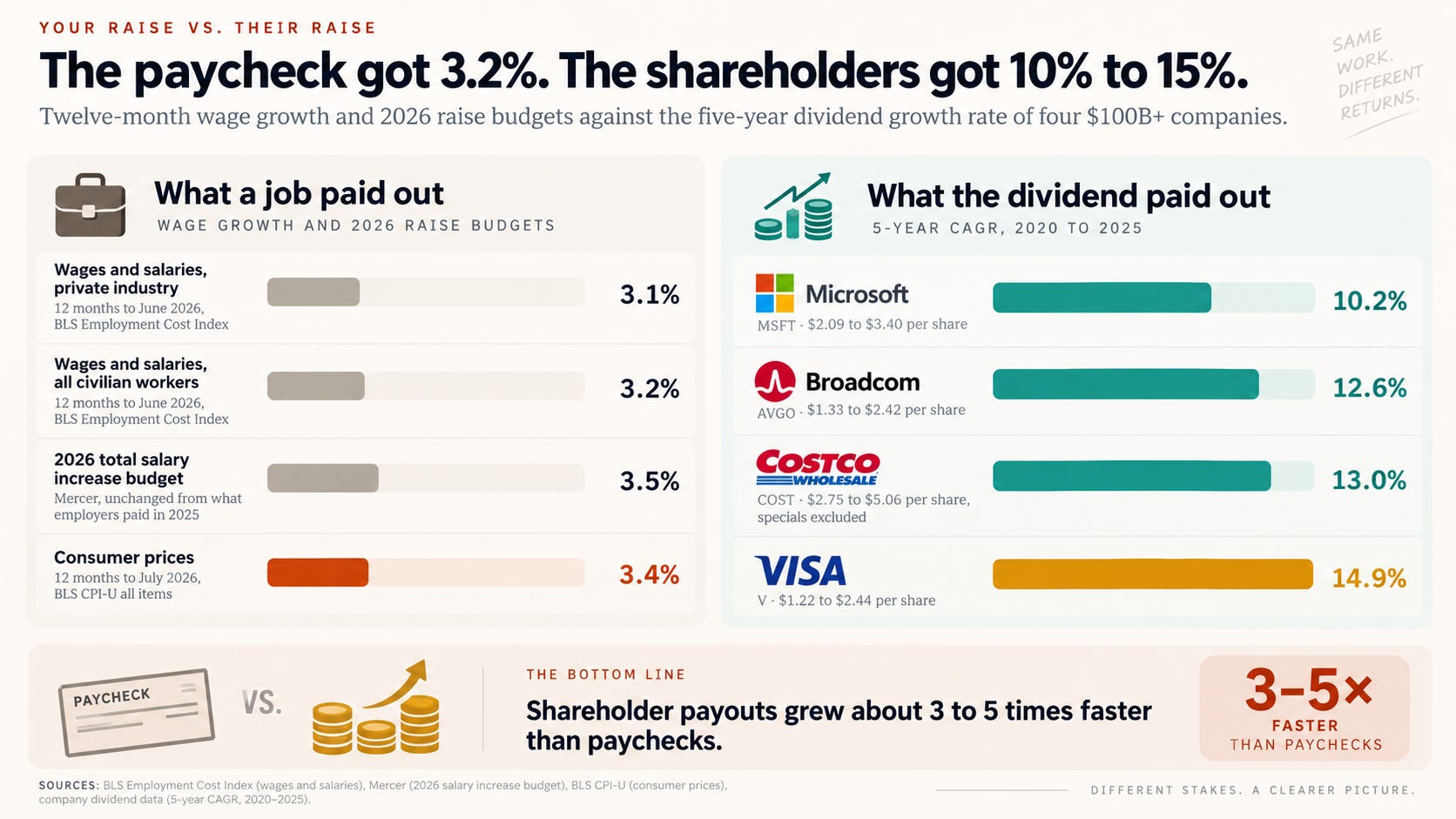
Four $100B+ companies grew their regular dividends 10.2% to 14.9% a year from 2020 to 2025, against a 3.2% national wage increase.
All four have paid an uninterrupted quarterly dividend from 2017 through their latest 2026 declaration.
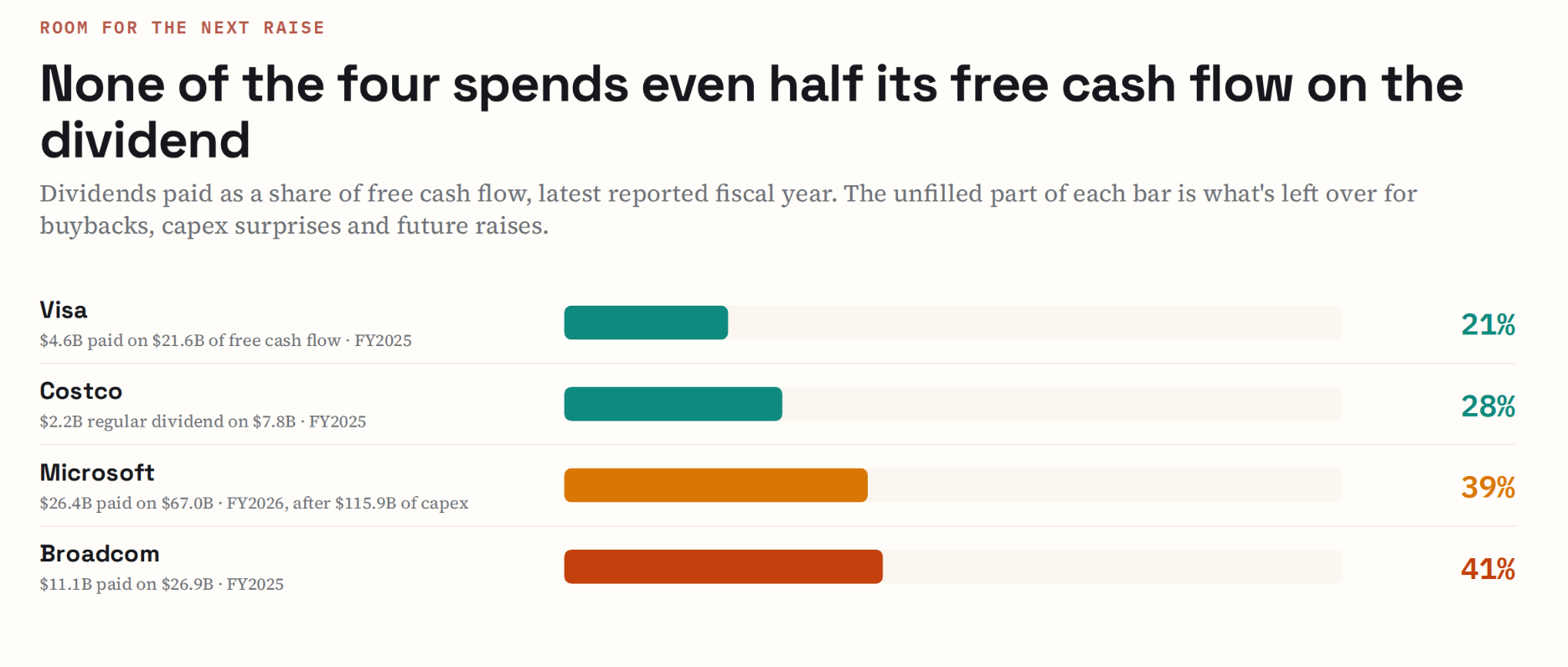
None of the four spends more than 41% of free cash flow on the dividend, which is the room for the next raise.
The catch is yield: 0.64% to 0.73% today. These are raise machines rather than income machines, and I explain where they fit next to the 10% payers I own.
Stop Chasing The Work Raises
Employers budgeted a 3.5% total salary increase for 2026, the same figure they actually paid in 2025, with merit raises at 3.2%. Mercer surveyed those companies in late 2025 and the headline was that nobody planned to raise the number. Put that next to the 3.4% rise in consumer prices and the average worker’s real raise this year rounds to zero.
What changed my mind about money was noticing that the dividend on a stock I owned had been raised by more in one announcement than my salary had been raised in three years. That’s what pushed me to build the habit of investing every paycheck, which is how I got to $100K by the time I was 25.
The chart below is that budget next to what four companies paid their owners over the same stretch.
👉 The four companies are:
Visa V 0.00%↑
Costco COST 0.00%↑
Broadcom AVGO 0.00%↑
Microsoft MSFT 0.00%↑
Microsoft: The Slowest Raise, The Safest Check
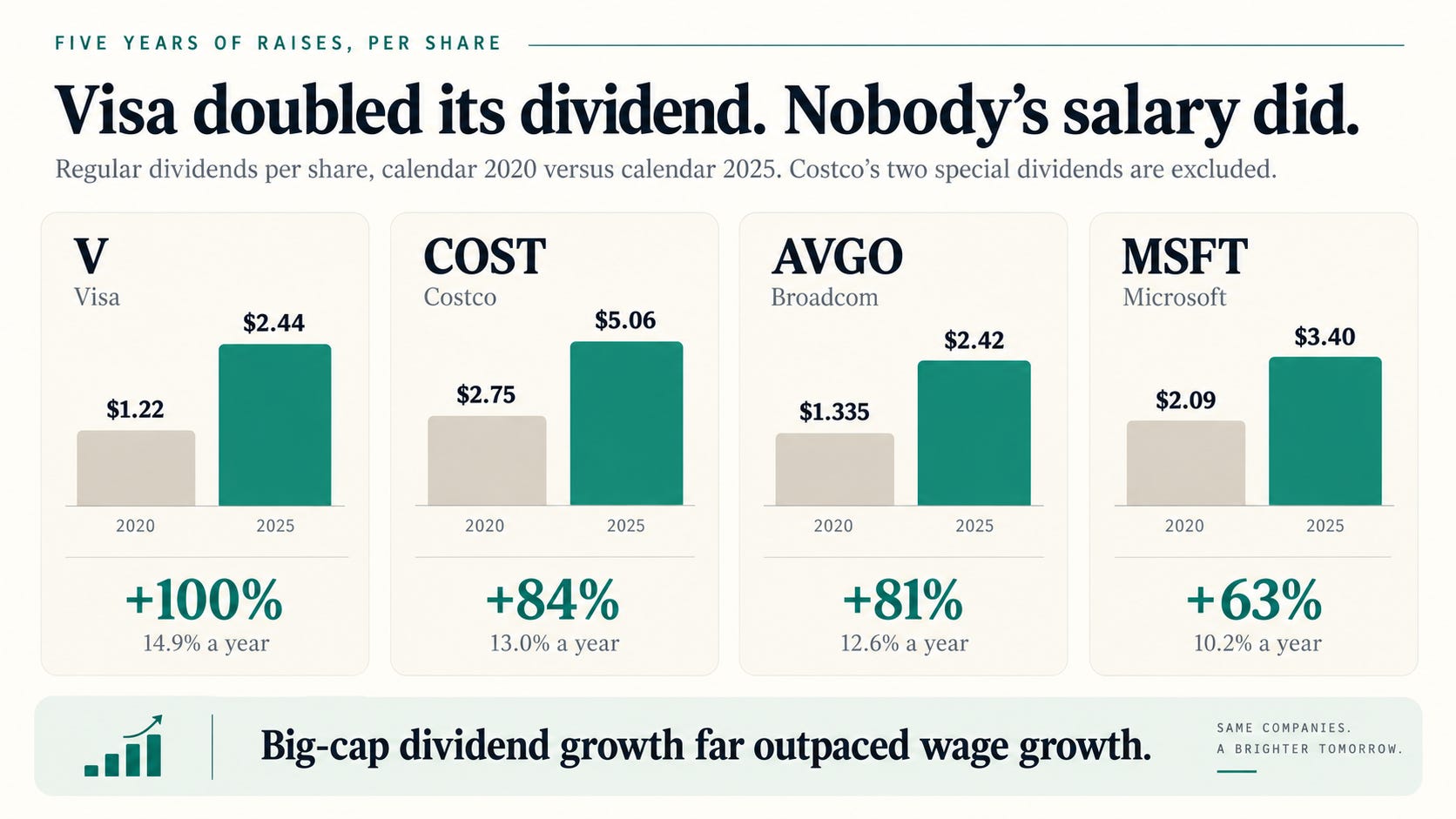
Microsoft grew its dividend 10.2% a year from 2020 to 2025, the slowest of the four, and it’s also the one I own the most of. The most recent raise took the quarterly payment from $0.83 to $0.91, a 9.6% bump, on the November 2025 ex-date.
If you pay for Microsoft 365 or your company runs on Azure, you’re one of the customers funding that raise, which is a strange thing to think about the first time.
Revenue was $331.8B in the fiscal year that ended June 30, 2026, up from $281.7B the year before and $168.1B in FY2021. Earnings growing 17.4% while the dividend grows 10.2% means the payout ratio has been shrinking even as the check gets bigger, and that’s the healthiest version of a raise a company can give.
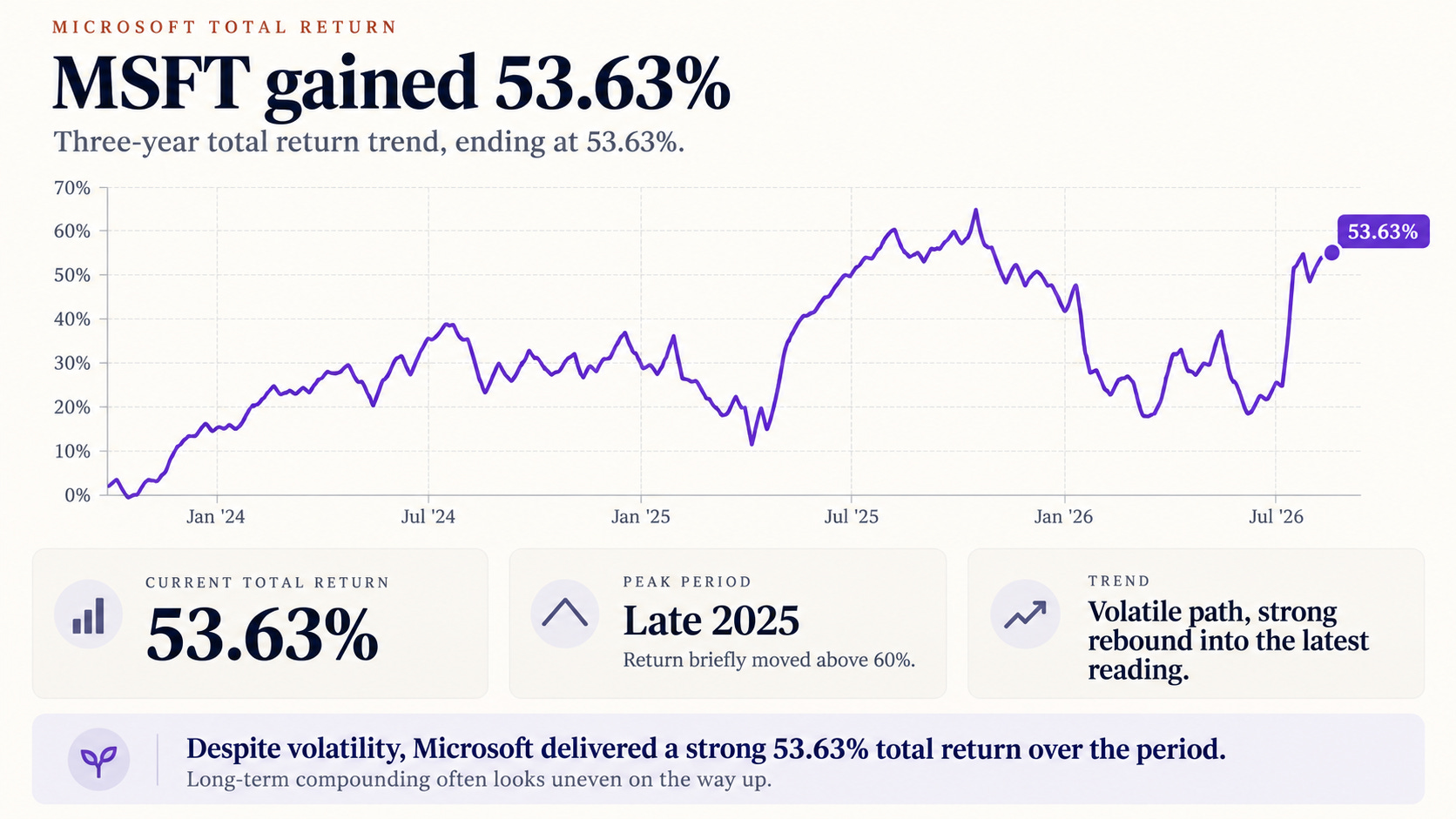
Not only would you be getting raises, but you’d have grown your capital by more than 53%.
The AI buildout decides how fast the raises come, and it has almost no bearing on whether they come at all. I went deep on that spending in Microsoft Is Extremely Undervalued.
Visa: A Raise On Every Swipe
Visa’s dividend went from $1.22 a share in 2020 to $2.44 in 2025, an exact doubling in five years and a 14.9% compound rate. The latest raise moved the quarterly payment from $0.59 to $0.67, or 13.6%, on the November 2025 ex-date. Every time you tap a card at a coffee shop, a small fee runs through this network, and that fee is what funds the raise.
The reason Visa can keep raising this fast comes down to how little it costs to run a payments network. Capex was $1.5B in FY2025 against $23.1B of operating cash flow, so 94% of the cash the business generates is free cash. Revenue of $40.0B turned into $19.9B of net income, a 50% net margin, and the $4.6B dividend consumed only 21% of free cash flow.
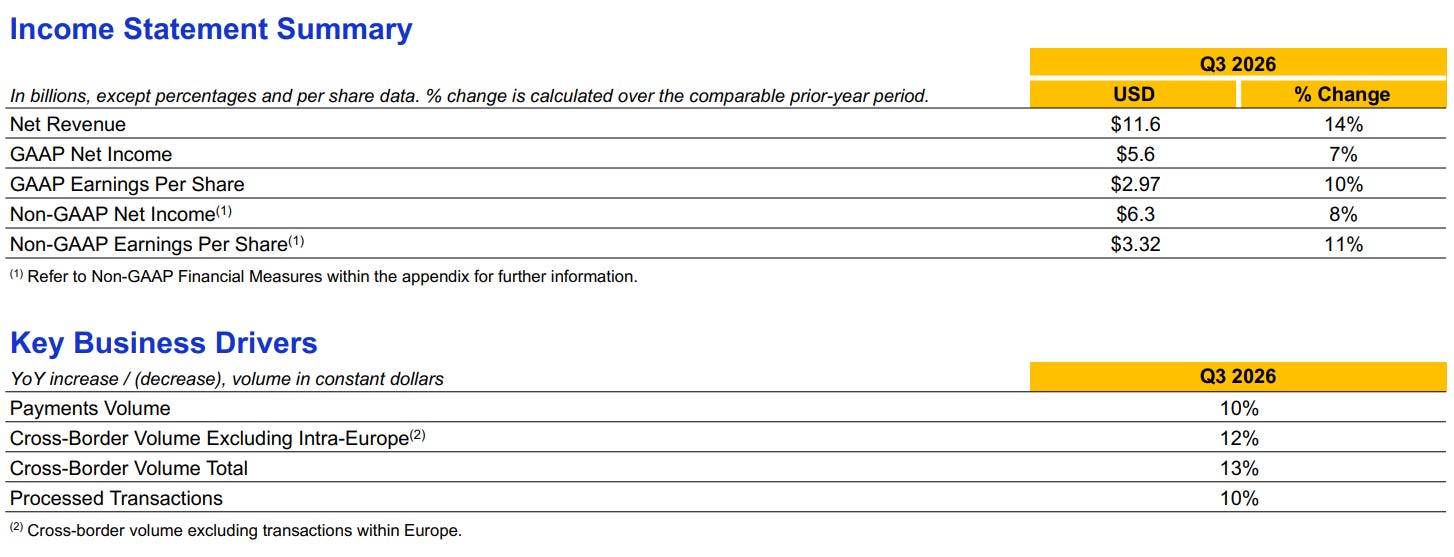
The rest of the cash goes to buybacks. Visa repurchased $13.4B of stock in FY2025, and the diluted share count has dropped from 2.22B to 1.97B since FY2020, an 11.6% reduction. Every share that disappears makes the next raise cheaper, because the same total dividend dollars get split across fewer owners.
Broadcom: Paid On Every AI Server
Broadcom’s dividend grew 12.6% a year from 2020 to 2025, and its revenue grew 21.7% a year over the same period, the fastest top line of the four. The latest raise took the quarterly payout from $0.59 to $0.65, a 10.2% increase, on the December 2025 ex-date. Broadcom designs custom AI chips and the networking gear inside the data centers that budgets like Microsoft’s $115.9B of capex are paying for, so in a real sense one company on this list is helping fund another’s raise.
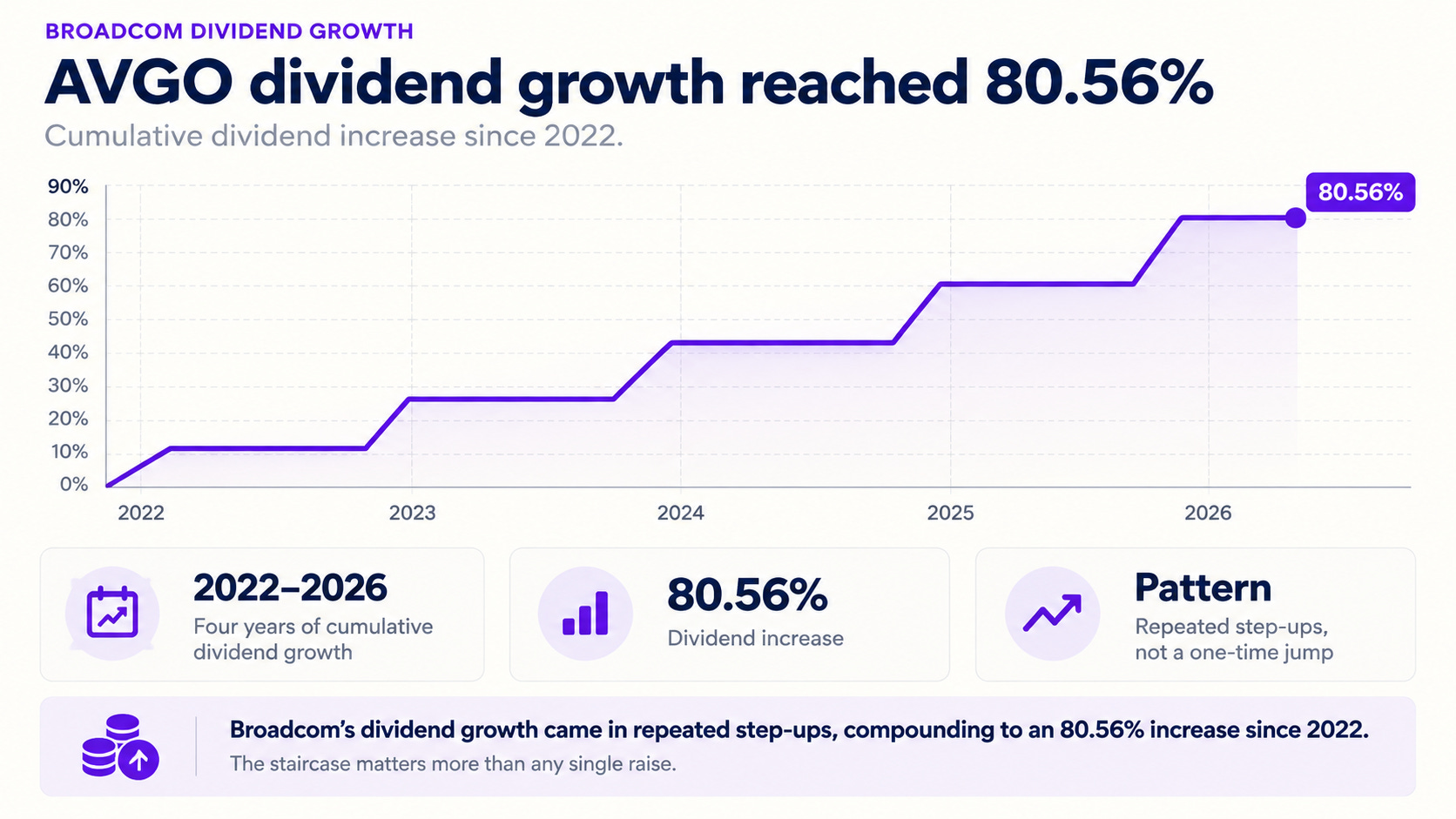
The honest weakness is that Broadcom carries the highest payout of the four at 41% of free cash flow, and the diluted share count went the wrong way, from 4.21B to 4.85B, because VMware was partly paid for in stock.
Each raise now has to be spread across more shares. The offset is that free cash flow grew 39% in FY2025 while the dividend bill grew 14%, so coverage improved despite the extra shares. I laid out why I’m bullish on the spending behind this in I’m Betting On 2027 And Collecting 11%.
Costco: The Membership You Already Pay For
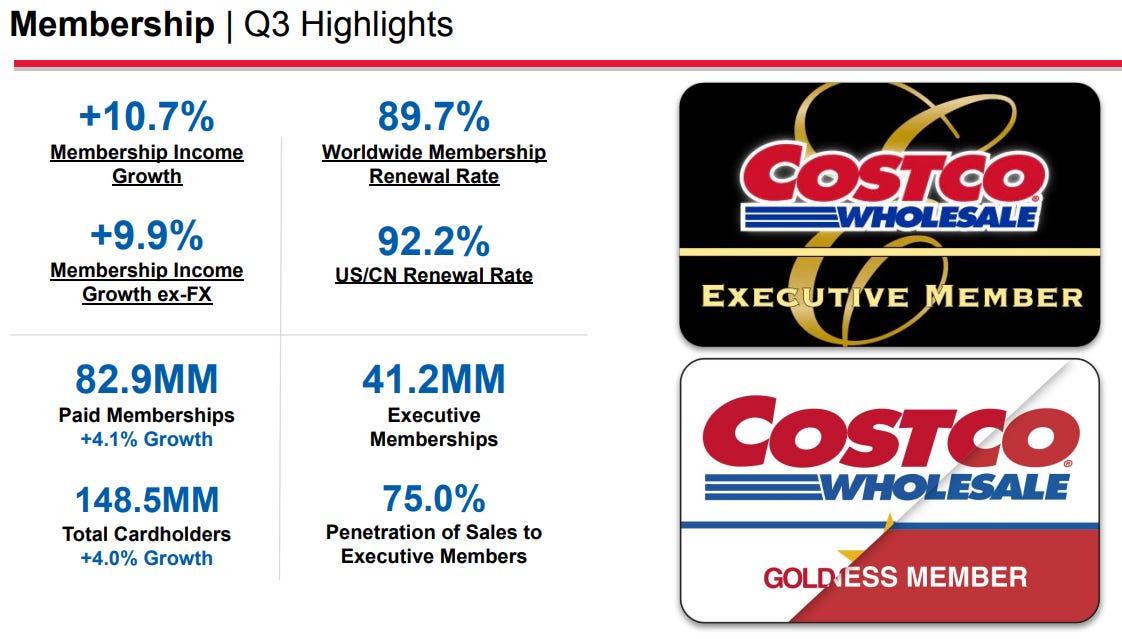
Costco raised its quarterly dividend from $1.30 to $1.47 in May 2026, a 13.1% increase, and the regular payout has compounded at 13.0% a year since 2020. If you hand Costco a membership fee every year, you already understand the business: people pay to get in, then keep coming back, and the renewal rate makes the revenue behave like a subscription.
The trade-off is the yield: at the Sep 4 close of $915.74, the $5.88 forward dividend yields 0.64%, the lowest of the four. You’re paying up for the most reliable raise in the group, and whether that’s worth it depends on what job you’re giving the stock. I’ll get to that in section 09, because it’s the question that decides whether any of these four belong in your portfolio.
What A 13% Raise Does Over Five Years
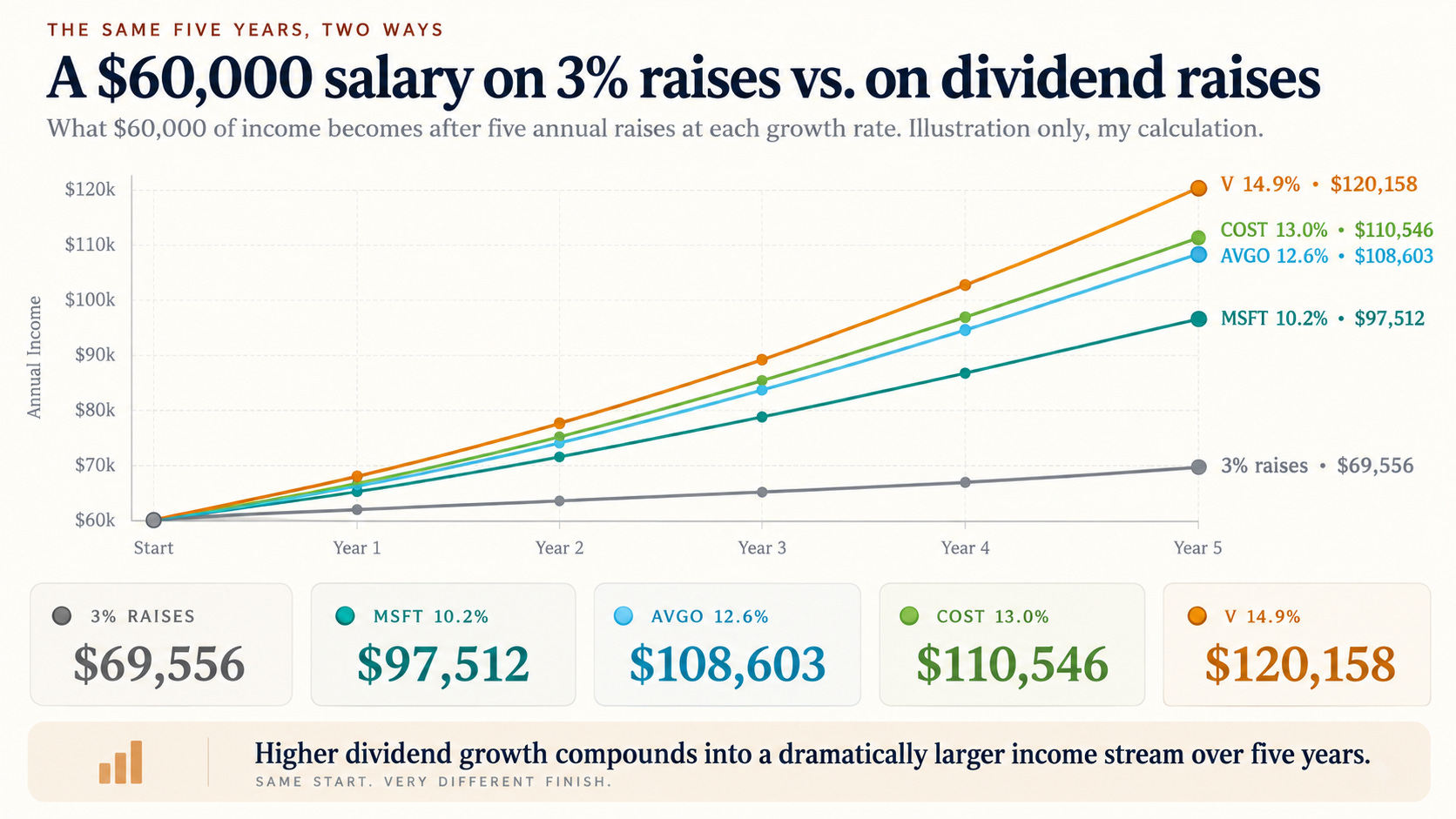
A 3% raise on $60,000 turns into $69,556 after five years, my calculation, and that’s before inflation takes most of it back. Run the same $60,000 through Visa’s 14.9% dividend growth rate and you land at $120,158.
This shows you what the gap between 3% and 13% means in dollars, and the gap is the entire reason I’d rather own the raise than negotiate for one.
The raise machines belong next to the income funds in a portfolio rather than in place of them. My portfolio pays me a real monthly check from the 10% payers, and I reported $4,918 in August. The dividend growers are the sleeve that makes sure that check is bigger in 2031 than it is now. If you only own the high yielders, your income is flat forever, which is the exact problem with a 3% raise wearing a different outfit.
How To Start This Week
Any broker’s stock screener will filter by market cap and dividend growth, and the dividend history for each company is on its investor relations page. Here’s the order I’d do it in.
Pull your last three raises and write down the average. Most people land near the 3.2% national figure. That number is your benchmark, and any dividend growth rate below it isn’t worth your time.
Screen for market cap above $100B and five-year dividend growth between 10% and 15%. You’ll get a short list, so cut anything above 15% (usually a payout ratio catching up) and anything below 10% (not beating your raise by enough).
Check ten years of payments on each survivor. One skipped or reduced quarter since 2017 disqualifies it. This takes five minutes per company on the investor relations page.
Divide dividends paid by free cash flow from the latest cash flow statement. Under 50% means there’s room for the next raise. Over 75% means the raise is coming out of something else.
Buy one and hold it through at least two raise announcements before judging it.
If the individual stock route feels like too much, a dividend growth ETF does the screening for you at the cost of some growth. I reviewed the two most popular ones in Vanguard VIG Review and Is DGRO Still One Of The Best, and you can check whether these four sit in the top holdings before you buy. The trade is simpler execution for a growth rate that averages in the slower payers too.
Frequently Asked Questions
What is a dividend growth stock?
A dividend growth stock is a company that raises its dividend per share every year, usually because earnings are growing and the payout ratio is low enough to leave room. The four in this article (Microsoft, Visa, Broadcom and Costco) raised their regular dividends 10.2% to 14.9% a year from 2020 to 2025 with no missed payments since 2017.
Which large companies grow their dividends 10% or more a year?
From a screen of NYSE and Nasdaq companies above $100B market cap, run Sep 6, 2026: Visa (14.9%), Mastercard (13.7%), Costco (13.0%), Broadcom (12.6%), UnitedHealth (12.5%) and Microsoft (10.2%) all grew regular dividends per share between 10% and 15% a year from 2020 to 2025. Lowe’s grew faster at 15.9% and Home Depot slower at 8.9%.
Is a 0.7% dividend yield worth owning?
Only if you’re buying the growth rate rather than the income. At 0.64% to 0.73%, $100,000 across these four pays about $700 a year today (my calculation). At the trailing growth rates that income doubles in roughly five to seven years. For income you need this year, a higher-yielding fund is the better tool.
How is five-year dividend CAGR calculated?
Take the regular dividends per share paid in calendar 2025, divide by the amount paid in calendar 2020, and raise the result to the power of one fifth, then subtract one. Special dividends are excluded. For Visa: ($2.44 ÷ $1.22)^(1/5) − 1 = 14.9%.
How much did wages grow in 2026?
The BLS Employment Cost Index shows wages and salaries for civilian workers up 3.2% in the twelve months to June 2026, and 3.1% for private industry. Mercer’s survey found employers budgeting 3.5% total salary increases for 2026, unchanged from 2025. Consumer prices rose 3.4% in the twelve months to July 2026.
This is such a smart way to frame dividend growth. Most people focus on the yield today, but the rate at which that income grows can matter far more over a long enough timeline. The comparison with salary raises really puts that into perspective.
its crazy, I recently watched an interview of a guy named David Bahnsen and his case for dividend growth investing ( waiting on the book ) , namely with sequence of returns risk, and this article pushes that case even further and I can appreciate the case for it, I knew it had to do with dividends but with the comparison to wage growth it puts it in perspective — great article as always 🫡