

Most investors are going to make money on AI and still underperform. They’ll own the right theme, at the wrong stage, and walk away wondering what happened.
The mistake isn’t ignorance. Everyone understands AI at this point. The mistake is timing. Billions of dollars are flowing into infrastructure names that are already approaching peak pricing power, while the next generation of compounders sits one stage ahead, largely ignored.
This is why people are chasing the stocks that already boomed higher:
Micron Technologies MU 0.00%↑
Sandisk SNDK 0.00%↑
So here’s what I want to do today: forget the daily earnings noise for a moment, step all the way back, and map this AI transition into four distinct stages, from the bottleneck winners of today to the distribution giants of tomorrow. I’ll tell you exactly where I’m concentrating capital and attention, and which companies I’m watching closely at each point along the way.
We’ll close with a brief current-event case study that grounds the broader themes in something real.
Stick with me. I believe we can get very rich over the next few years, without having to take massive risks.
Stage 1: The Scarcity Stage — The Bottlenecks
We’re living through this one right now.
When a technology curve inflects this sharply and this fast, demand for the underlying inputs explodes faster than any supply chain can respond. GPUs, data center capacity, power infrastructure, cooling systems, specialized networking — all of it became scarce almost overnight. When something is scarce and non-negotiable, whoever controls that scarce thing prints money.
This is why Nvidia became the most talked-about company on earth. This is why data center REITs re-rated. This is why every hyperscaler started issuing “we’re spending $X0 billion on capex” press releases as competitive signaling. The demand signal was so clear and so urgent that the sellers of the raw inputs could charge almost whatever they wanted.
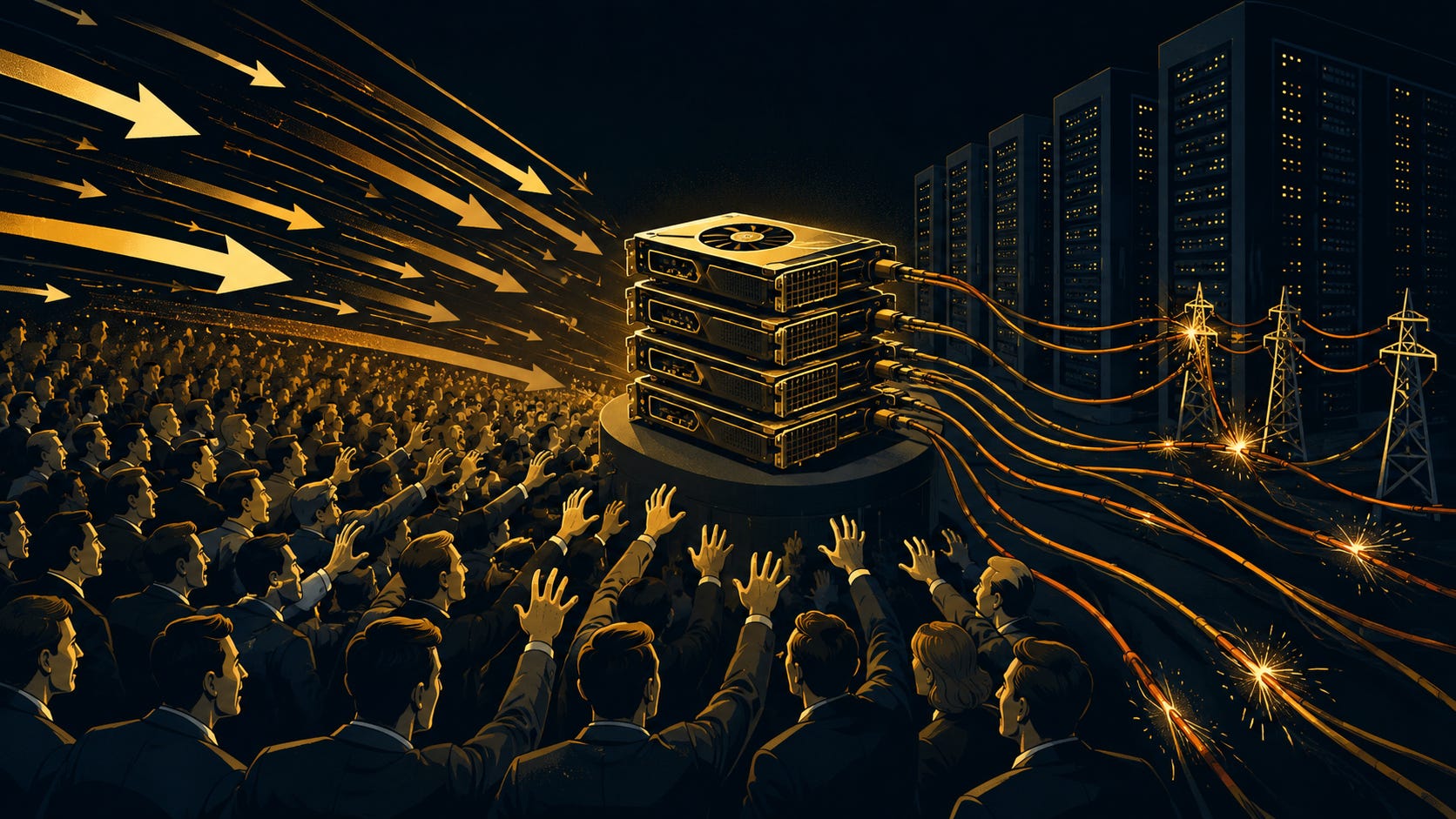
The Stage 1 winners share a recognizable profile:
They sit directly at a structural bottleneck in the AI supply chain
Their product or service has no near-term substitute
They have enormous pricing power, which flows straight to margins
Customers are essentially forced buyers, because delay means falling behind
That’s a beautiful setup. But here’s the honest caveat every investor needs to hear: this stage is already maturing. The extraordinary pricing power that characterized 2023 and 2024 is exactly what’s attracting capital to close the supply gap. More fabs are coming online. Alternative chip architectures are getting funded. Hyperscalers are designing their own silicon. The window of peak scarcity doesn’t stay open forever.
👉Here are the clearest Stage 1 beneficiaries:
Chips & Hardware
Nvidia NVDA 0.00%↑ (GPUs)
TSMC TSM 0.00%↑ (manufacturing)
Broadcom AVGO 0.00%↑ (custom AI chips, networking)
Marvell Technology (data center networking)
Data Center Infrastructure
Equinix (colocation)
Digital Realty (data center REITs)
Vertiv (cooling and power management)
Eaton (power infrastructure)
Buying the best Stage 1 names at reasonable prices still makes sense. But if you’re paying for scarcity rents that are actively being arbitraged away, you’re paying for a trade with a time stamp on it. Know the difference.

Stage 2: The Normalization Stage
Supply catches up. Hype stabilizes. The euphoria of the initial sprint gives way to the quiet, grinding work of figuring out who actually built something durable.
This is where Stage 1 winners get sorted into two very different buckets:
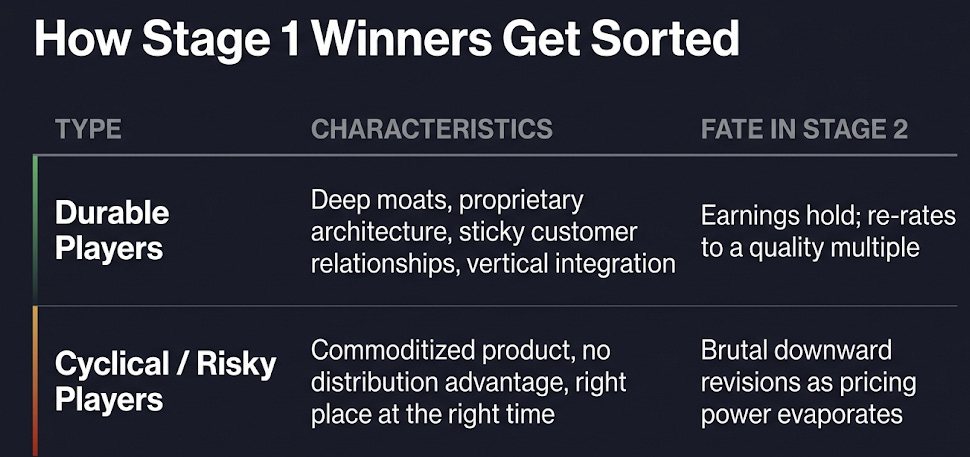
The trap investors fall into is assuming that a company which thrived in Stage 1 has earned its Stage 2 valuation. Often it hasn’t. The tailwind disappears and suddenly the underlying business looks much thinner than the revenue numbers suggested.
👉 Cyclical / Risky Players (facing pressure)
Super Micro Computer SMCI 0.00%↑ (server assembly, thin moat, heavy competition)
Arm Holdings ARM 0.00%↑ (richly valued, but licensing model faces long-term pressure as hyperscalers design around it)
Think about generic cloud storage providers in the post-2015 world. Or early-generation CDN players. Or any number of semiconductor companies that rode a single product cycle with no follow-on. The infrastructure gold rush creates genuine winners, and a lot of bagholders.
The question to ask about every Stage 1 winner in your portfolio right now: Does this company have structural advantages that survive the normalization, or was it just selling shovels to miners? If you can’t answer that confidently, you probably want to trim before the crowd figures it out.
Stage 3: Power Dynamic — Buyers Take Control
This is the stage I find most compelling to position for right now, because it’s the one most investors are systematically underweighting.
Once the infrastructure becomes widely available, once GPUs are plentiful, once model APIs are cheap, once the raw capability is commoditized, the balance of power shifts completely. The hyperscalers and platform giants who spent Stage 1 writing enormous checks to build and buy capacity now hold extraordinary leverage. They have options in a way they simply didn’t before.
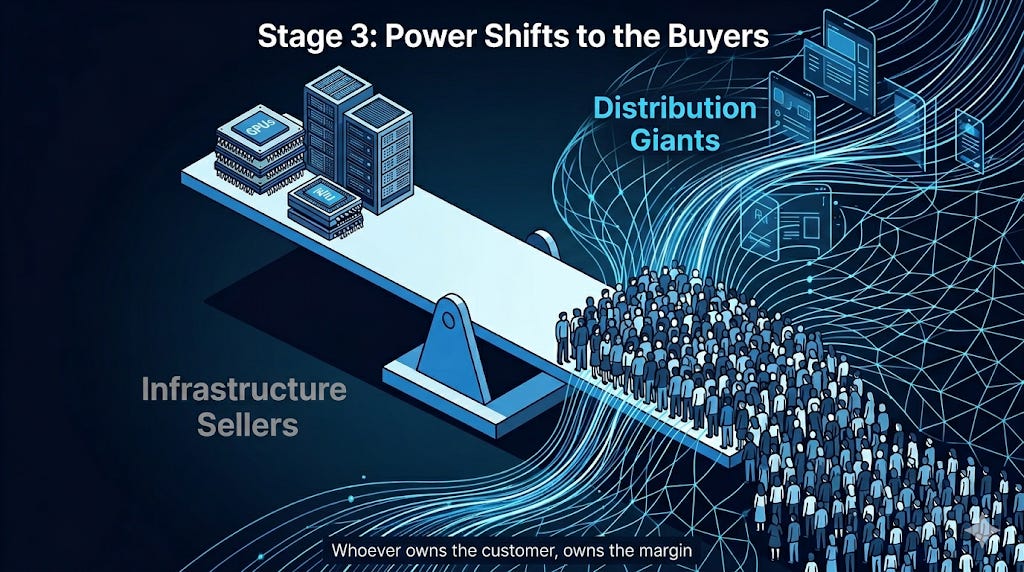
More importantly, they have something the infrastructure layer cannot acquire: direct relationships with hundreds of millions of end users. Decades of behavioral data. Trusted distribution channels. The asset every technology company ultimately needs and almost none can build from scratch.
Stage 3 giants fold AI capability into existing products and monetize it through those established customer relationships. The AI becomes a feature, then a product line, then a fundamental operating layer. Because these companies already have the customer, every incremental AI interaction flows straight into their existing monetization engine.
Stage 4: The Software and Application Layer
Once the underlying model capability is cheap, ubiquitous, and effectively invisible infrastructure, like electricity or broadband, the value migrates up the stack.
Stage 4 creates two completely different categories of winners and losers.
The Differentiated Winners are companies that sit on proprietary data moats, own deeply embedded workflows, and have distribution that can’t be replicated. Their advantage is everything around the AI: the data it learns from, the workflow it sits inside, the customer trust it leverages. These companies become vastly more profitable when underlying compute costs collapse, because their input costs fall while their pricing power holds.

The Permanently Commoditized are what I’d call wrapper businesses. A thin interface layer on top of a foundation model, with no proprietary data, no locked-in workflow, and no distribution advantage. When the incumbent platform adds that same capability as a native feature, the wrapper company faces an existential question. Many won’t survive it. These are high-risk, difficult-to-underwrite investments regardless of near-term revenue.
The key question for any software or application company you’re evaluating: If the foundation model provider decided to build exactly this product tomorrow, how quickly would they capture the market?
If the honest answer is “quickly,” you’re probably looking at a wrapper. If the honest answer is “years, because of the data and distribution moat,” you might be looking at something genuinely durable.
PAID SUBSCRIBER SECTION: The Stocks I’m Actually Buying🔒
The following section is for paid Dividendomics subscribers only. This is where I get specific — tickers, rationale, and how each name maps to the stage framework above.
If you want to get involved with investors who love growing their wealth and talking about stocks, consider joining the paid subscription. 10% discount included.
