

Using options as one of the methods of wealth building isn’t as spooky as people make it seem. There’s a solid chance that you associate options with gambling because there are tons of investors who use options specifically for gambling. But I always had shitty luck as a gambler so that’s not my thing. Instead, I use covered calls as a way to generate extra income against my long-term holdings.
It’s a calculated method that allows you to generate extra income within your portfolio.
For the monthly of August, I’ve already collected $726 in option premiums from covered calls.
Here’s how it works:
You already own 100 shares of something. You believe the stock will be worth more in the future, so you simply hold and remain patient.
There’s a way to get paid a second time on those exact same shares. A covered call is an options strategy where you sell call options on a stock you already own to make cash (a premium), but you agree to sell your shares at a set price if the stock goes up.
In ideal conditions, you don’t sell those shares but you keep the income paid.
That’s the covered call process I am describing. And it’s the thing I get asked about more than anything else I write, usually right after somebody opens an option chain for the first time and immediately closes the tab. I don’t blame them. It looks complicated for no reason.
👉 Covered calls brought in $1,882.57 for me last month, on top of my dividends. Where every dollar came from is in my latest income report.
So let’s get you started and help you understand how easy the process is. In this article, I’m going to take one real setup and walk it line by line, and by the end you’ll know how to pick a strike, how to pick an expiration, what happens if your shares get called away, and what this trade actually costs you when it goes against you.
No options experience needed. If you’ve never placed one, you’re exactly who I’m writing this for.
What You’re Actually Selling
A covered call is just an agreement between you and somebody else.
You own 100 shares. Somebody pays you cash today for the right to buy those shares off you at a set price, before a set date. That’s it. That’s the whole trade.
What if the stock stays below that price you selected? Nothing happens. You keep the cash AND you keep your shares. Stock goes above it? You sell at the price you agreed to, and you STILL keep the cash that was paid to you.
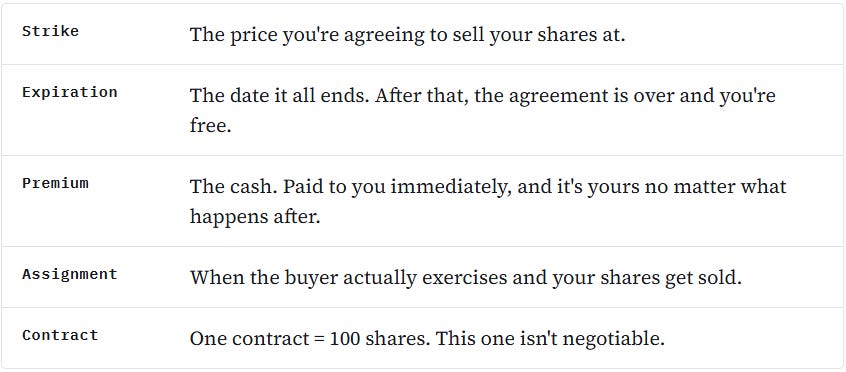
Before getting started, there are 5 terms that you need to know.
Five terms and you’re done:
However, there’s an important requirement for this process. In order to write covered calls, you need 100 shares of one stock. If you own 250 shares you can write two contracts and the leftover 50 shares just sit there. If you only have 25 shares, you aren’t capable of initiating a covered call strategy.
If you don’t have 100 shares of any position you hold, that’s your first goal before you worry about any of the rest of this.
To make it simpler, there are a ton of ETFs that WRITE OPTIONS FOR YOU. You can collect income on a weekly basis from option ETFs. I compiled a list of 10 funds below.


Let’s Look At A Real Example
Here’s an actual scan on OUST 0.00%↑. Say you own 300 shares and you want to know what a covered call would pay you.
Here’s a snippet from the Covered Call Dashboard that guides you:
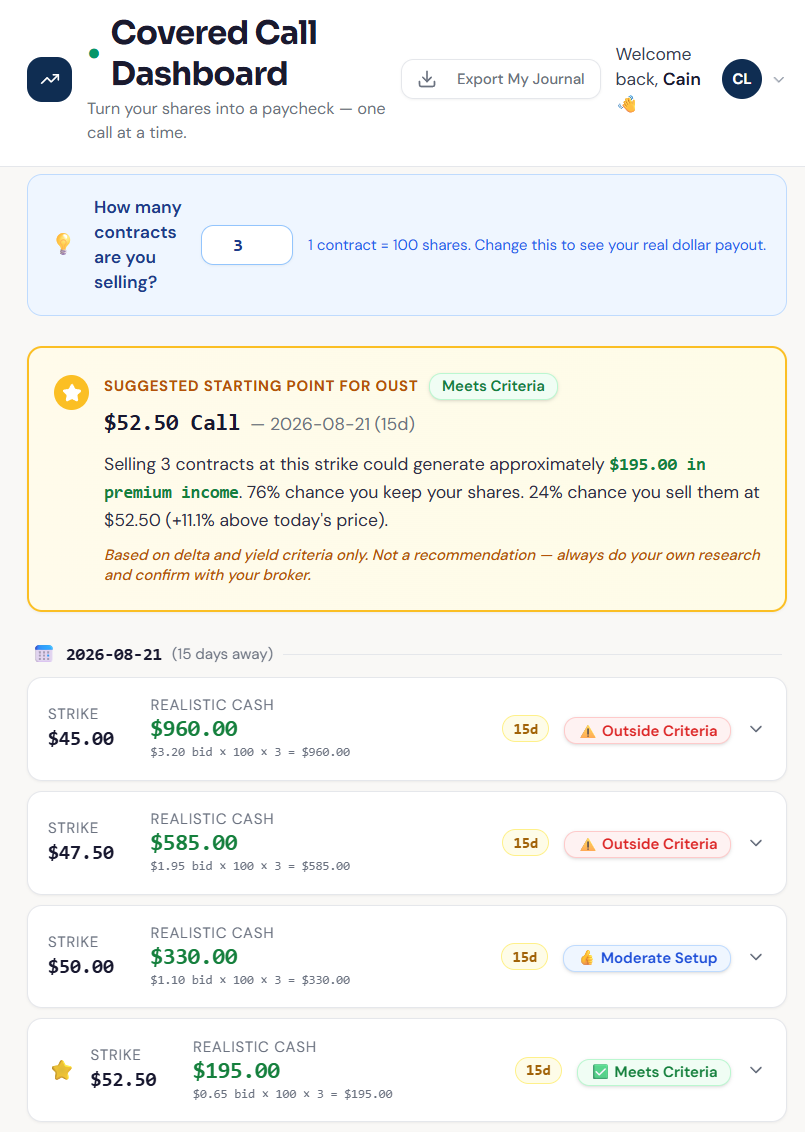
Look at the cash column. $960 at the top, $195 at the bottom, and the only thing changing is the strike price going up.
That’s basically the tradeoff: a higher strike price means you collect less premium income and more upside. A lower strike price means more premium income but less upside growth.
The $45 strike pays the most because you’re agreeing to sell at a price the stock could actually hit in two weeks. The $52 strike pays $195 because you’re agreeing to something that probably won’t happen.
The premium is compensation for the odds you'll have to hand over your shares. More cash on the screen always means better odds that happens.
Why The Biggest Number Is A Trap
Most newbies tend to pick the strike price that provides the largest premium. It’s understandable since it’s the one sitting closest to where the stock trades right now, and it pays the most by a wide margin.
Here’s the problem.
A strike close to today’s price is a strike the stock can actually reach. So you collect the fattest premium on the board, hand over your shares at a price barely above where they already were, and then watch the thing keep climbing without you.
Ideally, you want to collect the premium AND keep your shares without losing upside growth. Trading potential upside for income generation isn’t always the right trade, especially on rapid growth companies that can rally significantly higher, such as META 0.00%↑, AMZN 0.00%↑, or MSFT 0.00%↑.
That’s why the scanner within the Covered Call Dashboard flags the closest strikes as outside criteria. They pay great but they’re also the ones most likely to take your shares.
The one it stars sits further up the board. It pays a fraction of what the closest strike pays, and here’s the logic behind it:
Far enough above the current price that you probably aren’t getting assigned before it expires
If you DO get assigned, you sold at a price you were happy with anyway
The premium is smaller, but it’s real money for two weeks of doing absolutely nothing
So start with the price you’d be happy selling at. Write that number down, go find the strike that matches it, and only then look at what it pays. In that order, every time.
Expiration Date: Shorter Pays Better
Your second decision is how long you’re locking yourself in for.
Referring to the same example from the table above, investors would have the decision to select another expiration date that is further out. But in exchange, this means that you will be locking up your shares for an extended period of time, which may lead to more of a chance for the stock price to reach your selected strike price.
The value decays faster the closer you get to expiration, so the last stretch of a contract is worth far more per day than the early stretch. When you write short contracts back to back, you’re capturing that fast-decay window over and over. Write one long contract and you capture it once, then sit through weeks of slow decay to get there.
That’s why all nine of my contracts last month were weekly or close to it. Same shares, four different expirations, premium coming in four separate times instead of once.
The tradeoff is your attention. One long contract is one decision. Four weekly contracts is four decisions, four order tickets, and four chances to get it wrong. If you already know you’re not going to check your account every week, take the longer date and the lower daily rate. There’s no shame in that. A trade you actually manage beats a better trade you forget about.
👉 See It Over A Full Month
I wrote nine contracts across four expirations last month. Every one of them, with the premium collected and what it cost to close, is in my latest dividend income report. Founding members can see the open positions live in the Covered Call Dashboard.
Access to the Covered Call Dashboard Is Limited to Founding Members!
👉 Subscribe to get those alerts! Upgrade Your Subscription - $0.82 per day to become a better investor.
What If You’re Wrong
Let’s say you write a covered call and select a strike price of $50. For that covered call, you might receive a premium of $100. There’s always the chance that the selected stock rips higher past your selected strike price and goes to $65.
In this scenario, your shares would get called away, meaning you’d lose them. However, you would be able to keep the initial premium that was collected.
But notice what didn’t happen here. You didn’t lose money. You sold at a price YOU picked, and you got paid an extra $90 for the trouble. What you lost was the upside past your strike. This isn’t necessarily a bad thing — it is just very situational.
That’s the real cost of every covered call, and it’s exactly why I don’t write them on stuff I think is about to run. For instance, AMZN rallied higher after its last earnings call and ripped right through my selected strike price. So I was forced to roll that out further. Selling calls on a stock you believe doubles this year is how you get paid $90 to miss a double.
Don’t do that to yourself.
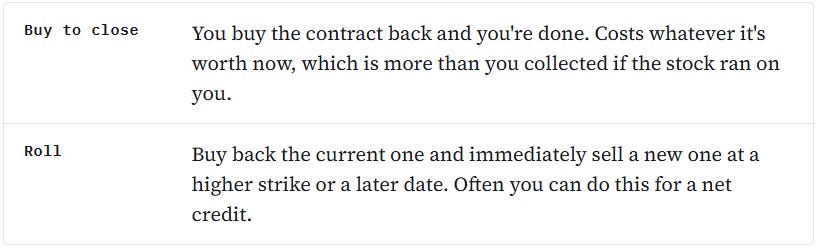
If you want out before expiration, you’ve got two options:
Where I Don’t Do This
Covered calls work best on shares you’d be happy to sell at a certain price. That sounds obvious until you’re staring at a potential $500 premium on your favorite holding. It gets tempting! For instance, I am able to write a covered call on ASTS 0.00%↑ with a strike price a few bucks out, which would yield a premium of $150 per contract.
If I write 3 contracts, that would result in a premium of $450 instantly. Quite tempting.
However, I would suggest there are three places I’d tell you to stay away:
Your highest conviction growth position. Capping the upside on the one stock you own FOR the upside kind of defeats the purpose.
Anything under 100 shares. You can’t write a contract. Build the position first.
Stocks nobody trades options on. For instance, many ETFs don’t offer the ability for covered calls to be written against them. This is standard.
The best candidates are usually positions you like but wouldn’t mind selling at a profit.
I think high volatility holdings would be the best option for investors looking to maximize option premiums. These are the companies that have the potential to rally or decline by double-digits within a single session.
The other thing worth making a note of is that assignment has tax consequences. Option premiums collected are typically classified as ordinary income. Of course it all depends on what type of account you utilize this strategy within. Inside an IRA it doesn’t matter.
Six Steps To Summarize
Pick a position where you own 100+ shares.
Don’t do this with your favorite holding — only something you’d happily sell.Decide your sell price BEFORE you look at any premiums.
The premiums will only tempt you. It makes the most sense to pick a strike price ABOVE your cost basis.Find the strike at or above that price
This ensures that it’s a win-win, no matter the outcome.Pick an expiration you’ll actually keep an eye on
A weekly expiration comes quick. A month out is a bit more flexible.Sell to open, one contract
Your broker calls it “sell to open” or just “write.” Use a limit order at or near the bid. The cash shows up in your account that same day.Write down what you did and why you did it
Strike, expiration, premium, reasoning. After ten trades you’ll start seeing your own patterns, and that’s worth more than any strategy somebody hands you.
How I Run This Every Week
Everything above, you can do by hand. I did for a long time.
Then I was checking a dozen positions every week and it stopped being realistic, so I built something.
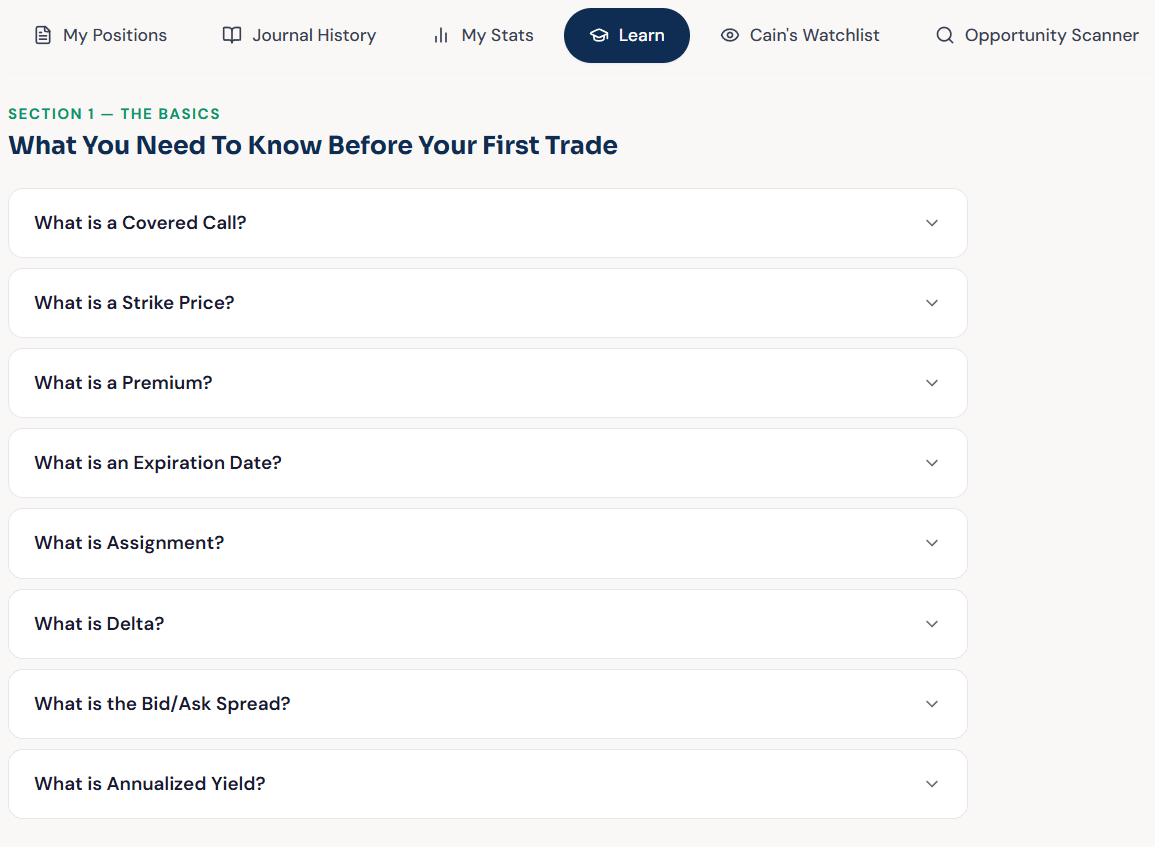
The Covered Call Dashboard does four things:
Opportunity Scanner. Type in any ticker you own and it shows you every strike and expiration, what it pays, the odds of getting assigned, and whether it’s a setup worth taking. That’s the table you looked at earlier in this article.
Position tracking. Log what you write and watch your premium income stack up over time.
My watchlist. The tickers I’m personally looking at right now for calls.
Trading journal. Every trade saved, your win rate tracked. Step six up there, done for you.
There’s also a Learn section that covers every term in this article, so you’re not opening a second tab to Google what delta means in the middle of placing a trade.
It’s a founding member tool.