

There are basically 2 ways for retirees to live off their investments. You either sell shares of your investment, which is what most financial advice will tell you, or you keep those shares and collect the dividends it pays you. However, the second option requires more planning and knowledge but I think it can be highly rewarding.
The 4% rule is the first option and it is the default advice nearly every retiree receives. The rule is to basically save 25x your annual expenses, then withdraw 4% in year one, and the historical data says the money should last thirty years.
So if you have $1,000,000, you would be required to live off $40,000 a year (4%).
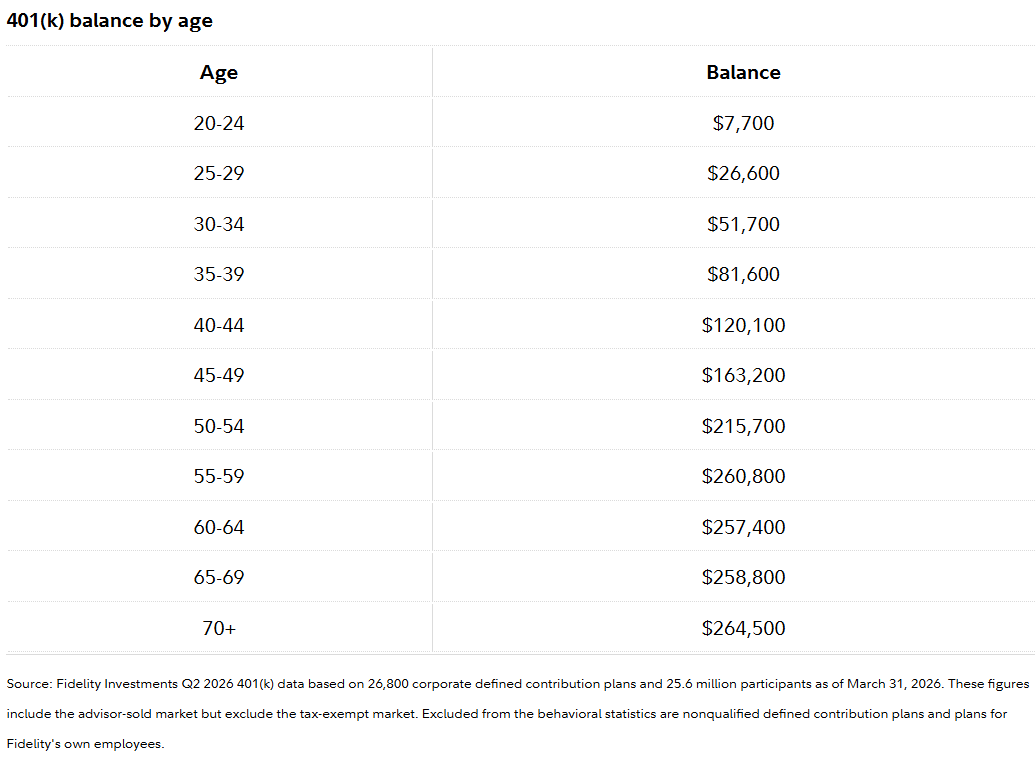
However, data from Fidelity says that the average retiree is far off from the level it needs to be.
However, the idea of selling shares of your portfolio always seemed a bit backwards to me. People are essentially selling the very same thing that compounds their wealth over time.
This is why I love the idea of dividends.
Dividends create cash flow and prevents you from ever needing to sell your shares. If you can avoid touching your invested capital, this means that your portfolio can live on far after you die.
Your family can inherit your cash-generating portfolio and have an established income stream. If you have kids, this is a power tool that gives them some flexibility and a cushion of safety in their life. Imagine handing your children a portfolio that’s generating $5,000 n dividends every month. Therefore, I wanted to provide some insights into the two approaches and why I think dividends are the superior route.
Need help getting started? 👉 Here’s how I would start with $1,000.
Case Study: The Two Approaches Side By Side
For this scenario, let’s imagine a retiree has a $1,000,000 portfolio and $70,000 of annual expenses.
If we follow the 4% rule, the retiree would only be able to withdraw $40,000 a year, which falls short of the annual expenses. For the income side I am using the iShares U.S. Large Cap Premium Income Active ETF BALI 0.00%↑, which BlackRock lists at a 7.68% distribution rate.
👉 A hypothetical $1M in BALI would produce $76,800 in annual income.
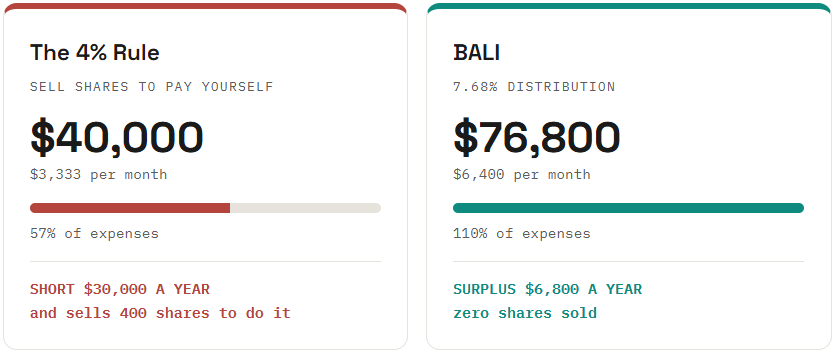
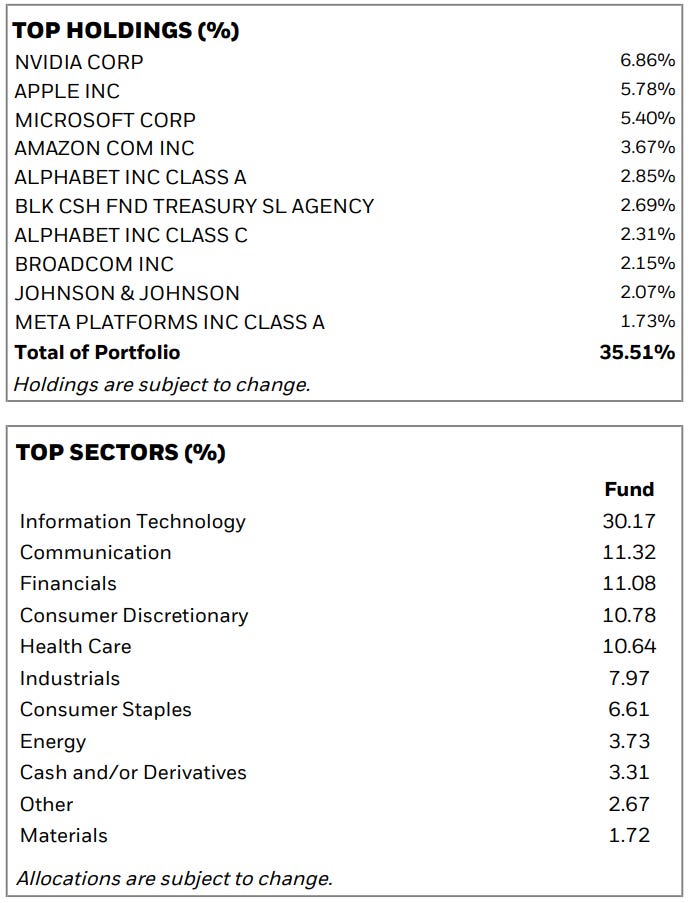
The gap between those two columns is $36,800 a year on identical capital, which works out to 92% more income. The best part is that BALI still allows investors to participate in the upside growth of the market over time. As we can see below, BALI provides direct exposure to some of the highest quality businesses in the world.
I’ve also issued a 4-star rating on BALI within the High Yield Database.
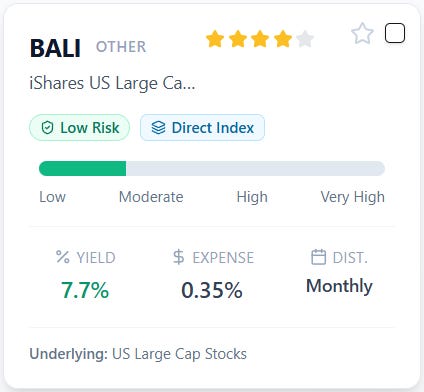
BALI covers the entire $70,000 with $6,800 left over. At $6,400 a month it also clears the inheritance figure I mentioned earlier, and the shares producing that income are still sitting there to hand down. This is a very simplified version of course but you get the idea.
On the surface the second column simply pays more, and that is true. But the number is not the reason I run it, because a bigger payout is easy to find and usually comes with something ugly attached.
The real difference is what each approach does to the portfolio in the years the market goes against you. That is where the two columns stop being close. Want a list of income funds rated by quality instead of headline yield? Paid subscribers get access to the High Yield ETF Database, 120 funds grouped by risk tier.
👉 Upgrade Your Subscription - $0.82 per day to become a better investor.
Where The 4% Rule Breaks Down
A withdrawal is a fixed dollar amount, so the number of shares it consumes depends entirely on the share price that year.
Shares sold = Dollars needed ÷ Current price
Price sits in the denominator, which means a falling market automatically increases how many shares you have to sell. To raise $40,000 at $100 a share you sell 400 shares. To raise the same $40,000 at $50 a share you sell 800. Naturally, those extra shares do not come back when the market recovers. Once you sell it, they’re gone forever.
As we can see below, this is what a bad first year actually costs on that same $1,000,000 portfolio, using a starting price of $100 a share.
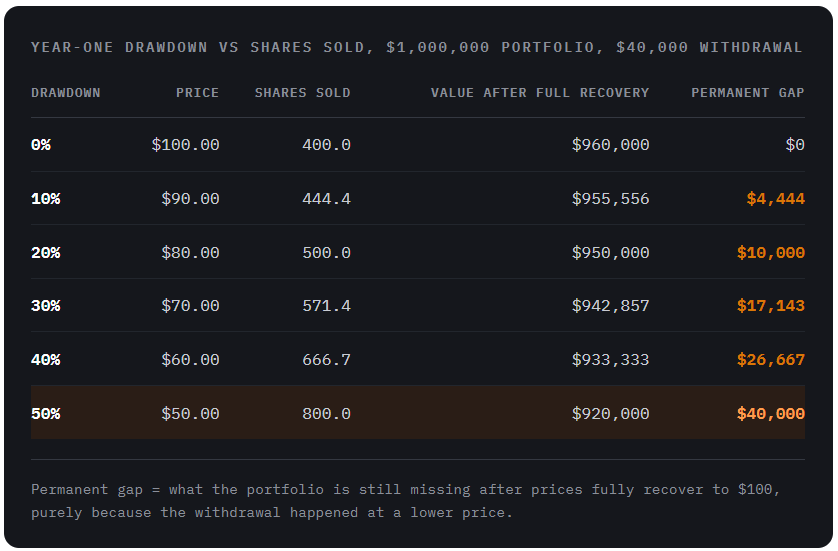
The bottom row is the one that made me stop defending the 4% rule. A retiree who withdrew through a 50% decline is permanently short $24,000 even after the market returns to where it started. Now of course, these sort of large declines have been historically rare.
The dividend investor sitting through that same decline sold nothing. Whether the markets up or down, a dividend investor would be able to collect their income regardless. Their share count on the other side is identical to what it was going in, and every one of those shares participates in the recovery.
The Income Can Actually Rise In A Selloff
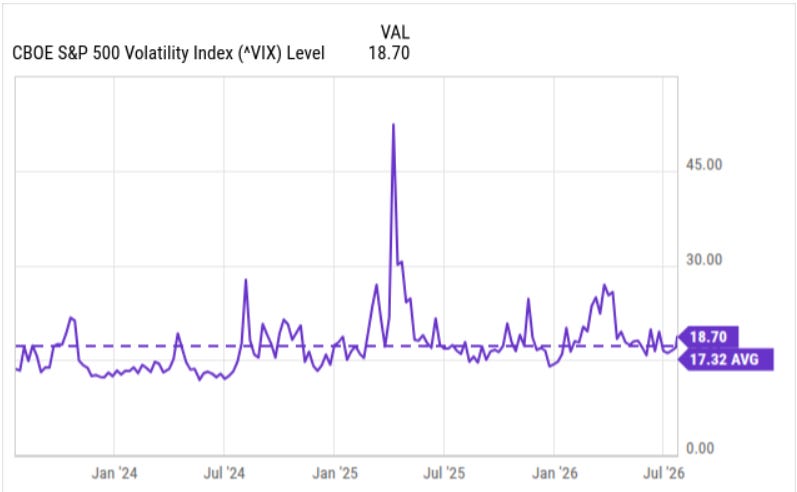
There is a second advantage that most comparisons miss entirely. Option premium is priced off implied volatility, and volatility rises when markets fall. Simply put, more volatility will lead to more income.
More volatility = more option premium collected.
In February 2020 the VIX went from the low teens to above 80 in a matter of weeks. A fund writing calls into that environment was collecting several times the premium it had the month before. The share price still fell and I am not going to pretend it did not, but the income line moved up while the price line moved down.
For reference, the market has generally remained more volatile than average over the last three years. We can use this to our benefit.
A Closer Look At BALI
BALI holds a large cap U.S. equity portfolio and writes options against it to generate income. BlackRock lists the distribution rate at 7.68% as of March 2026, with a 0.35% expense ratio, roughly $1.25 billion in assets, and a beta near 0.84.
A beta below 1 means that the fund will demonstrate less volatility against the S&P 500.
Similarly, BALI has outperformed against peer dividend ETFs that take a more traditional approach, including SCHD 0.00%↑, DIVO 0.00%↑, and VYM 0.00%↑.
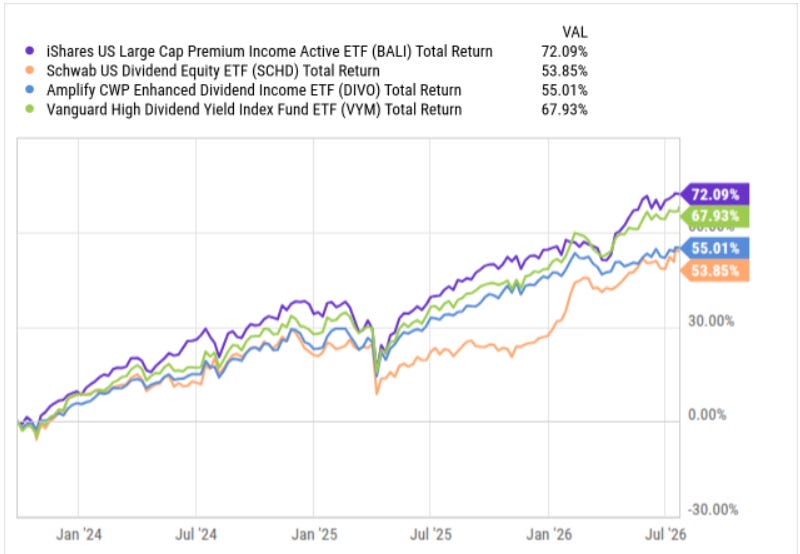
The 0.35% expense ratio is worth pointing out because it undercuts most of the covered call category. Plenty of competing income funds charge 0.55% to 0.99% for a similar structure, so BALI is not asking you to pay a premium for the payout.
The Same $1,000,000 Through A 30% Drawdown
During market declines, a dividend approach provides better flexibility. Having extra income and cash flow also means that investors can reinvest that capital at suppressed prices.
4% rule: selling shares gives you income needed but now you have fewer shares generating income on your behalf.
BALI at 7.68%: pays roughly $76,800 with zero shares sold. Covers the full $70,000 budget with about $6,800 left over to reinvest at depressed prices.
One approach arrives at the bottom having permanently destroyed inventory while still failing to cover the budget. The other arrives with the share count fully intact and surplus cash to put back to work. Furthermore, the volatility that drove the decline is the same volatility feeding the option premium on the way down.
Position sizing still matters here. BALI would not be the entire portfolio in my own allocation, for reasons I get into in the risks below and in the $500K portfolio breakdown.
4 Rules I Follow For An Income Floor
Fixed expenses get covered by distributions, never by sales. Housing, insurance, food, and utilities come out of the income line. Discretionary spending can come from anywhere.
Keep twelve months of expenses in cash. This is what guarantees you are never a forced seller in a month the distribution comes in light. I know that some folks only suggest 3-6 months, but I like to have a bigger cushion so that I feel more secure.
Own the counter-cyclical income source, not only the highest yield. High yields can translate to NAV erosion over time.
Size the concentrated fund smaller than the diversified one. BALI carries a top ten worth about 34.5% of assets, so it gets the smaller weight for that reason alone.
Risks
BALI launched in September 2023, so its entire history sits inside a rising market. Therefore, the fund hasn’t been thoroughly time tested yet. To be fair though, this was just meant to be an example. There are plenty of different high yield funds that are available to investors to choose from. There is no data showing how the strategy handles a prolonged decline.
With such a high yield like this that is mostly dependent on option premiums, the reality is that BALI may not always generate income that can support distributions.
When volatility collapses, premium shrinks and the monthly payment falls with it. Therefore the same property that helps during a crash works against you in a quiet, grinding bull market, and a retiree budgeting to the last dollar off a 7.68% figure is going to be disappointed in some months.
Concentration is the third issue. BALI’s largest positions are Nvidia, Apple, Microsoft, Amazon, and Alphabet, with the top ten running about 34.5% of assets. We’ve already seen how reactive the market has been to the unprecedented capex spending by the hyperscalers. Thankfully, the large option premiums collected allowed the fund to outperform the S&P 500 on a YTD basis.
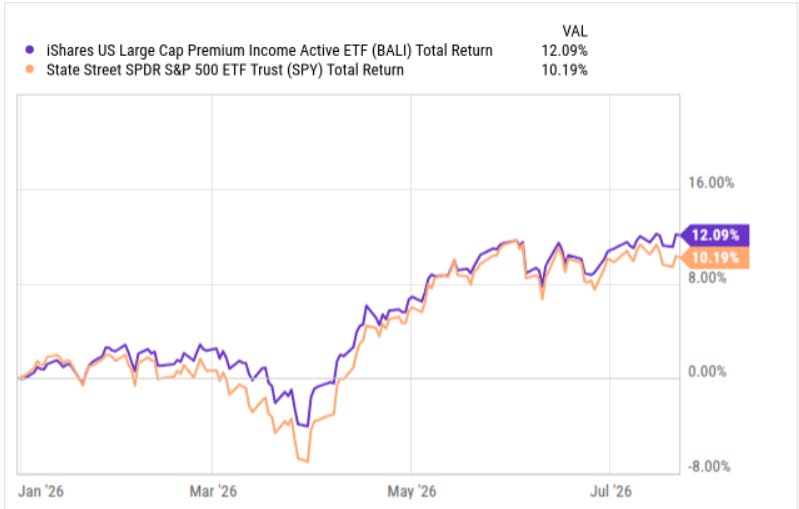
Additionally, this is effectively a large cap core with an income overlay, so anyone already holding an S&P 500 index fund is doubling down on the same names rather than diversifying away from them.
Finally, an options overlay caps upside by construction. Every dollar of premium is a dollar you were paid to give away appreciation, so this fund is not going to keep pace with the index in a strong rally. I run every income fund through the screen in 5 Numbers That Tell You If A Stock Is Actually High Quality before it earns a position, and the same discipline applies here.
Takeaway
The 4% rule is a popular approach for retirement but I don’t believe it is as attractive as using dividends as a way to support your lifestyle expenses. However, the 4% rule is a but flawed because it was never built to answer how much income the portfolio can produce right now, which is the question a retiree is actually asking.
On a $1,000,000 portfolio the 4% rule produces $40,000 and asks you to sell shares to collect it, which still leaves this retiree $30,000 short of their own budget. BALI produces $76,800 on the same capital, pays it monthly, covers the entire budget with room to spare, and leaves the share count alone. That is 92% more income from identical money.
You give up upside to the option overlay, the payment moves around, the concentration is real, and the fund has not been tested through a downturn. But I would rather manage those tradeoffs than build a thirty year plan around selling shares into whatever the market hands me that year.