

Key Takeaways
Heading into 2027, a married couple with no other income can collect at least $131,100 of qualified dividends and owe $0 federal income tax; a couple both 65+ can collect at least $146,400.
Only qualified dividends get the 0% rate: paid by U.S. corporations and held more than 60 days. Most covered call, REIT, and bond income does not qualify.
Crossing the threshold taxes only the overflow at 15%, never the income beneath it. This applies to federal tax; states set their own rules.
Every dollar you earn at a job gets taxed before you ever touch it. Federal withholding comes out ahead of the deposit, payroll taxes take their slice off the top, and the ordinary brackets climb as high as 37%. It’s almost like you’re getting punished for earning more.
This is why dividends are a bit of a necessity in modern life. Collect a qualified dividend and there’s potential for no taxes to be paid. You can get raises on that dividend income and still pay no taxes.
Get a raise at work and you’re paying a larger tax bill.

Dividends run through a different rulebook and wages sit in the harshest lane no matter how hard you worked for them. Qualified dividends get their own rate ladder, and the bottom rung of that ladder is 0%. This difference is exactly why I advocate investing on a continuous basis, every paycheck, in every market: each purchase converts a slice of the most-taxed income there is into ownership income, and as your dividend income grows, a rising share of what you collect can arrive with no federal tax on it at all.

How Much Dividend Income Will Be Tax-Free In 2027?
At least $65,550 for single filers and $131,100 for married couples filing jointly, rising to at least $73,600 and $146,400 for filers 65 and older. Those are the confirmed 2026 ceilings and the floor for 2027: thresholds index up with inflation, the official 2027 figures land around late October 2026, and published projections point 2% to 3% higher.
Each ceiling is the standard deduction stacked under the 0% qualified dividend bracket, per Revenue Procedure 2025-32. The 65+ rows also include the age add-on and the $6,000-per-person senior deduction that runs through 2028 for couples under $150,000 of income.
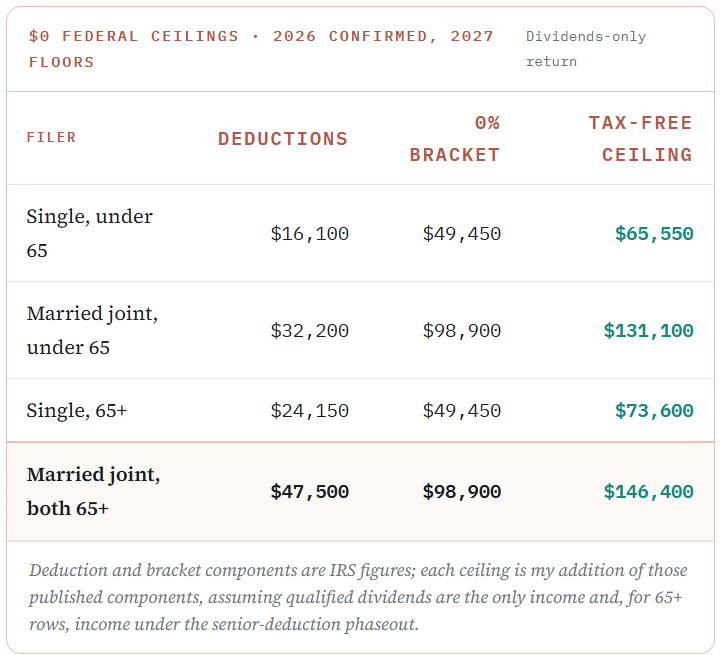
A retired couple can collect $146,400 in qualified dividends, more than double the median household income.
Want to get started on building your dividend income?
Here’s a structure that is easy to follow for beginners.

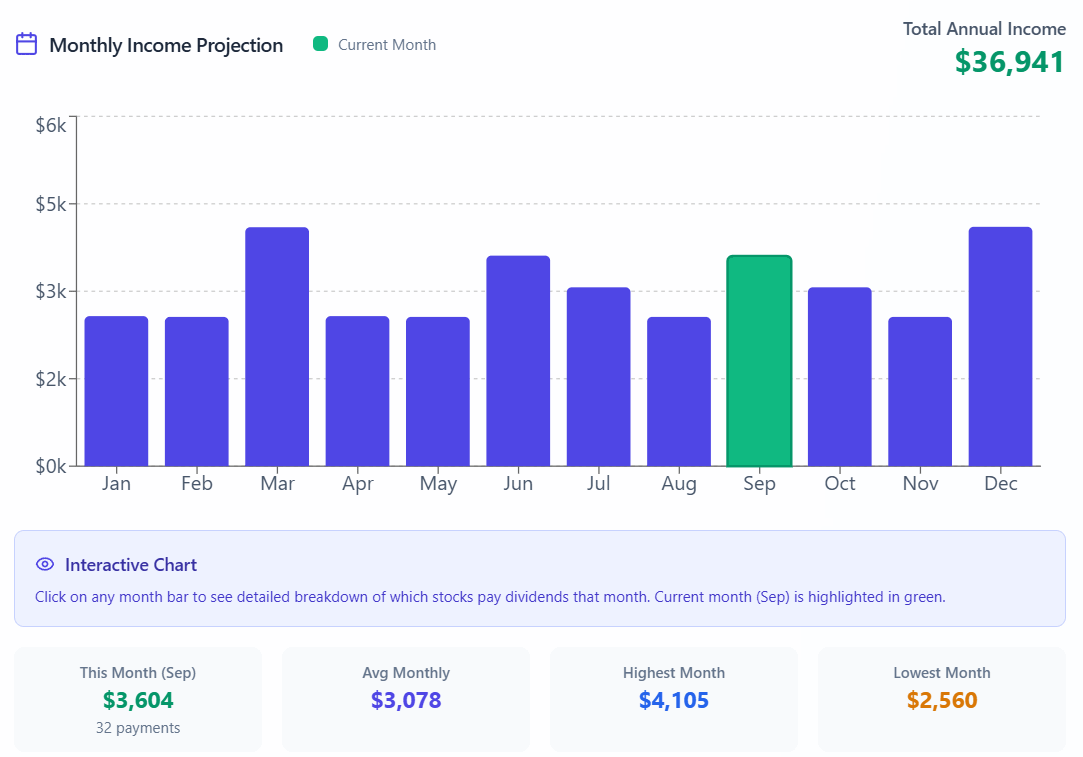
After some portfolio shifts, I am now estimated to collect roughly $37,000 in dividends over the next twelve months. Of this total, I anticipate that my overall tax burden will be quite low.
What Counts As A Qualified Dividend?
A qualified dividend is paid by a U.S. corporation (or qualified foreign company) on shares you held more than 60 day.

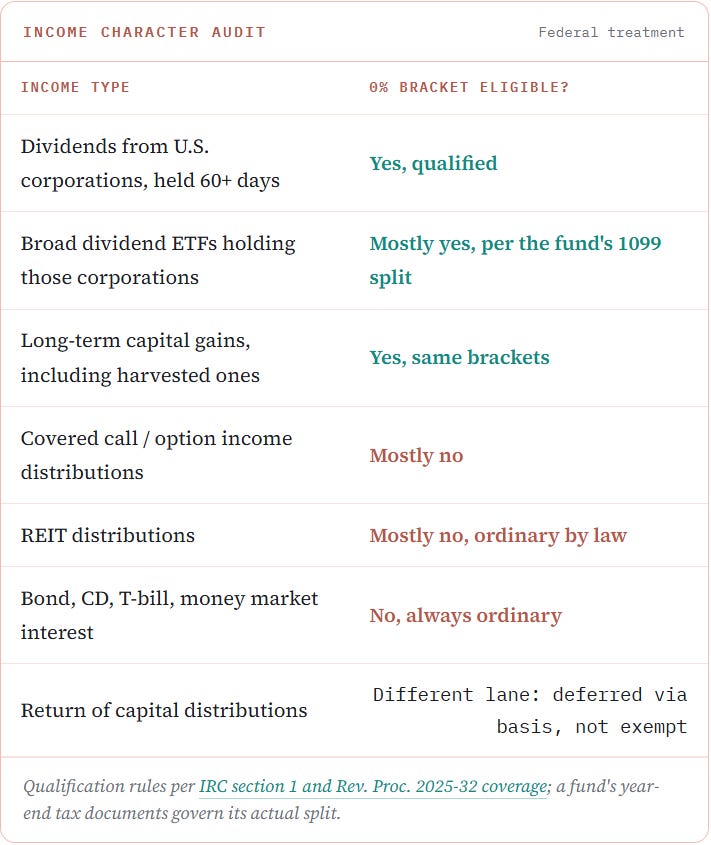
Regular readers will notice the highest-yielding rows fail the test, and I hold plenty of income that fails it (see my breakdown of 10 option income ETFs). That income runs on a different tax lane: return of capital defers tax by lowering your cost basis rather than exempting anything, and the eventual long-term gain can land on the 0% shelf later.
How Does The 0% Dividend Bracket Actually Work?
Your ordinary income fills the tax brackets first, and qualified dividends stack on top, taxed at the rate of whatever space they land in.
Ordinary income = job income.
The standard deduction wipes the first $32,200 off a couple’s return before any bracket applies, then the 0% tier covers taxable income up to $98,900. A couple with $70,000 of ordinary income has $28,900 of free shelf left. Every dollar of wages, interest, or non-qualified distributions you take pushes a qualified dollar off the shelf, which is why controlling the REST of your return is the whole game.
The myth that scares people off: crossing the line does NOT blow up the deal. The brackets work like floors of a building, so a couple who lands $2,000 over the threshold pays 15% on the $2,000 of overflow and still pays 0% on the entire $98,900 beneath it.
A couple filling the whole shelf saves over $14,800 a year versus the 15% tier by my math, so aim for the neighborhood, not the dollar.
How Is Return Of Capital From Option ETFs Taxed?
Return of capital distributions aren’t taxed in the year you receive them; they reduce your cost basis instead, deferring the bill until you sell. This is the lane most of my regular readers actually live in, because option income ETFs classify a large share of their monthly payouts as ROC on their 19a-1 notices and year-end tax documents. The cash hits your account like any other distribution; the difference is that no 1099 line taxes it now, and your recorded cost in the shares steps down by the same amount instead. Your broker tracks the adjustment, and it’s worth verifying on your statement once a year.
Here’s where this lane and the 0% shelf converge, and it’s the most underrated part of the whole strategy. Every ROC dollar you collect lowers your basis, and a lower basis manufactures a bigger capital gain the day you sell, long-term if you’ve held past a year. Long-term gains ride the exact same 0/15/20 ladder as qualified dividends, third row of the audit table above.
So a patient investor can collect double-digit option income for years with nothing due at receip. Deferred tax that ultimately lands on the free shelf stops being deferred and becomes erased.
Tax-Free Dividend Questions, Answered
How much dividend income will be tax-free in 2027?
At least $65,550 for a single filer and $131,100 for a married couple filing jointly, assuming qualified dividends are the only income; filers 65 and older can reach at least $73,600 and $146,400. Those are the confirmed 2026 ceilings, and the official 2027 thresholds will land at or above them.
When does the IRS announce the official 2027 thresholds?
Around late October 2026, in its annual inflation-adjustment revenue procedure. I’ll update the tables here the week the numbers drop.
What makes a dividend “qualified”?
It must come from a U.S. corporation or qualified foreign company, and you must hold the shares more than 60 days within the 121-day window around the ex-dividend date. Both tests are mechanical; miss either and the payment is taxed as ordinary income.
Do covered call ETF distributions get the 0% rate?
Mostly no. Option premium isn’t a corporate dividend, so those distributions largely arrive as ordinary income or return of capital. ROC defers tax by lowering your cost basis instead, a different mechanism I covered in this 10% yielder piece.
What happens if my income goes over the threshold?
Only the overflow gets taxed, at 15%. The brackets are floors, so going $2,000 over costs about $300 while everything beneath the line stays at 0%.
Is this really tax-free, or just federal?
Federal. Most states tax dividends as ordinary income under their own rules, and Social Security inclusion and health subsidy calculations can still be affected. Confirm your full picture with a tax professional.
This is the strategy I use for my taxable account so my qualified dividends and long term capital gains are tax free. It will be more interesting this year as I now own quite a few ETFs where dividends are mostly return of capital.